
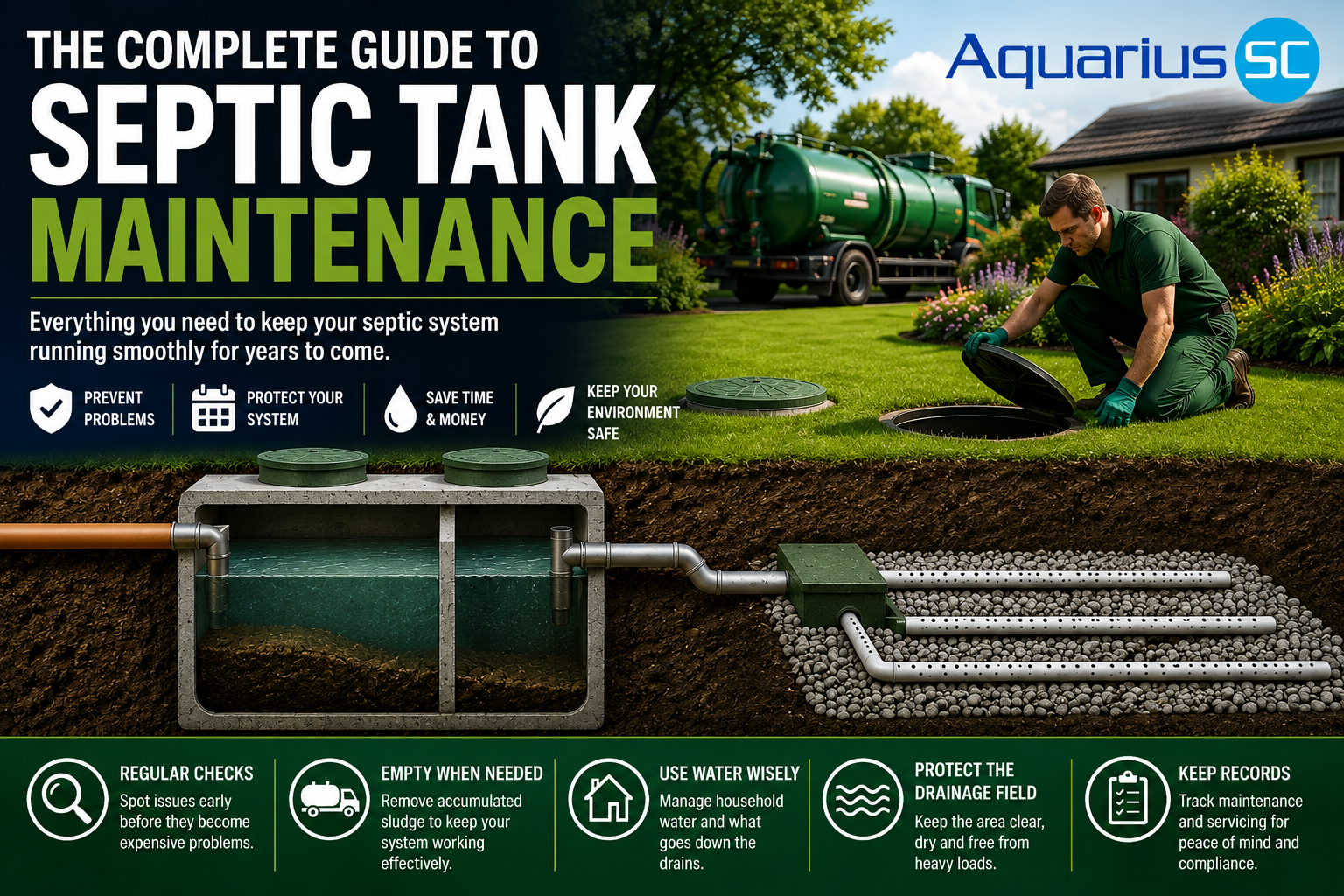
A septic tank system can operate effectively for many years, but that doesn’t mean it should simply be forgotten about until something goes wrong.
Good septic tank maintenance is largely preventative. It means having accumulated sludge removed when required, protecting the drainage field, keeping unsuitable materials out of the system and recognising changes that could indicate a developing problem.
It also helps to understand what normal looks like.
A septic tank normally contains a substantial amount of liquid. A drainage field may become temporarily wetter during prolonged rainfall. And an occasional slow sink could simply be a household plumbing problem rather than anything to do with the septic system.
Knowing the difference between normal operation and something that needs investigating can prevent unnecessary call-outs while helping genuine problems get noticed earlier.
This guide covers the complete maintenance process, including practical checks homeowners can make themselves, what to look for when the tank is emptied, how to assess the drainage field and when professional attention may be required.
Before getting into the detail, here’s a practical overview of the main things worth keeping an eye on.
| Maintenance task | When to do it |
|---|---|
| Observe household drainage | Ongoing |
| Look for unusual sewage smells | Ongoing |
| Visually check the drainage field | Regularly |
| Check for standing water or unusually boggy ground | Regularly and after prolonged rain |
| Keep vehicles and heavy loads off the drainage field | At all times |
| Check accessible tank covers and access points | Periodically |
| Check gutters and surface water aren’t directed towards the system | Periodically |
| Monitor the tank’s liquid level | If investigating abnormal drainage or suspected problems |
| Have accumulated sludge removed | According to regulatory/manufacturer requirements and the needs of the system |
| Look for defects while the tank is being emptied | During desludging/inspection |
| Record emptying, inspections and repairs | Whenever work is carried out |
| Arrange professional investigation | If abnormal symptoms persist or wastewater reaches the surface |
You don’t need to open the septic tank every week or continually interfere with a system that’s operating normally.
For many routine checks, what’s happening around the system tells you more than repeatedly looking inside it.
Changes in household drainage, smells, the condition of the drainage field and how the system responds to wet weather can all provide useful information.
Understanding the basic process makes septic tank maintenance considerably easier.
Wastewater from toilets, sinks, showers, baths, washing machines and other household sources flows through the property’s drainage pipework and into the septic tank.
Inside the tank, the wastewater is given time to separate.
Generally:
Heavier solids settle towards the bottom → liquid remains within the main body of the tank → lighter material can form a floating layer → liquid effluent leaves through the outlet.
The accumulated material at the bottom of the tank is commonly referred to as sludge.
This sludge doesn’t simply disappear.
Biological activity can break down some of the organic material entering the system, but solids still accumulate over time and eventually need to be removed.
The liquid effluent then leaves the septic tank and enters the drainage field.
A drainage field normally consists of perforated distribution pipes laid below ground. Effluent is distributed through these pipes and into suitable surrounding soil, where further treatment takes place as the wastewater moves through the ground.
This gives us a simple way of looking at the complete system:
House → Septic tank → Drainage field → Soil
And that’s why maintaining only the tank isn’t enough.
A perfectly sound septic tank can still be associated with serious drainage problems if the drainage field is damaged, saturated or no longer able to disperse wastewater effectively.
Likewise, a healthy drainage field can’t compensate indefinitely for a tank that is allowed to accumulate excessive quantities of sludge.
Both parts need to function together.
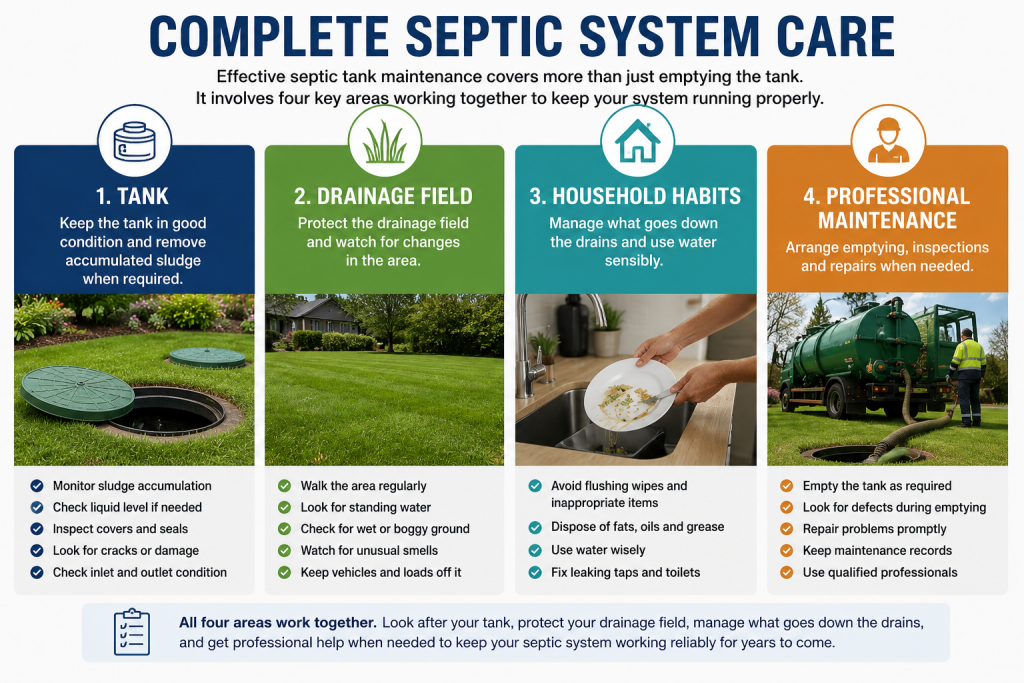
When people talk about maintaining a septic tank, they’re often really talking about emptying it.
That’s only one part of the job.
Good septic system maintenance can be divided into four areas.
The tank itself needs to remain structurally sound and capable of separating and holding wastewater correctly.
That means paying attention to things such as:
You don’t need to personally inspect every internal component.
In fact, you should never enter a septic tank. Septic tanks are confined spaces and can contain hazardous gases and low-oxygen atmospheres.
Some checks are better carried out when the tank is being professionally emptied or inspected.
The drainage field is just as important as the tank.
Its job depends on wastewater being able to disperse into suitable surrounding ground.
Maintenance therefore includes protecting that ground from activities that could interfere with it.
That means avoiding things such as repeatedly driving over the area, constructing buildings on top of it or allowing inappropriate surface water to be directed towards it.
You should also become familiar with how the area normally looks.
Persistent wet patches, sewage smells, unusually boggy soil or wastewater reaching the surface can all justify further investigation.
A septic tank receives virtually everything that leaves the property through the wastewater drainage system.
What happens inside the house therefore affects what happens outside.
Maintenance includes sensible household habits such as:
This doesn’t mean treating your septic tank as something incredibly fragile.
Normal domestic wastewater is exactly what the system is designed to handle.
The objective is to avoid introducing unnecessary solids, unsuitable chemicals or excessive quantities of water that make its job more difficult.
Eventually, accumulated sludge needs to be physically removed from the tank.
This is normally carried out using a tanker by an appropriate waste contractor.
Professional attention may also be required if there are:
One of the most useful maintenance habits is knowing when something has changed.
A system that has behaved predictably for years and suddenly begins producing smells, draining slowly or becoming waterlogged deserves more attention than a system continuing to behave exactly as it always has.
There isn’t one perfect emptying interval that applies to every septic tank.
The rate at which sludge accumulates depends on the individual system and how it’s used.
Important factors include:
A larger tank serving two people may accumulate sludge very differently from a smaller tank serving a busy family home.
However, homeowners in England also need to consider the regulatory requirements applying to their system.
Under the Environment Agency’s General Binding Rules, septic tanks should be emptied at least once a year or in accordance with the manufacturer’s instructions.
It’s worth keeping a record of each emptying rather than relying on memory.
Over time, that creates a useful history of how your particular system behaves.
If a tank that previously followed a predictable pattern suddenly appears to require much more frequent attention, that change itself may be useful information.
The important distinction is between liquid and accumulated solids.
A working septic tank is normally supposed to contain liquid.
Emptying is primarily required because sludge and other accumulated material gradually build up inside the tank.
If too much sludge accumulates, the effective working capacity of the tank is reduced.
There’s also a greater risk of solids progressing towards the outlet and potentially reaching parts of the system where they don’t belong.
This is why simply looking into a tank, seeing liquid near the normal operating level and deciding that it’s “full” can be misleading.
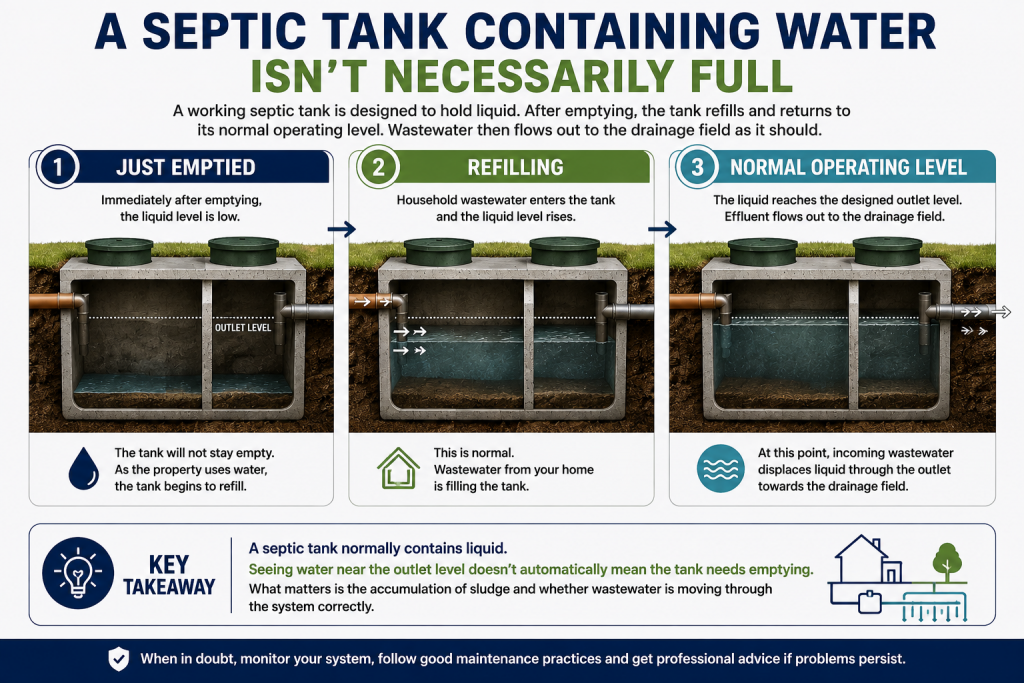
This is one of the most useful things for a septic tank owner to understand.
Once a tank has been emptied and the property begins using water again, the tank starts filling.
Eventually, it returns to its normal operating liquid level.
From that point, incoming wastewater displaces treated liquid through the outlet towards the drainage field.
So:
Liquid at the normal operating level = expected.
It does not automatically mean:
The tank needs pumping.
What matters is the accumulation of sludge and whether wastewater is moving through the system correctly.
Later in this guide we’ll look at how the liquid level itself can become a useful diagnostic clue, because a level that is unusually high or unusually low can sometimes point towards a different problem.
Two apparently identical septic tanks can require different levels of attention depending on how they’re used.
More people generally means more wastewater and more solids entering the tank.
A property occupied by one person isn’t placing the same load on its system as a four- or five-person household.
Capacity matters because it affects how much material the tank can accommodate while maintaining its intended treatment process.
The tank should be appropriately sized for the property and usage it serves.
Introducing inappropriate solids can unnecessarily increase the material accumulating inside the system.
Items that don’t readily break down have no reason to be there in the first place.
Water doesn’t create sludge in the same way as solid waste, but the volume and rate of wastewater entering the system influence its hydraulic loading.
A continuously leaking toilet, for example, can introduce wastewater around the clock without anyone consciously using more water.
A permanently occupied family home and a holiday property used occasionally may place very different demands on otherwise similar systems.
This is another reason maintenance should take account of the actual system and its usage, rather than relying entirely on generic rules of thumb.
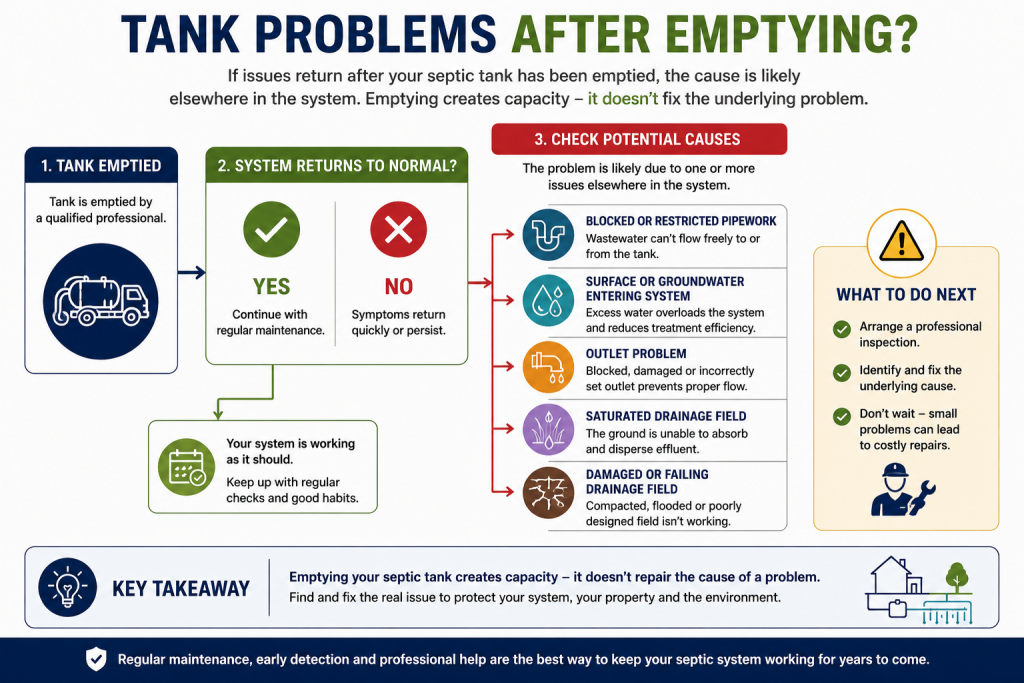
Sometimes the tank simply needs desludging.
But emptying isn’t a universal repair.
If the underlying problem is a blocked pipe, damaged outlet, groundwater entering the system or a failing drainage field, pumping out the tank may temporarily create additional capacity without fixing the actual cause.
Once household wastewater begins entering again, the symptoms can return.
This distinction becomes particularly important when a homeowner finds themselves repeatedly arranging emptying at increasingly short intervals.
Instead of assuming:
“My tank keeps filling up.”
The better question can be:
“Why isn’t wastewater moving through the system normally?”
That could lead to a completely different diagnosis.
If you’re unsure whether the tank actually requires emptying or whether you’re seeing its normal operating liquid level, our guide to how to tell when a septic tank is full explains the difference in more detail.
Learn what’s normal for your system.
Know approximately:
That gives you a baseline.
When something changes, you’ll be in a much better position to recognise it.
Routine septic tank maintenance doesn’t mean regularly opening the tank and trying to inspect everything inside it. Many useful checks can be made from outside the system, and internal inspection should be left to appropriately trained professionals.
There are, however, occasions when observing the tank can provide useful information — particularly when you’re investigating slow drainage, unusual smells, repeated problems after emptying or suspected issues with the drainage field.
One of the most useful things to understand is the normal operating liquid level.
As covered earlier, a working septic tank is supposed to contain liquid. The important question isn’t simply “Is there water in my septic tank?” but rather:
“Is the liquid where it should normally be, and is wastewater able to leave the tank correctly?”
The liquid level inside a conventional septic tank is largely determined by the position of its outlet.
As wastewater enters from the house, the tank fills until liquid reaches its normal operating level. Further incoming wastewater then displaces effluent through the outlet towards the drainage field.
This means a tank can appear surprisingly full when viewed through an access point while actually operating normally.
What you’re looking for is a significant departure from the tank’s normal operating level, particularly when accompanied by other symptoms.
The exact level depends on the design of the tank, so there isn’t a universal measurement in centimetres that applies to every system.
In a conventional gravity-fed septic tank, the liquid surface will normally sit around the designed outlet level.
Think of the outlet as establishing the tank’s working waterline.
When wastewater enters:
Incoming wastewater → liquid level rises slightly → an equivalent volume leaves through the outlet.
The tank therefore remains largely full of liquid during normal operation.
This is why looking through an access cover and seeing a large quantity of water isn’t, by itself, evidence that the tank needs emptying.
If you don’t know the normal level for your particular tank, its manufacturer information, installation records or an appropriate septic professional may provide a better reference than trying to apply a generic measurement.
An abnormally high liquid level can be much more informative.
If wastewater has risen noticeably above the normal outlet level, it can indicate that liquid isn’t leaving the tank as quickly as it should.
Possible causes include:
The symptoms elsewhere around the property can help provide context.
For example:
High tank level + several slow household drains
suggests something different from:
High tank level + drainage field covered in standing wastewater after prolonged rainfall.
Neither combination provides a definitive diagnosis on its own, but they give you considerably more information than simply deciding that the tank looks “full”.
This distinction is important.
Sludge accumulation and liquid level are related to different aspects of the system.
Pumping a tank with an abnormally high liquid level creates temporary capacity, but if the underlying problem is a restricted outlet or failing drainage field, wastewater will begin accumulating again.
That’s why a tank that appears to “fill up again” unusually quickly after emptying deserves further investigation.
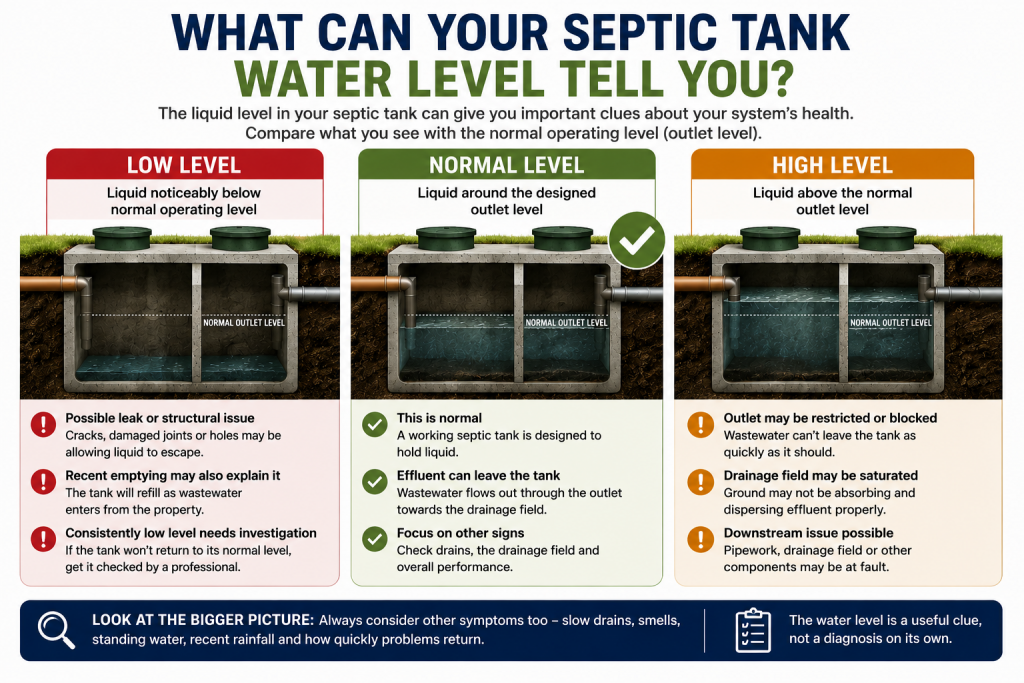
An unexpectedly low liquid level can also provide useful information.
Immediately after emptying, a low level is obviously expected.
The tank will then gradually refill as wastewater from the property enters it.
But if an established system that should have returned to its normal operating level consistently remains substantially below it, possible explanations can include:
Context again matters.
A holiday property that’s been unoccupied since its tank was emptied is very different from a permanently occupied family home whose tank suddenly won’t retain its usual liquid level.
A persistently abnormal level should therefore be investigated rather than diagnosed from the waterline alone.
Safety is more important than getting a closer look.
Never enter a septic tank.
You should also never put your head inside the tank or deliberately inhale gases coming from it. Septic tanks are confined spaces that can contain toxic gases and oxygen-deficient atmospheres.
Where your particular system has an access or inspection point that can be safely opened from ground level, a basic visual observation may allow you to see whether the liquid appears to be around its normal operating level.
If doing so:
If the cover is extremely heavy, damaged, difficult to access or not designed for routine homeowner access, leave it alone and arrange an appropriate professional inspection instead.
Never compromise safety simply to check a water level.
The liquid level becomes much more useful when considered alongside other observations.
For example, ask:
Are several drains inside the house slow?
Has the problem appeared after prolonged rainfall?
Is the drainage field unusually wet?
Is there a persistent sewage smell?
Was the tank emptied recently?
Has the system historically behaved differently?
Is wastewater reaching the ground surface?
Combining these observations can help determine whether you’re looking at normal operation, a household drainage problem or something that requires professional investigation.
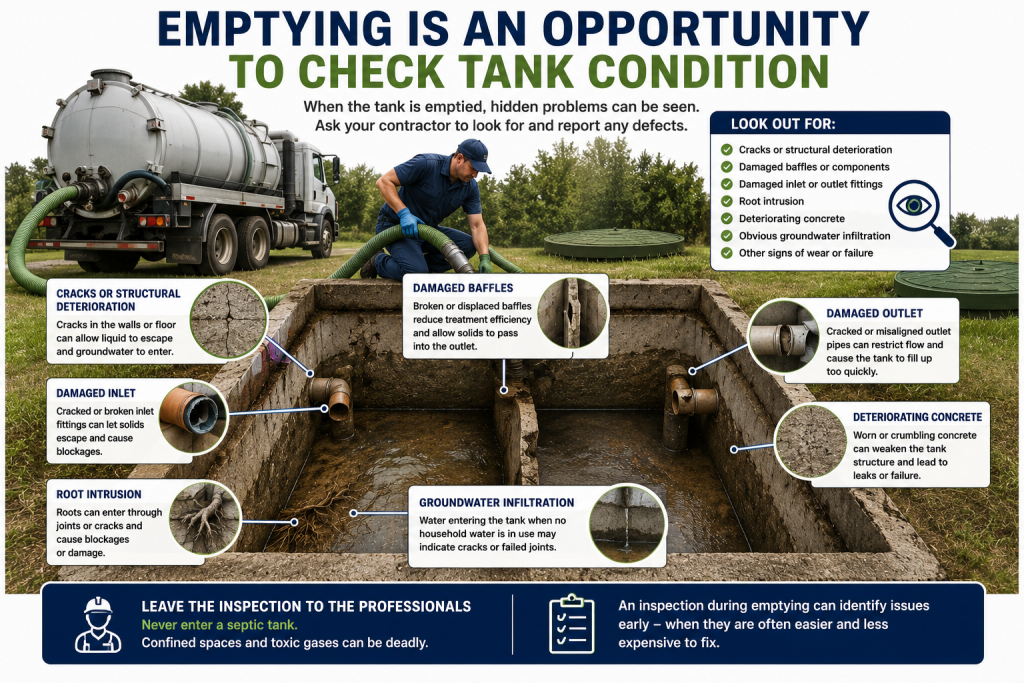
Having the tank professionally emptied creates one of the best opportunities to identify defects that are normally hidden below the liquid level.
You shouldn’t climb into the tank to inspect it yourself.
Instead, ask the contractor whether they’ve noticed anything unusual during the emptying process.
Depending on the tank design and what can safely be observed, potential issues may include:
This is particularly useful with an older system where little is known about its condition.
One useful observation after emptying is whether water appears to be entering the tank from somewhere it shouldn’t.
Some incoming wastewater from the house is obviously normal if appliances, toilets or taps are being used.
What deserves attention is persistent unexplained water ingress, particularly when no household water is being used.
Depending on the system and ground conditions, this could potentially indicate groundwater entering through:
Again, this isn’t something to investigate by entering the tank.
If unexplained ingress is visible, mention it to the contractor while the tank is accessible.
The access cover is easy to overlook because it isn’t involved in treating wastewater, but its condition matters.
Periodically look for:
A damaged cover isn’t simply a maintenance inconvenience.
It can create a serious physical safety hazard, particularly where children, pets or livestock can access the area.
Covers should remain secure and suitable for their location.
Don’t cover an access point permanently with landscaping, decking or another structure simply because you don’t like how it looks. Future emptying and inspection still require appropriate access.
The area immediately surrounding the tank access can also tell you something.
After heavy rainfall, look at where water is travelling.
You don’t want roof water, surface runoff or standing water being deliberately channelled towards the tank opening.
Possible clues include:
A small amount of rain falling onto a sealed cover is obviously unavoidable.
The concern is significant quantities of surface water finding a route into the wastewater system, adding unnecessary hydraulic load.
The inlet brings wastewater from the property into the tank.
The outlet allows liquid effluent to leave towards the drainage field.
Both need to remain functional for the system to operate correctly.
Many septic tanks also incorporate baffles or tees around these areas. Their exact arrangement depends on the tank design.
The inlet helps introduce wastewater without excessively disturbing the tank contents, while the outlet arrangement helps reduce the amount of floating material and solids progressing downstream.
Potential problems can include:
These aren’t components homeowners should start dismantling themselves.
The useful maintenance point is simply to recognise their importance and have their condition considered during professional inspection when appropriate.
This is where understanding the normal operating level becomes particularly useful.
If the liquid level is significantly above the outlet, yet wastewater isn’t leaving normally, there may be a restriction downstream.
If the tank repeatedly rises unusually high while the drainage field is saturated, the problem may lie beyond the tank itself.
Conversely, if the tank can’t maintain its expected operating level despite normal household use, loss of liquid through the tank structure may warrant investigation.
The waterline isn’t a complete diagnostic tool.
But when combined with the condition of the inlet, outlet, household drainage and drainage field, it becomes a useful clue.
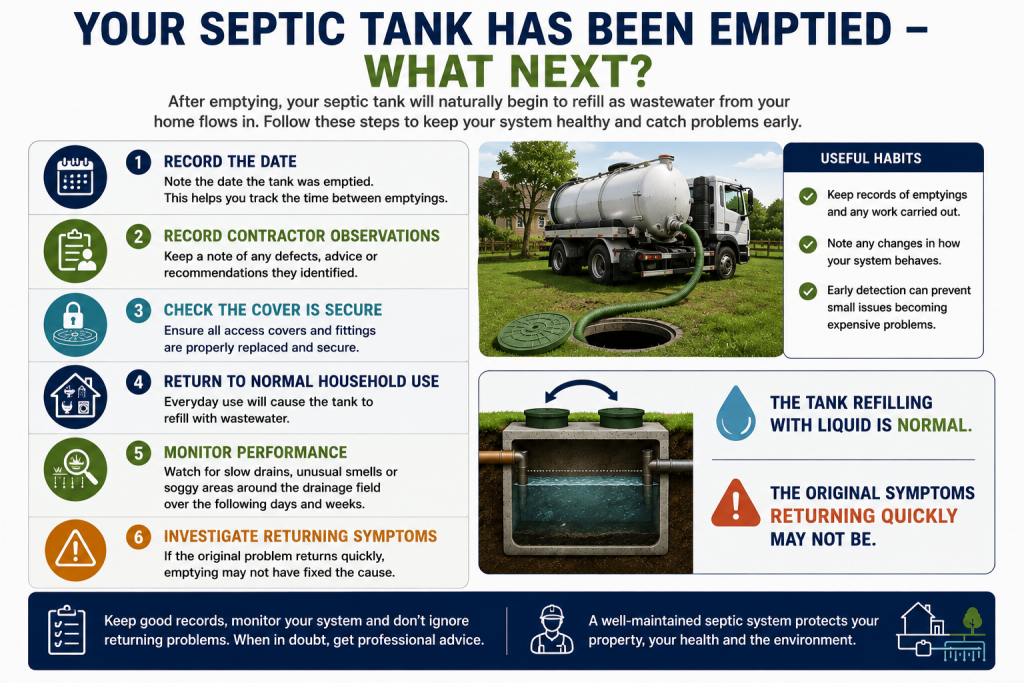
Once the tanker leaves, don’t expect the tank to remain empty.
Every toilet flush, shower, washing-machine cycle and sink adds wastewater back into it.
The liquid level will therefore begin rising towards its normal operating level.
That is expected behaviour.
After an emptying, it’s worth doing a few simple things:
You can also record the mileage—or more practically, the time interval—between emptyings.
If the system historically behaves consistently, that gives you another baseline against which future changes can be judged.
This depends on the design and manufacturer’s instructions for the particular system.
You shouldn’t automatically assume every septic tank needs to be manually refilled after pumping, nor should you deliberately introduce thousands of litres of water without knowing what the system requires.
In normal use, household wastewater will begin entering the tank again immediately.
Certain tank designs or installation circumstances may have specific requirements relating to water levels, structural stability or groundwater pressure, so manufacturer instructions and professional advice for the particular system take priority over generic internet advice.
This is particularly important where groundwater conditions could potentially place external pressure on an emptied tank.
Pay particular attention if the original symptoms return very quickly.
For example:
Tank emptied → drains improve → several drains become slow again shortly afterwards
or:
Tank emptied → liquid rapidly rises abnormally high → drainage field remains waterlogged.
Those patterns suggest the emptying may have relieved the symptoms temporarily without resolving their cause.
Potential causes could include downstream restrictions, drainage-field problems, groundwater ingress or another fault elsewhere in the system.
If you’re arranging professional emptying and want an idea of typical charges beforehand, we’ve covered the factors affecting price in our guide to how much it costs to empty a septic tank in the UK.
One of the simplest maintenance tricks is to build your own reference point.
You could record:
You don’t need to turn septic maintenance into a weekly inspection routine.
The purpose is simply to have something to compare against when the system behaves differently.
A statement such as:
“The drainage field has always been slightly damp in winter.”
is less useful than knowing:
“The field normally dries within two days, but this time the same area has remained waterlogged for two weeks.”
That kind of comparison can provide genuinely useful information when diagnosing a developing problem.
The septic tank itself is only one part of a working septic system.
Once wastewater has separated inside the tank, liquid effluent leaves through the outlet and travels towards the drainage field, where it is distributed into the surrounding soil for further treatment.
That makes the condition of the drainage field just as important as the condition of the tank.
Fortunately, you don’t need to dig anything up to carry out basic checks. In fact, excavating a drainage field simply to inspect it can cause more harm than good.
Some of the most useful checks involve nothing more complicated than walking around the area and knowing what to look for.
Start with a visual inspection of the ground above and immediately surrounding the drainage field.
Ideally, you should already know approximately where the drainage field is located. If you don’t, installation records, property plans or previous contractors may help establish its position.
Walk around the area and look for changes such as:
None of these observations should be interpreted completely in isolation.
A wet patch following exceptionally heavy rainfall, for example, doesn’t necessarily mean the drainage field has failed.
A wet patch containing foul-smelling wastewater during otherwise dry conditions is considerably more concerning.
The objective is to look at the overall pattern.
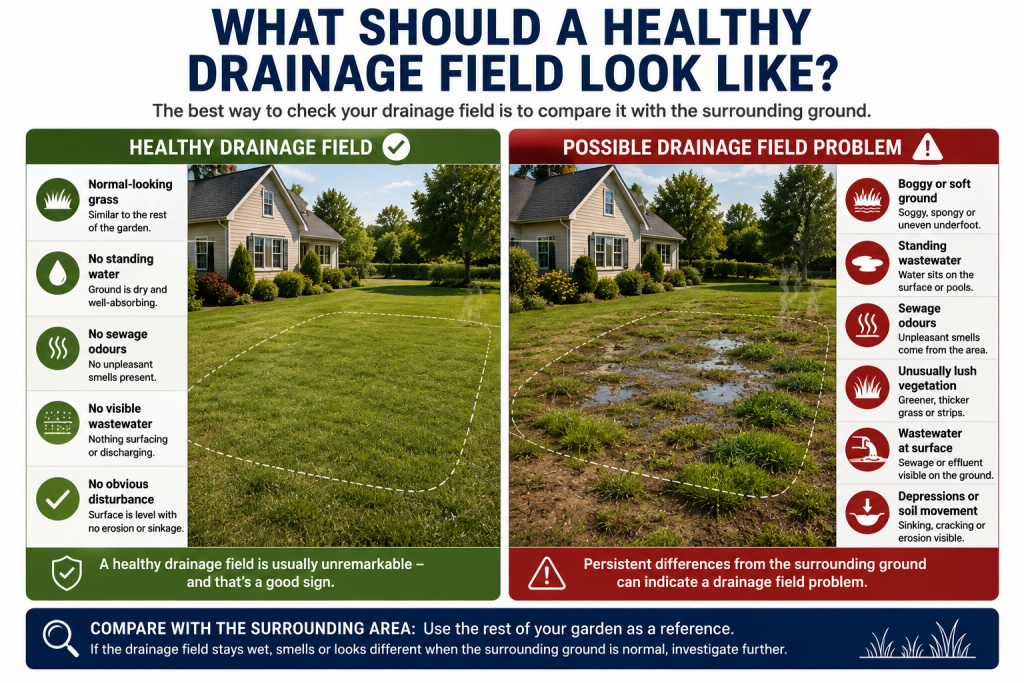
A functioning drainage field is often rather unremarkable — and that’s a good thing.
In normal conditions, you generally shouldn’t have wastewater sitting visibly on the ground or persistent sewage smells coming from the area.
The ground should be capable of accepting the effluent being distributed through the system without routinely becoming saturated at the surface.
A healthy drainage field would typically have:
The vegetation covering the area may look much like the rest of the garden.
What matters most isn’t whether every blade of grass looks identical, but whether there is an obvious and persistent difference associated with the drainage area.
This is one of the simplest practical checks you can make.
Don’t look at the drainage field in isolation.
Look at the rest of the garden as well.
Imagine there has been several days of heavy rain and almost the entire garden is saturated.
Finding wet soil over the drainage field under those conditions doesn’t tell you very much.
Now imagine the rain stops.
A few days later, most of the garden has returned to normal, but the area directly above the drainage field remains:
That difference is much more informative.
You’re effectively using the unaffected parts of the garden as a reference point.
The same principle can be useful during dry weather. If one particular area repeatedly becomes saturated while the surrounding ground remains relatively dry, it’s worth investigating why.
Not necessarily.
Grass growth is influenced by moisture, soil condition, sunlight, nutrients and numerous other factors, so greener grass alone isn’t enough to diagnose a drainage-field problem.
However, an obvious pattern of unusually lush growth directly following the distribution lines can be worth noting, particularly if it’s accompanied by:
Again, patterns of symptoms are more useful than one observation on its own.
Bright green grass doesn’t automatically mean your drainage field is failing.
Problems can become more obvious as the soil loses its ability to accept and disperse wastewater effectively.
Possible warning signs include:
Persistent waterlogging
The drainage area remains saturated when surrounding ground has recovered.
Standing wastewater
Pools repeatedly appear over or around the drainage field.
Sewage odours
Persistent foul smells develop around the area.
Surfacing effluent
Wastewater becomes visible at ground level.
Slow drainage inside the property
Several household fixtures begin draining slowly because wastewater is struggling to move through the complete system.
Unusually high tank liquid level
Effluent isn’t leaving the tank normally because of a restriction or downstream problem.
A combination such as:
high tank level + slow household drains + saturated drainage field
provides considerably more reason for investigation than any one of those observations by itself.
If you suspect there’s a problem, resist the temptation to start digging trenches to see what’s happening underground.
The distribution pipework can be relatively shallow depending on the system design, and careless excavation can damage components that were previously intact.
Digging also disturbs the soil structure that the drainage field relies upon.
Basic homeowner inspection should therefore concentrate on what can be observed from the surface.
If underground investigation is necessary, it should be approached appropriately with an understanding of the system layout.
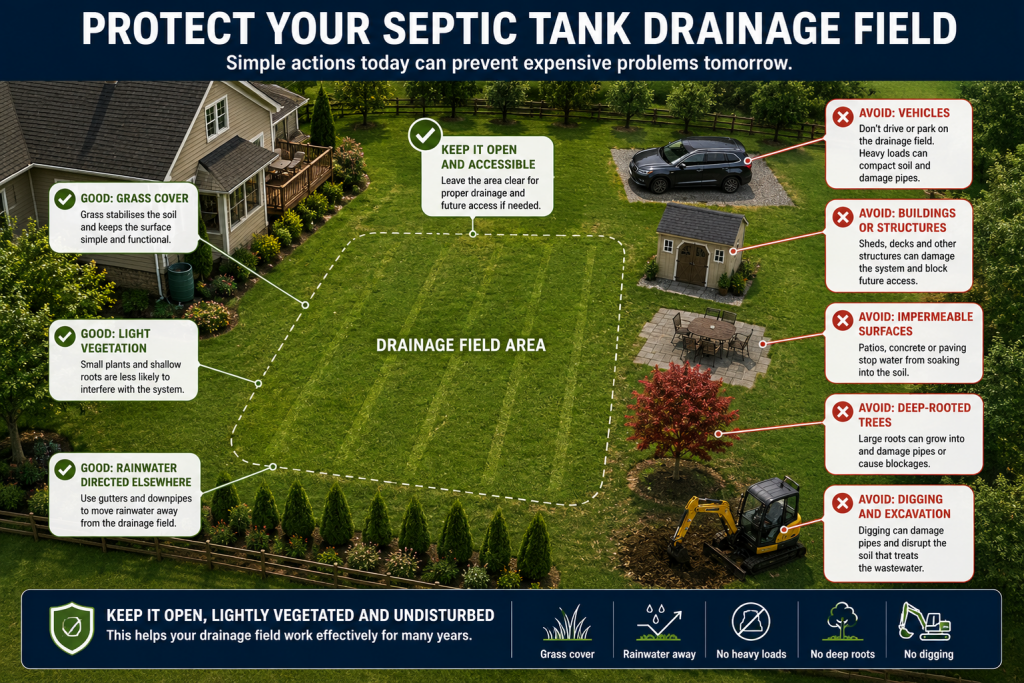
One of the best forms of drainage-field maintenance is simply leaving it capable of doing its job.
The area shouldn’t be treated like an ordinary piece of land where anything can be built, parked or planted.
Avoid:
Natural Resources Wales advises owners to keep vehicles and livestock away from drainage fields and avoid planting deep-rooted trees nearby.
The reasons are practical.
Heavy loads can compact the soil and potentially damage buried pipework.
Deep roots can interfere with drainage components.
Impermeable surfaces can alter how water moves through the ground and make future access considerably more difficult.
For a more focused overview of everyday tank and drainage-field care, see our guide on how to look after a septic tank and drainage field.
A simple grass covering is generally preferable to landscaping the area heavily.
Grass helps stabilise the soil while keeping the surface relatively open and accessible.
Avoid turning the drainage field into somewhere that requires:
If you’re unsure about planting around a particular system, take account of the layout and depth of the drainage pipework before making significant landscaping changes.
The safest general principle is:
Keep the drainage field simple, lightly vegetated and undisturbed.
A drainage field already has one important job: accepting and dispersing septic tank effluent.
It doesn’t benefit from receiving additional water unnecessarily.
Check where rainwater from the property goes, particularly:
These shouldn’t be deliberately directed onto the drainage field.
During prolonged rainfall, the surrounding soil naturally becomes wetter. As the amount of water already occupying spaces within the soil increases, its ability to accept additional wastewater can become reduced.
This can explain why some septic systems appear to struggle more during prolonged wet weather.
The Environment Agency’s guidance for small sewage discharges also requires owners to ensure their system is appropriately maintained and not causing pollution, with specific requirements applying to septic tank discharges to the ground.
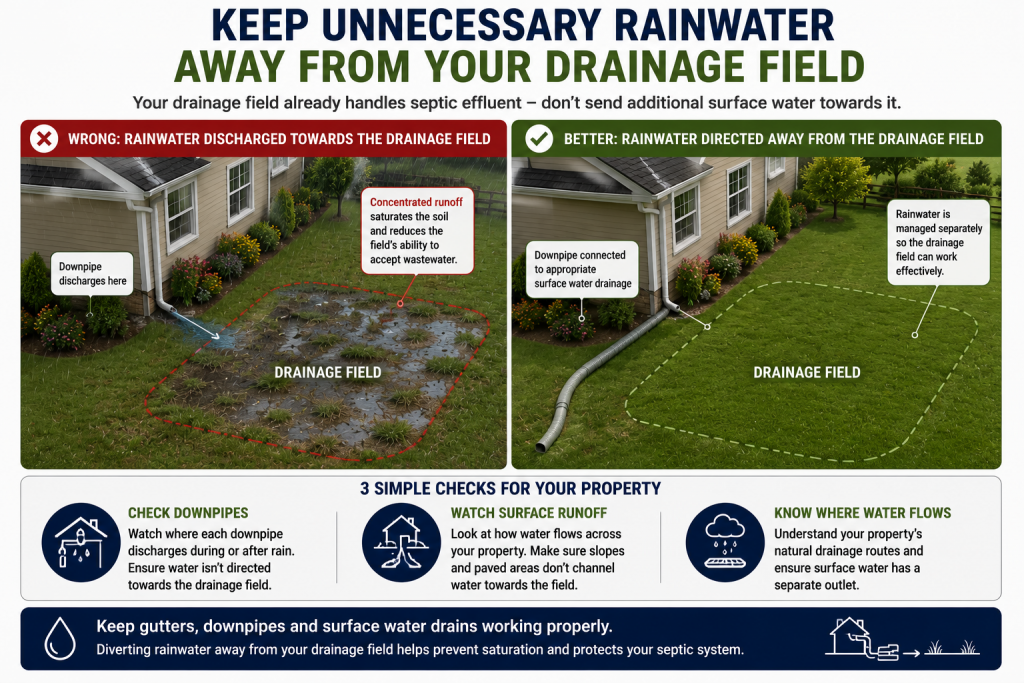
This is a particularly easy maintenance check that’s often overlooked.
Walk around the house during or shortly after rainfall and see where the water from each downpipe actually ends up.
You’re looking for situations where large quantities of roof water are being concentrated:
towards the septic tank → around an access cover → across the drainage field
rather than being managed by the property’s appropriate surface-water drainage arrangements.
Also look at the shape of the land.
Even if a downpipe doesn’t physically terminate on the drainage field, a sloping garden could still channel runoff towards it.
This is particularly worth checking if septic problems consistently appear during wet weather.
Heavy rain doesn’t automatically mean a drainage field has been permanently damaged.
The immediate problem is often saturation.
If the soil surrounding the distribution pipes is already holding a large quantity of rainwater, wastewater has fewer places to go.
During particularly wet conditions you may therefore notice changes in how the system behaves.
The important question is what happens after the weather improves.
If the ground dries and normal septic performance returns, the problem may have been temporary saturation.
If the drainage field remains waterlogged, smells persist or wastewater continues reaching the surface long after surrounding ground has recovered, further investigation becomes more important.
We’ve covered the relationship between rainfall, saturated soil and septic performance in more detail in [Can Heavy Rain Affect a Septic Tank?]
Emptying the tank can temporarily reduce the volume of wastewater within it.
What it cannot do is restore the drainage capacity of saturated soil.
If the drainage field is the underlying problem, the tank will begin receiving wastewater again as soon as the property resumes normal use.
This can create a frustrating cycle:
Tank appears high → tank is emptied → symptoms improve → tank refills → symptoms return → tank is emptied again.
Repeated pumping may relieve immediate pressure, but it doesn’t explain why effluent isn’t leaving the system normally.
If that pattern develops, investigation of the drainage field and downstream system becomes more important than simply shortening the emptying interval.
If a drainage field is struggling, don’t attempt to solve the problem by creating an improvised pipe or channel that allows untreated or inadequately treated wastewater to discharge elsewhere.
Septic tank discharges are subject to environmental requirements, and wastewater shouldn’t be allowed to create pollution or a risk to health.
Visible sewage or effluent reaching the ground surface is therefore not something to simply redirect further down the garden.
It indicates that the system needs attention.
Flooding is different from ordinary rainfall.
If floodwater has covered the septic tank or drainage-field area, avoid assuming the system can immediately operate exactly as it did beforehand.
Potential concerns include:
Avoid unnecessary traffic over saturated ground, particularly heavy vehicles.
Once floodwater has receded, inspect the area from the surface and pay attention to how the household drainage system behaves.
If you suspect structural damage or the system isn’t operating normally, arrange an appropriate inspection.
Even if you normally avoid parking over the drainage field, this becomes particularly important when the ground is saturated.
Wet soil is more susceptible to compaction and rutting.
A heavy vehicle crossing the area could place additional pressure on both the soil and buried components.
This includes more than cars.
Think about:
If work is being carried out at the property, make sure contractors know where the drainage field is before vehicles arrive.
That’s a simple precaution that can prevent accidental damage.
You don’t need a formal inspection every time you walk outside.
Instead, make the drainage field something you’re naturally aware of.
When you’re cutting the grass or working in the garden, notice:
After prolonged rain, take another look.
If you’ve recently had a septic problem, compare the area with how it looked previously.
Over time, you’ll develop a good understanding of what is normal for your property.
Every so often, ask yourself five questions:
1. Is the ground reasonably similar to the surrounding garden?
2. Is there any persistent standing water?
3. Can I smell sewage or wastewater?
4. Is any effluent visible at the surface?
5. Has anything recently driven, built, dug or discharged water over the area?
If everything looks and smells normal and the household drainage is working properly, there’s usually no reason to start interfering with the drainage field.
If something has clearly changed, that’s when further investigation becomes worthwhile.
Some of the most effective septic tank maintenance happens before wastewater ever reaches the tank.
How much water a household uses, how quickly that water enters the system and what gets flushed or poured down the drains can all influence how effectively a septic system operates.
This doesn’t mean living differently simply because you have a septic tank. A properly designed system is intended to handle normal household wastewater.
The objective is to avoid placing unnecessary loads on the system and to recognise when a change in performance could indicate something that needs attention.
Every litre of water that enters the wastewater drainage system eventually has to be dealt with by the septic system.
Normal activities such as:
are all part of ordinary household use.
The issue isn’t simply how much water you use over an entire day. How quickly large volumes enter the system can also matter.
For example, imagine a household running several washing-machine cycles while people are simultaneously showering, bathing and using other water-intensive appliances.
That creates a much larger short-term flow into the septic tank than spreading those activities across the day.
Where practical, avoiding unnecessary peaks gives the system more time to process incoming wastewater.
This becomes particularly useful when the surrounding ground is already very wet and the drainage field has less capacity available.
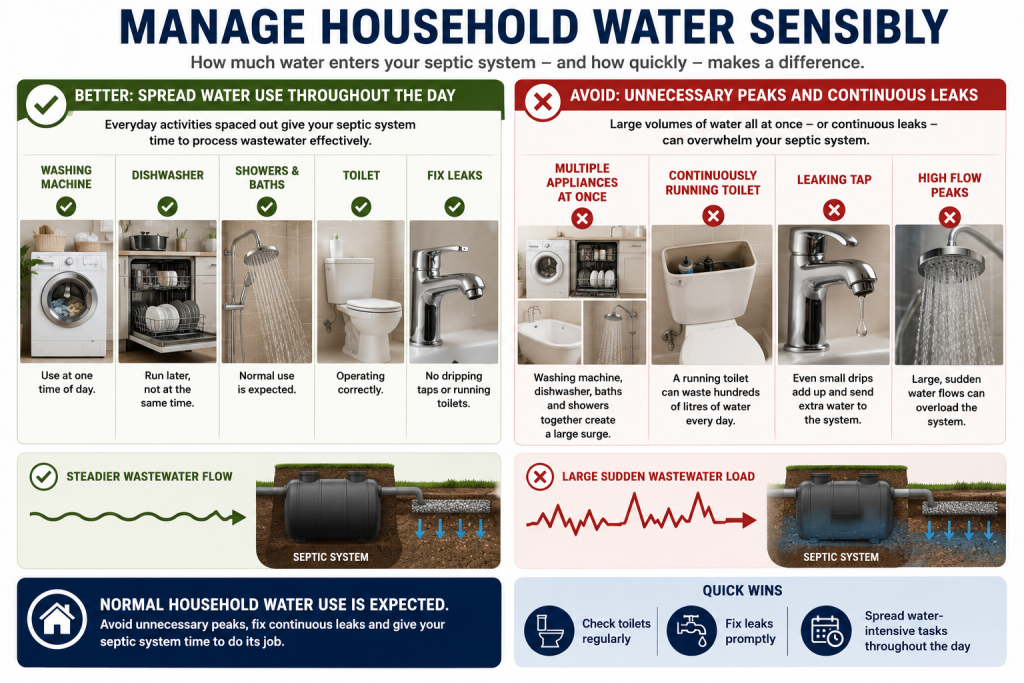
Some unnecessary water use is easy to miss because nobody is actively using it.
A leaking toilet can continuously send water into the wastewater system throughout the day and night.
A dripping tap is usually less significant, but it still represents water entering the drainage system unnecessarily.
If your septic system suddenly seems to be receiving considerably more water than usual, checking for household leaks is an easy place to start.
Look for:
This is especially useful when investigating a tank that appears to be reaching an unusually high level without an obvious increase in household occupancy.
Sensible water management doesn’t mean becoming afraid to use your plumbing.
A septic system serving an occupied property should be capable of handling the normal wastewater load it was designed for.
Reducing unnecessary peaks and repairing leaks makes sense.
Trying to compensate for an underlying drainage problem by drastically restricting normal household water use is different.
If ordinary showers, toilets and washing-machine use repeatedly cause the system to back up, the reason the system can’t cope with normal use needs investigating.
Using less water may temporarily reduce the symptoms without addressing the actual problem.
A useful rule for toilets is straightforward:
Human waste and toilet paper only.
Products such as wet wipes may disappear when flushed, but that doesn’t mean they behave like toilet paper once they’re inside the drainage system.
Keep items such as:
out of the toilet.
Kitchen and utility drains also shouldn’t be treated as convenient disposal routes for unwanted substances.
Avoid deliberately pouring significant quantities of:
into the wastewater system.
The issue isn’t only whether something can physically travel through the pipe.
It also matters what happens after it reaches the tank and drainage field.
We’ve covered individual products and why they can cause problems in more detail in What Should You Never Flush Into a Septic Tank?
Owning a septic tank doesn’t mean you have to stop cleaning your house.
Normal domestic use of appropriate cleaning products is very different from deliberately pouring large quantities of concentrated chemicals into the drainage system.
The important distinction is normal use versus excessive disposal.
Follow the manufacturer’s instructions for household products and avoid assuming that using more than recommended will produce a better result.
It’s also worth remembering that several products used together can introduce a much larger chemical load than any one product individually.
Never mix household cleaning chemicals unless their instructions specifically state that doing so is safe. Some combinations can produce dangerous gases before they ever reach the septic tank.
This is one of the most common questions septic tank owners ask.
Occasional normal household use of bleach isn’t the same thing as deliberately pouring large quantities into a septic tank.
The septic environment contains microorganisms involved in breaking down organic material, so repeatedly introducing unnecessarily large quantities of strong disinfectants isn’t desirable.
The practical approach is:
Use cleaning products as directed, don’t routinely overdose them, and don’t use the septic system as a disposal route for unwanted chemicals.
If you need to dispose of a substantial quantity of an unused chemical product, follow the appropriate disposal guidance for that substance rather than tipping it down the sink or toilet.
A septic tank isn’t simply a storage container.
Physical separation is an important part of what happens inside it, but microorganisms also contribute to the breakdown of biodegradable organic material.
Wastewater entering the tank naturally introduces microorganisms, and the tank develops its own biological environment.
These organisms help break down some of the organic matter present in the waste.
They do not, however, make all solids disappear.
Material still accumulates as sludge, which is why biological activity doesn’t eliminate the need for appropriate emptying.
Understanding that distinction is important:
Bacteria help process organic waste.
They don’t turn a septic tank into a system that never needs desludging.
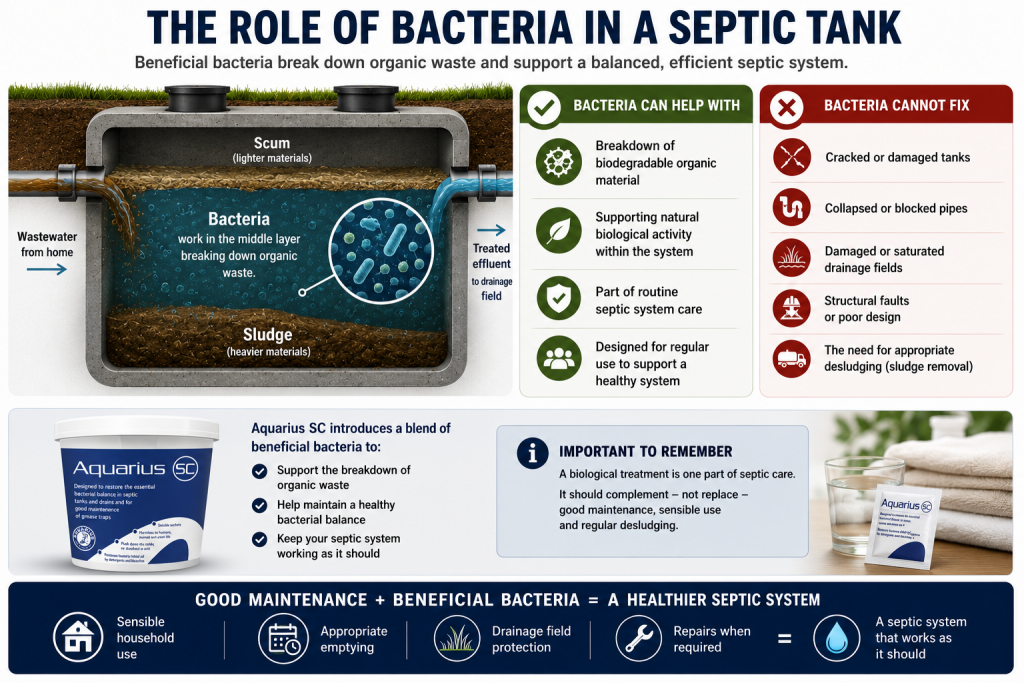
Biological septic tank treatments are designed to introduce selected microorganisms and, depending on the formulation, other components intended to support the biological breakdown of organic waste.
They should be viewed as one part of septic system care, rather than a replacement for the physical and structural maintenance we’ve already covered.
Aquarius SC, for example, is designed for regular use in septic tanks and other domestic wastewater systems, introducing a blend of beneficial bacteria to support the breakdown of organic waste within the system.
The distinction between what a biological treatment can and cannot do is important.
A treatment doesn’t physically repair:
Nor should using a bacterial treatment be treated as a reason to ignore appropriate sludge removal.
Instead, biological treatment sits alongside sensible system use, appropriate emptying and good drainage-field care.
The microorganisms within a septic system live in an environment that changes according to what the household sends down its drains.
Potential disruption can occur when unusually large quantities of unsuitable substances enter the system.
Examples could include substantial quantities of:
A brief change in household activity doesn’t automatically mean the entire bacterial population has disappeared.
Septic systems aren’t sterile environments, and microorganisms are continually introduced with wastewater.
The sensible approach is therefore not to panic every time a toilet is cleaned.
Instead, avoid unnecessary chemical shocks and inappropriate disposal practices.
This deserves emphasising because it’s an easy misconception.
No additive should be expected to compensate for poor physical maintenance indefinitely.
If a tank contains excessive accumulated sludge, it needs appropriate desludging.
If wastewater is surfacing over the drainage field, that problem needs investigating.
If the tank is cracked, bacteria aren’t going to repair the concrete.
If a pipe has collapsed, adding more biological treatment won’t reopen it.
Good septic care works as a system:
Sensible household use + biological activity + appropriate emptying + drainage-field protection + repairs when required.
Remove one of those fundamentals and another can’t necessarily compensate for it.

The earlier sections of this guide have covered individual symptoms in context.
It’s useful, however, to bring some of them together.
| What you notice | What it could indicate |
|---|---|
| One sink or fixture draining slowly | Local household plumbing blockage |
| Several drains becoming slow | Wider drainage or septic system problem |
| Tank liquid unusually high | Outlet restriction, downstream problem or drainage-field issue |
| Tank liquid unusually low | Recent emptying, low usage or possible leakage |
| Persistent wet ground over drainage field | Saturation or impaired drainage |
| Sewage smell around system | Wastewater issue requiring investigation |
| Wastewater reaching ground surface | Significant drainage problem |
| Problems repeatedly appearing after rain | Saturated ground or water ingress may be involved |
| Symptoms quickly returning after emptying | Emptying may not have addressed the underlying cause |
These are clues, not diagnoses.
The same symptom can have more than one cause.
That’s why it’s useful to consider several pieces of information together.
This is a particularly useful first troubleshooting step.
If one bathroom sink is draining slowly but:
a local blockage in that particular waste pipe may be more likely than a septic-system problem.
If toilets, sinks, baths and showers across the property all begin draining unusually slowly at around the same time, the picture changes.
The problem may be further downstream.
This doesn’t tell you precisely where the fault is, but it helps narrow down where to start looking.
This question causes a lot of confusion because a septic tank is supposed to refill with liquid after it has been emptied.
Imagine the tank is pumped out on Monday.
The household then:
All of that wastewater enters the tank.
The liquid level therefore rises again until it reaches the system’s normal operating level.
That alone isn’t a fault.
The better question is:
If liquid reaches approximately the normal outlet level and effluent is leaving the system correctly, that’s expected operation.
If liquid rises significantly above its normal level and household drainage begins slowing or backing up, something may be preventing wastewater from leaving correctly.
Possible causes include:
That’s very different from a tank simply containing water again.
Pumping removes both accumulated material and a large quantity of liquid from the tank.
That immediately creates space.
If wastewater was backing up because it couldn’t leave the system quickly enough, creating that temporary capacity can make household drainage appear normal again.
But the property then continues producing wastewater.
If the downstream problem still exists:
tank empties → spare capacity created → household use continues → tank refills → abnormal level returns → symptoms return.
The time between emptying and the problem returning can therefore be useful information.
If the same symptoms repeatedly return shortly after pumping, simply arranging increasingly frequent emptying may not be the best long-term response.
The underlying reason needs identifying.
If the tank appears to be receiving unusually large quantities of water, don’t only think about toilets and showers.
Consider other potential sources.
Check for:
Consider:
A useful clue is when the problem occurs.
If the system behaves normally during dry weather but struggles consistently after prolonged rainfall, that pattern is worth recording.
If problems occur regardless of weather, another explanation may be more likely.
Basic observation is useful.
Repeatedly experimenting with a failing wastewater system isn’t.
Professional investigation becomes particularly important if:
Avoid opening pipework, entering tanks or attempting structural repairs without the appropriate knowledge and equipment.
The goal of homeowner troubleshooting isn’t necessarily to repair everything yourself.
It’s to recognise what has changed, where the problem may be occurring and when specialist investigation is justified.
When something goes wrong, it’s tempting to focus entirely on the tank because that’s the most obvious component.
But wastewater follows a route:
Household drains → inlet pipe → septic tank → outlet → drainage field → surrounding soil
A problem anywhere along that route can affect what you observe elsewhere.
A blocked household pipe can look like a drainage problem.
A restricted outlet can make the tank appear excessively full.
A saturated drainage field can slow the entire system.
Groundwater entering a damaged tank can increase hydraulic loading.
That’s why the most useful approach is to look at the whole system rather than one symptom in isolation.
Good septic tank maintenance doesn’t require constant attention.
Once you understand how your system normally behaves, the aim is to establish a simple long-term routine: keep appropriate records, occasionally check the areas you can safely observe, protect the drainage field and respond when something changes.
Many septic problems develop gradually.
A drainage field may become progressively wetter. Emptying intervals may change. A cover may deteriorate. A small leak may continuously introduce additional water. Household drains may become slower over several months.
These changes are much easier to recognise when you know what is normal for your system.
One of the simplest things you can do is keep a basic record of your septic system.
You don’t need anything complicated.
Record things such as:
Keep invoices and paperwork relating to the system as well.
Over several years, these records can reveal patterns that would otherwise be difficult to remember.
For example, if the tank has historically been emptied at predictable intervals but suddenly appears to require attention much sooner, you can investigate what has changed rather than relying on memory.
It’s also worth knowing the approximate location of:
If you have plans showing the system layout, keep them somewhere accessible.
This becomes particularly useful when landscaping, building work or excavation is planned.
It also means you can tell contractors where not to drive or dig.
This is a surprisingly useful maintenance trick.
Take a few photographs of the drainage-field area when the system and surrounding ground are behaving normally.
You then have a visual reference if something changes later.
For example, you may notice:
Photographs taken from roughly the same position can make gradual changes much easier to recognise.
You could also take additional photographs following unusually wet weather and record the date.
The objective isn’t to photograph the garden constantly. It’s simply to establish a useful baseline.
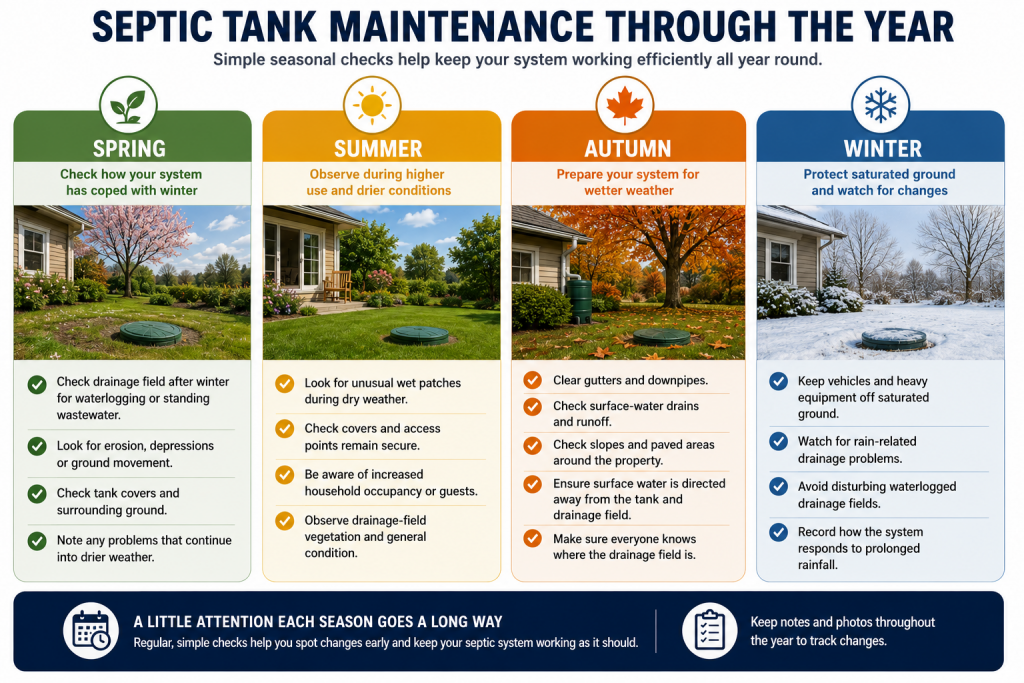
A septic system operates throughout the year, but different seasons can bring different things worth watching.
The precise maintenance requirements don’t suddenly change every three months, so there’s no need for an elaborate seasonal programme.
Instead, use changes in weather as convenient reminders to observe the system.
After a wet winter, take a look at the drainage-field area.
Check for:
Also check the tank access area for obvious damage caused during winter.
If the system struggled during prolonged rainfall but returned completely to normal as conditions improved, make a note of it.
If problems continue into drier conditions, further investigation may be worthwhile.
Summer can sometimes mean more people at home, visiting family, children being off school or guests staying at the property.
That can increase wastewater production.
There’s usually no reason to worry about normal household use, but be aware of substantial changes in occupancy.
Summer is also a convenient time to visually check:
Dry conditions can make persistent wet areas particularly noticeable.
If the entire garden is dry but one area directly over the drainage field remains consistently saturated, that’s useful information.
Before prolonged winter rainfall arrives, check where surface water around the property is going.
Look at:
Clear blocked gutters and deal with obvious drainage problems so large quantities of rainwater aren’t unnecessarily concentrated towards the septic system.
Autumn is also a good opportunity to make sure everyone who regularly accesses the property knows where the drainage field is.
During prolonged wet weather, the soil may already contain substantial quantities of water.
Avoid unnecessary traffic over the drainage field, particularly:
Saturated soil can be more vulnerable to rutting and compaction.
If you notice septic problems during very wet conditions, record what happens as the weather improves.
Whether the system returns to normal once the surrounding soil dries can provide useful information.
A large part of maintaining a septic system is simply avoiding actions that create unnecessary problems.
A working septic tank normally contains liquid.
Seeing water inside doesn’t automatically mean it needs pumping.
The more useful questions are whether sludge removal is due and whether the liquid is at approximately its normal operating level.
A sewage backup is a very obvious problem, but it shouldn’t be the first time you pay attention to your septic system.
Earlier signs can include:
Recognising these changes gives you an opportunity to investigate before conditions become more serious.
If pumping solves the problem for only a short period, don’t automatically assume the answer is simply to pump more frequently.
The system may have an outlet, pipework or drainage-field problem.
Emptying can create temporary capacity without repairing the underlying fault.
A drainage field isn’t an overflow car park.
Regular vehicle traffic and heavy loads can compact the soil and potentially damage buried components.
Make sure contractors and visitors know where the drainage field is if there’s a realistic chance they could drive across it.
Your drainage field already has to accept septic effluent.
Don’t unnecessarily add roof or surface water to the same area.
Check downpipes, gutters and the natural direction of runoff around the property.
Whether an object physically disappears around the U-bend isn’t the only consideration.
Your toilet isn’t a waste bin.
Human waste and toilet paper are the safest rule for what should routinely be flushed.
Use household products according to their instructions.
Pouring unnecessarily large quantities of concentrated cleaning chemicals into drains isn’t a substitute for cleaning properly and introduces an avoidable chemical load into the wastewater system.
Biological treatments can support biological activity.
They can’t repair a collapsed pipe, cracked tank or failed drainage field.
Aquarius SC should therefore form part of good overall septic care, rather than being treated as a replacement for emptying, inspection or repairs when those are required.
Sheds, extensions, patios and other structures can interfere with the area and make future investigation considerably more difficult.
Know where the drainage field is before planning work.
Never enter a septic tank.
Septic tanks are confined spaces and can contain dangerous gases and oxygen-deficient atmospheres.
Internal inspection should be left to appropriately trained and equipped professionals.
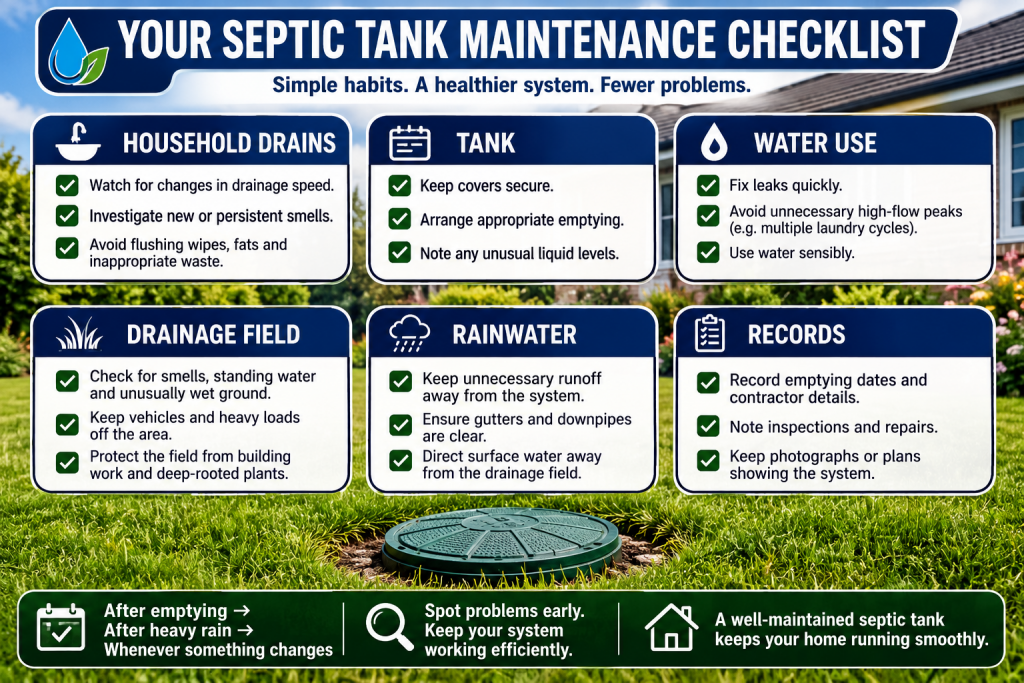
The following checklist brings together the practical maintenance covered throughout this guide.
☐ Pay attention to how quickly household drains empty.
☐ Investigate new or persistent sewage smells.
☐ Look over the drainage-field area when you’re in the garden.
☐ Watch for persistent standing water or unusually boggy ground.
☐ Keep vehicles and heavy equipment off the drainage field.
☐ Keep unsuitable materials out of toilets and drains.
☐ Check for leaking toilets, taps and appliances.
☐ Be aware of significant changes in household water use.
☐ Check accessible tank covers for visible damage or movement.
☐ Make sure access covers remain secure.
☐ Check for obvious surface-water accumulation around the tank.
☐ Look at where gutters and downpipes discharge.
☐ Check whether paved areas or garden slopes direct runoff towards the drainage field.
☐ Review when the tank was last emptied.
☐ Update your maintenance records.
☐ Keep photographs or plans showing the system’s location.
☐ Record the date.
☐ Record the contractor’s details.
☐ Ask whether they noticed any obvious defects.
☐ Note concerns involving baffles, inlet/outlet components or structural condition.
☐ Pay attention to unexplained water entering the tank where observable.
☐ Record any repairs recommended.
☐ Make sure the access cover is correctly replaced and secured.
☐ Keep the invoice or waste documentation with your records.
☐ Compare the drainage field with surrounding ground.
☐ Look for persistent waterlogging.
☐ Check for standing wastewater.
☐ Note any sewage smells.
☐ Observe whether household drains have become slower.
☐ Check for obvious runoff towards the tank or drainage field.
☐ Reassess the area once surrounding ground has had time to dry.
☐ Determine whether one drain or several drains are affected.
☐ Consider whether the problem coincides with heavy rainfall.
☐ Check the drainage field from the surface.
☐ Consider whether household water use has recently changed.
☐ Check for leaking toilets or other continuous water sources.
☐ Safely observe the tank liquid level if appropriate for your system.
☐ Check your maintenance history for similar previous problems.
☐ Arrange professional investigation if significant symptoms persist.
Homeowner observation can be extremely useful, but there’s a point where further investigation should be left to someone with appropriate experience and equipment.
Seek professional advice if you encounter problems such as:
If sewage is reaching the surface, keep people and animals away from the affected area.
Don’t enter the tank or attempt to inspect confined spaces yourself.
There isn’t usually a need to repeatedly open a functioning septic tank simply to look inside.
Instead, routinely observe the things you can see safely: household drainage performance, the drainage field, access covers and signs such as smells or standing wastewater.
The tank itself can receive closer attention when it’s being emptied or when a specific problem needs investigating.
Yes, during normal operation a conventional septic tank will contain a substantial amount of liquid.
Wastewater enters from the property and the tank fills towards its designed operating level. Further incoming wastewater then displaces effluent through the outlet towards the drainage field.
A tank containing liquid isn’t automatically overdue for emptying.
The exact level depends on the design of the system.
Generally, the normal operating liquid level in a conventional gravity-fed septic tank corresponds approximately with its designed outlet level.
A level significantly above or below what’s normal for the particular tank can provide a useful clue that something deserves investigation.
Because wastewater immediately starts entering it again.
Every toilet flush, shower and washing-machine cycle adds water to the tank.
The tank returning to its normal operating liquid level is expected.
What isn’t necessarily normal is the liquid rising significantly above that level, particularly if several drains become slow or wastewater begins backing up.
Don’t assume every septic tank should automatically be manually refilled.
Requirements can vary according to tank construction, installation and manufacturer instructions.
Normal household wastewater will begin refilling the tank after pumping.
Where a particular tank requires a specific post-emptying procedure — especially where groundwater or structural considerations are relevant — follow the manufacturer’s instructions or professional guidance for that system.
A functioning drainage field generally shouldn’t produce persistent pools of wastewater, recurring sewage smells or obvious effluent at the surface.
Compare the drainage area with the surrounding ground.
If it remains persistently saturated when the rest of the garden has returned to normal, that difference may justify further investigation.
Normal household use according to the product instructions is different from pouring large quantities of concentrated bleach into the wastewater system.
Avoid unnecessary chemical loading and don’t use your drains to dispose of unwanted cleaning chemicals.
Septic tanks naturally contain microorganisms, and biological septic treatments are intended to support the microbial processes involved in breaking down biodegradable organic material.
Products such as Aquarius SC can be incorporated into a routine septic-care programme, but bacterial treatments shouldn’t be viewed as replacements for appropriate emptying, drainage-field protection or physical repairs.
Heavy rain can affect the overall septic system, particularly the drainage field.
When surrounding soil becomes saturated, it has less capacity to accept additional wastewater.
Problems that consistently appear during prolonged rainfall and disappear as the ground dries can provide a useful clue about what’s happening downstream of the tank.
You shouldn’t normally have a persistent strong sewage smell around the property simply because you own a septic tank.
A brief odour during emptying is obviously different.
Recurring smells around the tank, drains or drainage field can indicate a problem worth investigating, particularly when accompanied by slow drainage, high liquid levels or wet ground.
Avoid driving or parking over the drainage field.
Heavy loads can compact the soil and potentially damage buried components.
Tank access covers and structures also have specific load ratings, so don’t assume they’re suitable for vehicle traffic unless the installation has specifically been designed for it.
Yes, but that doesn’t mean constantly interfering with it.
Preventative maintenance includes appropriate desludging, sensible household use, protecting the drainage field, keeping records and periodically observing the parts of the system that can safely be checked.
The aim is to keep a functioning system functioning, rather than waiting for a failure before doing anything.
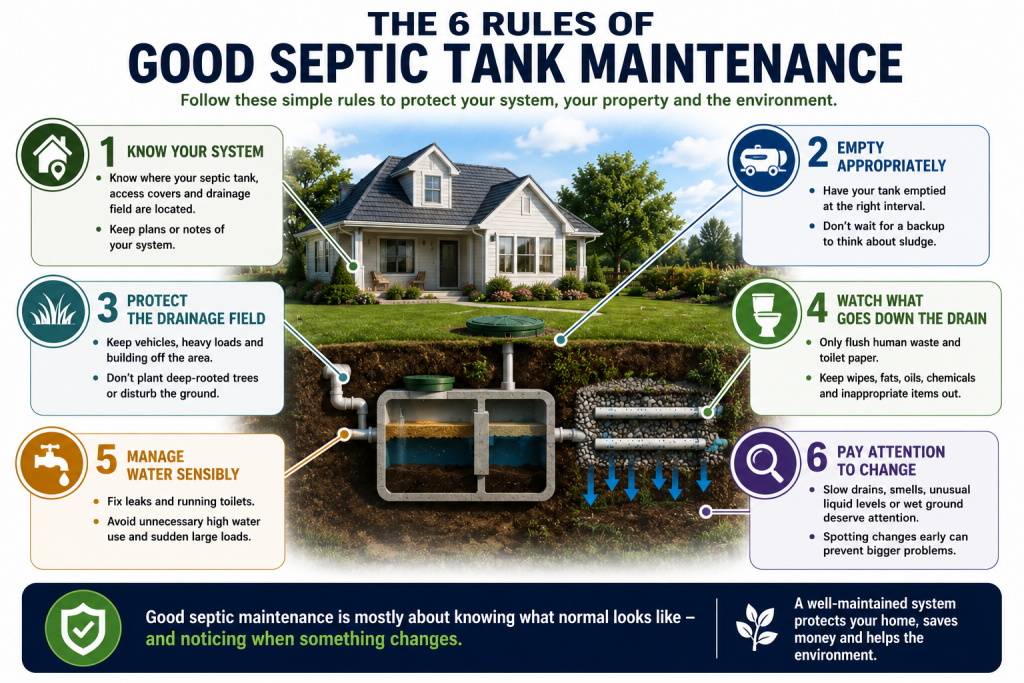
A septic tank doesn’t need to dominate how you use your home.
Most of the time, good maintenance comes down to a handful of sensible habits:
Know your system.
Know where the tank and drainage field are and understand what normal operation looks like.
Keep records.
Record emptying, inspections, repairs and unusual problems.
Look after the drainage field.
Keep heavy loads, inappropriate construction and unnecessary surface water away from it.
Use your drains sensibly.
Normal household wastewater is expected. Wipes, inappropriate solids and unwanted chemicals aren’t.
Understand the water level.
A septic tank containing liquid isn’t automatically full. Significant changes above or below its normal operating level are more informative.
Don’t treat emptying as a universal repair.
If problems quickly return after pumping, investigate why.
Support the biological process without neglecting physical maintenance.
Healthy biological activity is part of septic treatment, but it can’t compensate for damaged infrastructure or excessive sludge indefinitely.
And perhaps most importantly:
Pay attention to change.
You don’t need to become a septic tank expert to notice that several drains have become slower, the drainage field is wetter than it used to be or a problem now appears every time it rains.
Those observations can help you identify developing problems earlier and make better decisions about when professional attention is needed.
A well-maintained septic system should largely remain in the background — quietly dealing with household wastewater without demanding constant attention. The purpose of maintenance is to help keep it that way.