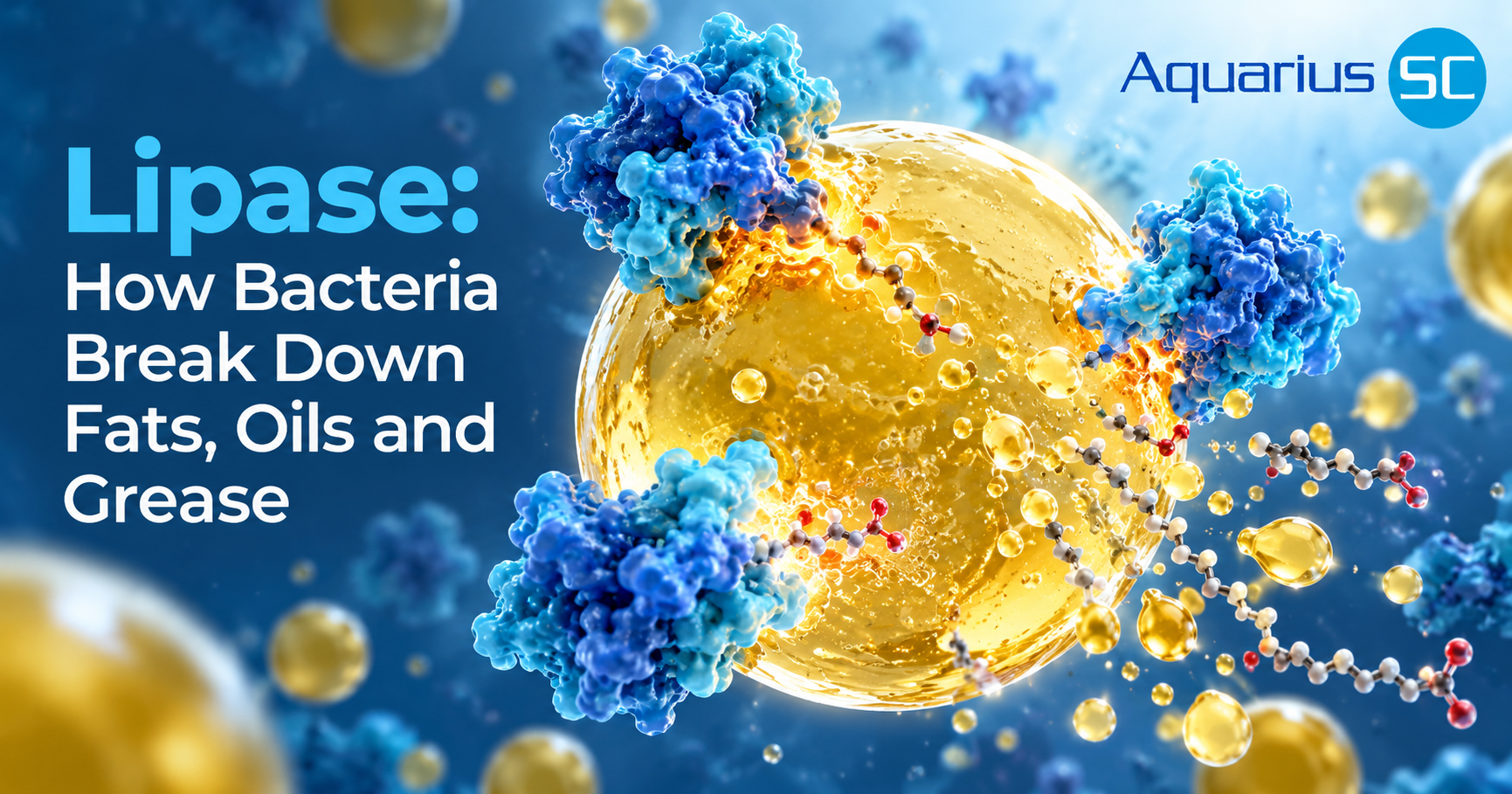
Fats and oils are particularly challenging substances in wastewater because they do not readily mix with water. Instead, they can form floating layers, accumulate on surfaces and become difficult for microorganisms to access.
Certain bacteria produce specialised compounds called biosurfactants, which influence how oily materials interact with water.
Biosurfactants are an important part of the science behind biological wastewater treatment. Aquarius SC’s formulation includes a microbial culture capable of producing its own biosurfactant, complementing the activities of its enzyme-producing microorganisms.
Understanding this process helps explain why microbial waste treatment involves more than simply breaking chemical bonds.
Biosurfactants are surface-active compounds produced by certain microorganisms, including bacteria, yeasts and fungi.
Their defining characteristic is an ability to interact with substances that have different chemical properties, particularly water and oils.
Many biosurfactants are amphiphilic, meaning their molecular structures contain two distinct regions:
This combination allows biosurfactant molecules to accumulate at interfaces between materials.
By changing the interactions occurring at these boundaries, biosurfactants can influence wetting, dispersion and emulsification.
A scientific review of the properties and functions of microbial biosurfactants explores their molecular structures and environmental applications.
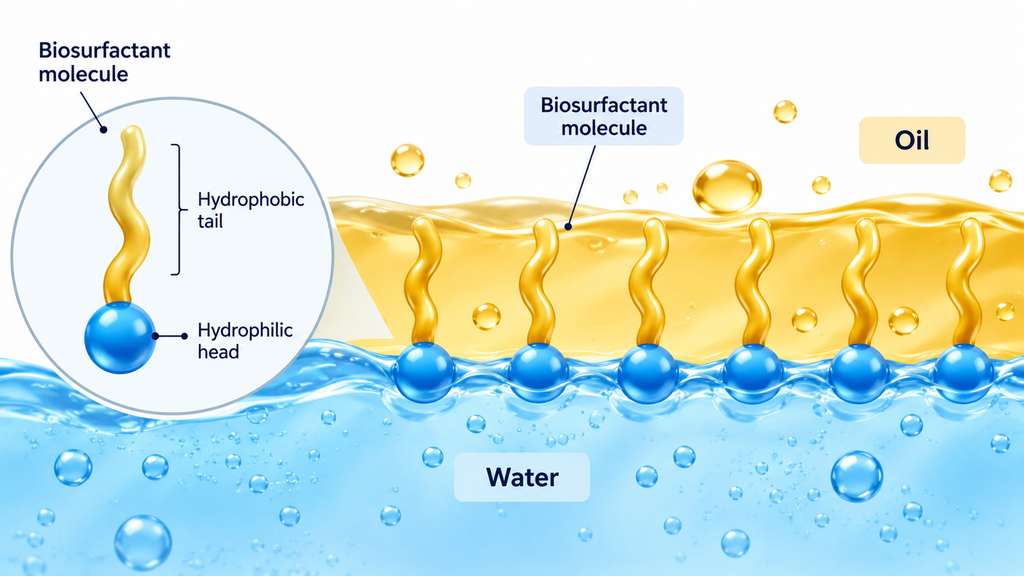
When oil enters water, it typically separates into droplets or layers because the two liquids have different chemical properties.
Biosurfactant molecules can position themselves at the oil-water interface.
Their hydrophobic regions interact with the oil, while their hydrophilic regions interact with the surrounding water.
This arrangement can reduce interfacial tension, making it easier for oil to disperse into droplets.
Depending on the compound and conditions, biosurfactants may also help stabilise emulsions.
This process can be explained in four stages:
Importantly, dispersion does not necessarily mean the oil has been chemically degraded.
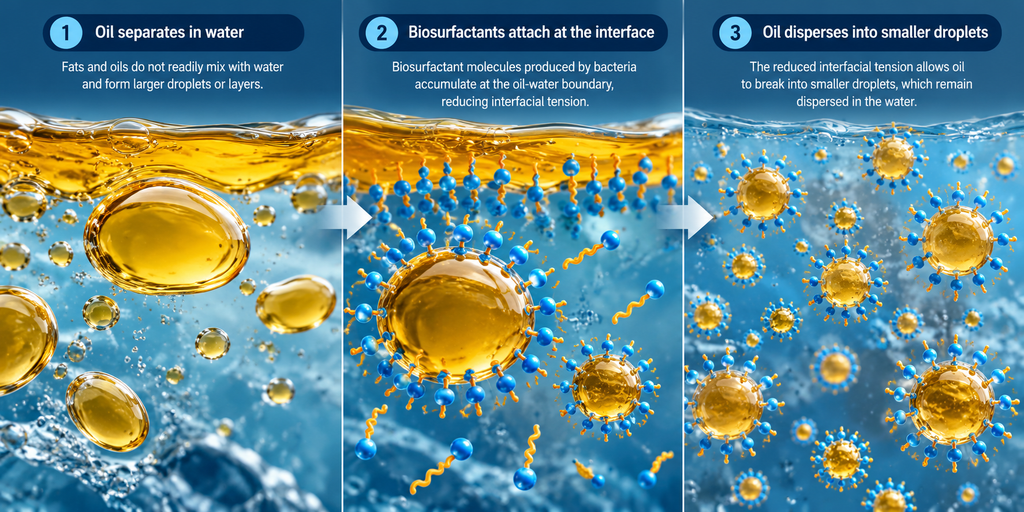
Emulsification describes the dispersion of one liquid into another as droplets.
In wastewater containing fats and oils, emulsification can influence how organic materials become accessible to microorganisms.
Smaller droplets generally provide greater surface area relative to their volume, potentially increasing contact between oily substrates and microbial processes.
However, greater dispersion is not always beneficial.
Stable oil emulsions can complicate physical separation, and different wastewater treatment systems have different requirements.
Research into biosurfactant applications in environmental remediation explains how microbial surfactants can influence oil mobilisation, solubilisation and emulsification.
Their usefulness therefore depends on the wastewater composition, treatment design and specific biological conditions.
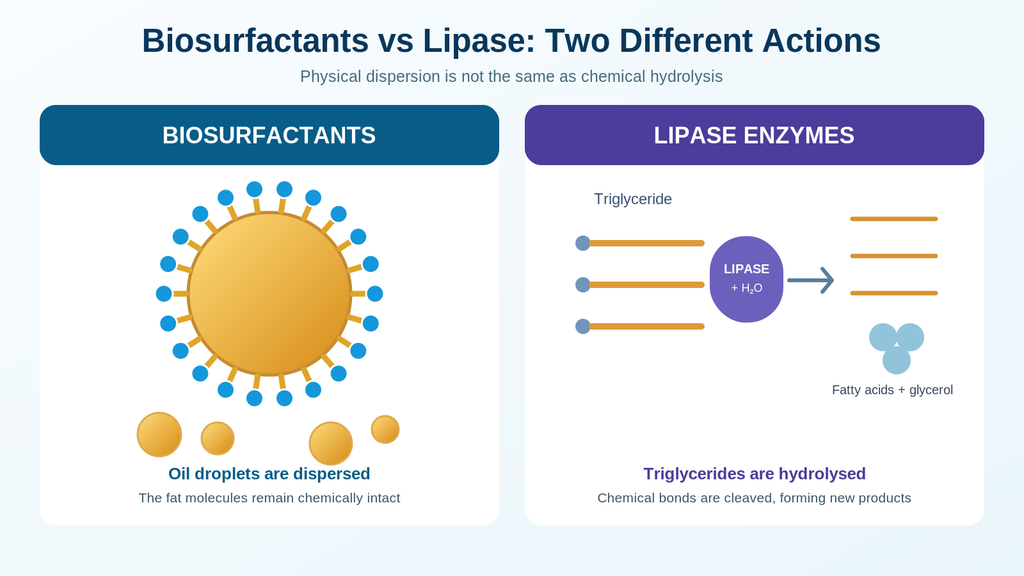
Biosurfactants and lipase are involved in different processes.
Biosurfactants influence physical interactions between oily materials and water, including interfacial tension and dispersion.
Lipase is an enzyme that catalyses chemical reactions involving suitable fats, including the hydrolysis of triglycerides.
Lipase can produce smaller chemical compounds, such as fatty acids and glycerol.
Biosurfactants do not perform that hydrolysis reaction simply by dispersing oil.
The two activities can complement one another because improved contact with oily substances may influence how accessible those materials are to enzymes.
For a detailed explanation of triglyceride hydrolysis, read Lipase – How Bacteria Break Down Fats, Oils and Grease.
Aquarius SC combines selected microbial cultures with complementary biological capabilities.
Its published formulation identifies six enzyme activities: amylase, protease, cellulase, lipase, pectinase and keratinase.
Alongside these, the product includes a microbial culture capable of producing its own biosurfactant.
This provides an additional biological mechanism relevant to the interaction between wastewater and fatty organic materials.
Rather than relying exclusively on enzymes, the formulation brings together microorganisms associated with different waste-processing activities.
However, the available information does not identify the exact biosurfactant compound or the bacterial strain responsible for producing it.
For the complete explanation, read Aquarius SC Ingredients – How Beneficial Bacteria, Enzymes and Biosurfactants Work Together.
Several bacterial genera are known to produce biosurfactants, including Bacillus and Pseudomonas.
Different microorganisms produce different types of compounds with distinct chemical structures and functions.
Examples investigated in scientific research include lipopeptides, glycolipids and other surface-active substances.
Some Bacillus species produce lipopeptide biosurfactants, but production varies between species and strains.
The Aquarius Microbial Magic eBook identifies Bacillus as an important genus across the wider Aquarius biological product range.
Nevertheless, this does not confirm the identity of Aquarius SC’s biosurfactant-producing microorganism.
Biosurfactant production depends on the microorganism involved and its environment.
Important factors include temperature, pH, nutrient availability, oxygen conditions and wastewater composition.
The presence of fatty substrates may influence production in certain microorganisms, although responses vary between species.
The physical properties of biosurfactants can also change with temperature, acidity and dissolved salts.
Consequently, the ability of a microorganism to produce a biosurfactant does not guarantee identical performance across every wastewater system.
Biosurfactants may help influence the dispersion or mobilisation of certain oily substances, but they cannot guarantee the removal of established grease blockages.
Severe accumulations may require mechanical cleaning or professional drainage work.
Households and businesses should continue preventing unnecessary fats, oils and grease from entering drainage systems.
The UK Government’s pollution prevention guidance specifically advises against disposing of fats, oils and grease through drains.
Biological treatments should complement responsible waste management rather than replace it.
Both can influence surface and interfacial tension, but biosurfactants are biologically produced. Their properties vary according to their chemical structure.
Not directly through enzymatic hydrolysis. They primarily influence how materials interact, disperse or become accessible.
Yes. Their different mechanisms may complement one another, depending on the microorganisms, substrates and operating conditions.
Biosurfactants are important microbial compounds that influence interactions between fats, oils and water.
Within Aquarius SC, a biosurfactant-producing culture complements the formulation’s enzyme-producing microorganisms.
Understanding the distinction between physical dispersion and chemical degradation provides a clearer picture of how different microbial capabilities contribute to biological wastewater treatment.