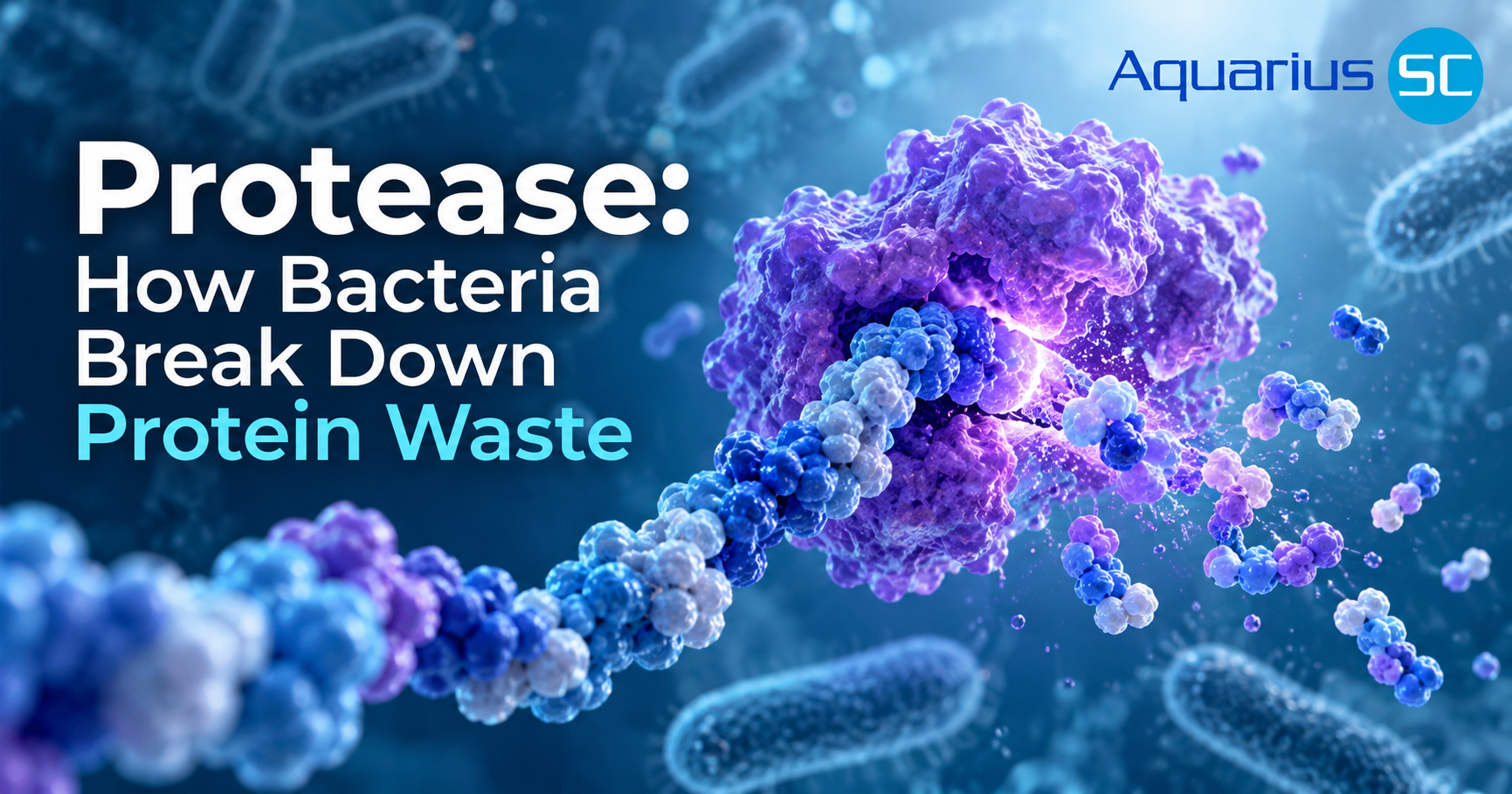
Proteins are an important component of organic waste found in septic tanks, drains and wastewater treatment systems. From food residues to naturally occurring biological material, these complex molecules must undergo decomposition before many microorganisms can use their constituent nutrients.
One of the key biological tools involved in this process is protease, a specialised enzyme produced by certain bacteria and other living organisms.
Protease is one of the six enzyme activities identified in the Aquarius SC biological formulation. Understanding its function helps explain how beneficial microorganisms contribute to the breakdown of protein-rich organic waste.
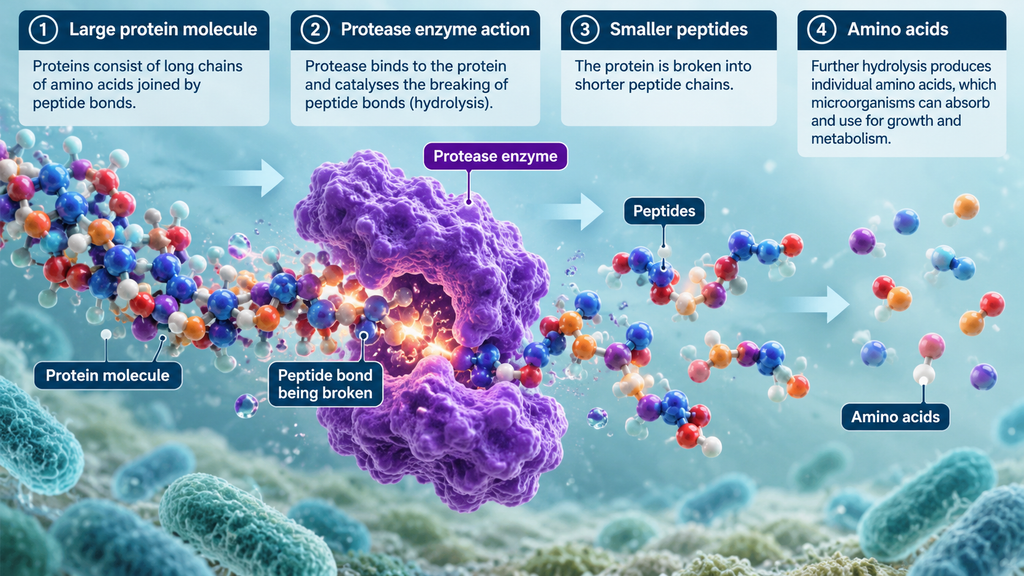
Protease is an enzyme that catalyses the breakdown of proteins into smaller peptides and, through further hydrolysis, amino acids.
Proteins consist of chains of amino acids joined by chemical connections called peptide bonds. Proteases act on these bonds, breaking larger protein structures into smaller components.
This process is known as proteolysis.
Different proteases act on different parts of protein molecules. Some break internal peptide bonds, while others remove amino acids from the ends of peptide chains.
A scientific review of microbial proteases and their applications explains how these enzymes function and their importance in biological waste processing.
Large protein molecules cannot always pass directly through bacterial cell membranes.
Certain microorganisms overcome this limitation by producing extracellular proteases, which act on proteins outside the cell.
The process typically involves four stages:
This extracellular digestion is important for nutrient cycling in natural environments.
Research published by the American Society for Microbiology on extracellular protease production describes how microorganisms use these enzymes to access nutrients contained within large proteins.
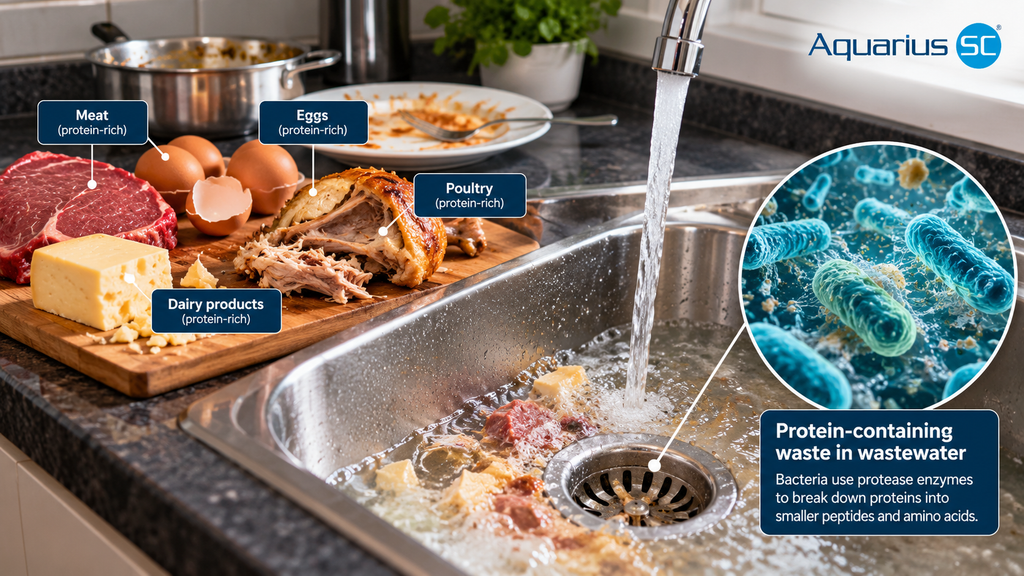
Domestic wastewater contains organic matter originating from several everyday activities.
Protein-containing materials may include:
Commercial wastewater can contain additional protein-rich substances, particularly from food processing and hospitality operations.
Although protease-producing microorganisms can help decompose these materials, excessive waste loading can still affect treatment performance.
Food scraps should therefore be kept out of sinks wherever practical.
A septic tank separates incoming wastewater into settled sludge, a liquid layer and floating scum.
Microorganisms contribute to the decomposition of biodegradable organic matter within the system.
Protein hydrolysis is one part of this broader process.
As proteins are broken into smaller compounds, microorganisms may use the resulting amino acids and peptides as sources of carbon, nitrogen and energy, depending on their metabolism.
Further microbial activity can transform these compounds into other substances.
However, protein decomposition does not mean all solids disappear. Septic tanks still accumulate sludge that must be removed periodically.
Excessive organic loading and unsuitable discharge practices can interfere with normal wastewater treatment.
Aquarius SC uses selected microbial cultures capable of producing several enzyme activities.
Its published formulation identifies six:
Protease contributes the protein-degrading component of this broader biological approach.
The Aquarius Microbial Magic technical eBook explains that living microorganisms can continue producing enzymes when sufficient nutrients and favourable environmental conditions are available.
This differs from relying solely on a purified enzyme preparation, which cannot reproduce or manufacture additional enzymes.
For an explanation of how these activities complement one another, read Aquarius SC Ingredients – How Beneficial Bacteria, Enzymes and Biosurfactants Work Together.
Numerous microorganisms produce proteases, including certain bacteria belonging to the Bacillus genus.
Different species and strains produce enzymes with different properties, including variations in their preferred temperature, pH and substrates.
Aquarius identifies Bacillus as an important group within its wider biological product range.
Its technical eBook discusses species including Bacillus subtilis and Bacillus licheniformis.
However, the precise bacterial strains used in Aquarius SC sachets have not been independently confirmed, so individual species should not automatically be presented as verified ingredients.
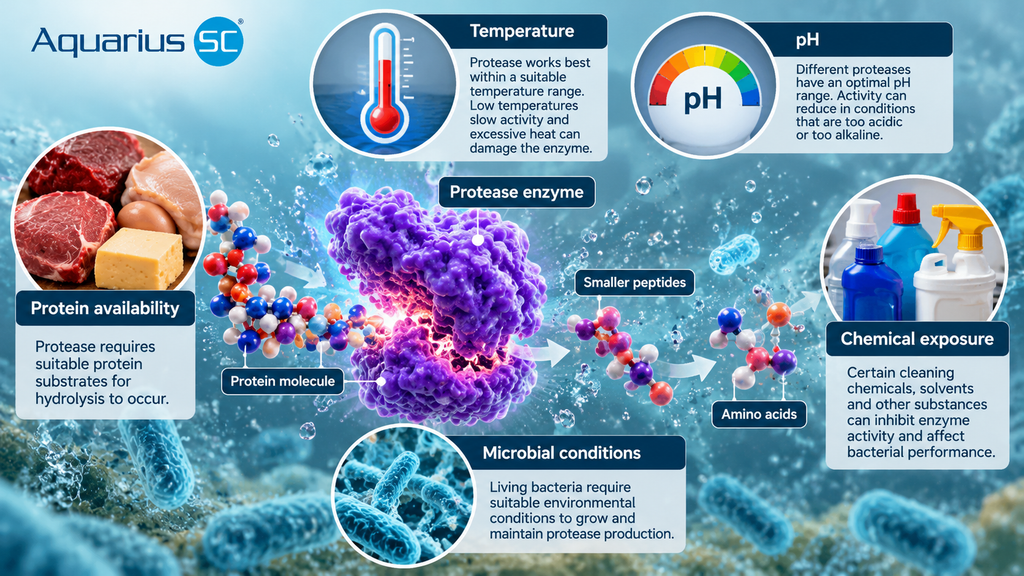
Like other biological catalysts, protease enzymes depend on suitable operating conditions.
Temperature: Low temperatures may slow enzymatic reactions, while excessive heat can damage enzyme structure.
pH: Different proteases function most effectively within particular acidity or alkalinity ranges.
Protein availability: Proteases require suitable protein substrates for hydrolysis to occur.
Chemical exposure: Certain cleaning chemicals, solvents and other substances may interfere with enzyme or bacterial activity.
Microbial conditions: Living bacteria require appropriate environmental conditions to grow and maintain enzyme production.
A scientific review of enzyme activity in biological wastewater treatment discusses hydrolytic enzymes and their role in breaking large organic molecules into components accessible to microorganisms.
These factors help explain why biological activity can vary between wastewater systems.
No. Protease catalyses particular biochemical reactions but cannot guarantee complete degradation of every protein-containing material.
Some proteins are more resistant to decomposition because of their structure or surrounding environment.
Protease also cannot correct damaged drainage pipes, poor tank design, excessive sludge accumulation or unsuitable discharge arrangements.
Biological treatments should therefore complement proper septic tank operation and maintenance rather than replace them.
For broader maintenance guidance, see The Complete Guide to Septic Tank Maintenance.
Yes. Numerous bacterial species produce protease enzymes to help break down proteins and obtain nutrients.
Protease primarily acts on proteins. Lipase is the enzyme group associated with hydrolysing fats and oils.
No. Protease contributes to protein decomposition, but septic tanks still require appropriate sludge removal and maintenance.
Protease plays an important role in biological wastewater treatment by breaking large proteins into smaller compounds that microorganisms can process.
Within Aquarius SC, protease-producing microbial activity complements other enzyme functions, helping explain the rationale behind a multi-culture biological formulation.
Understanding protease demonstrates how specialised enzymes contribute to the broader process of organic waste decomposition.