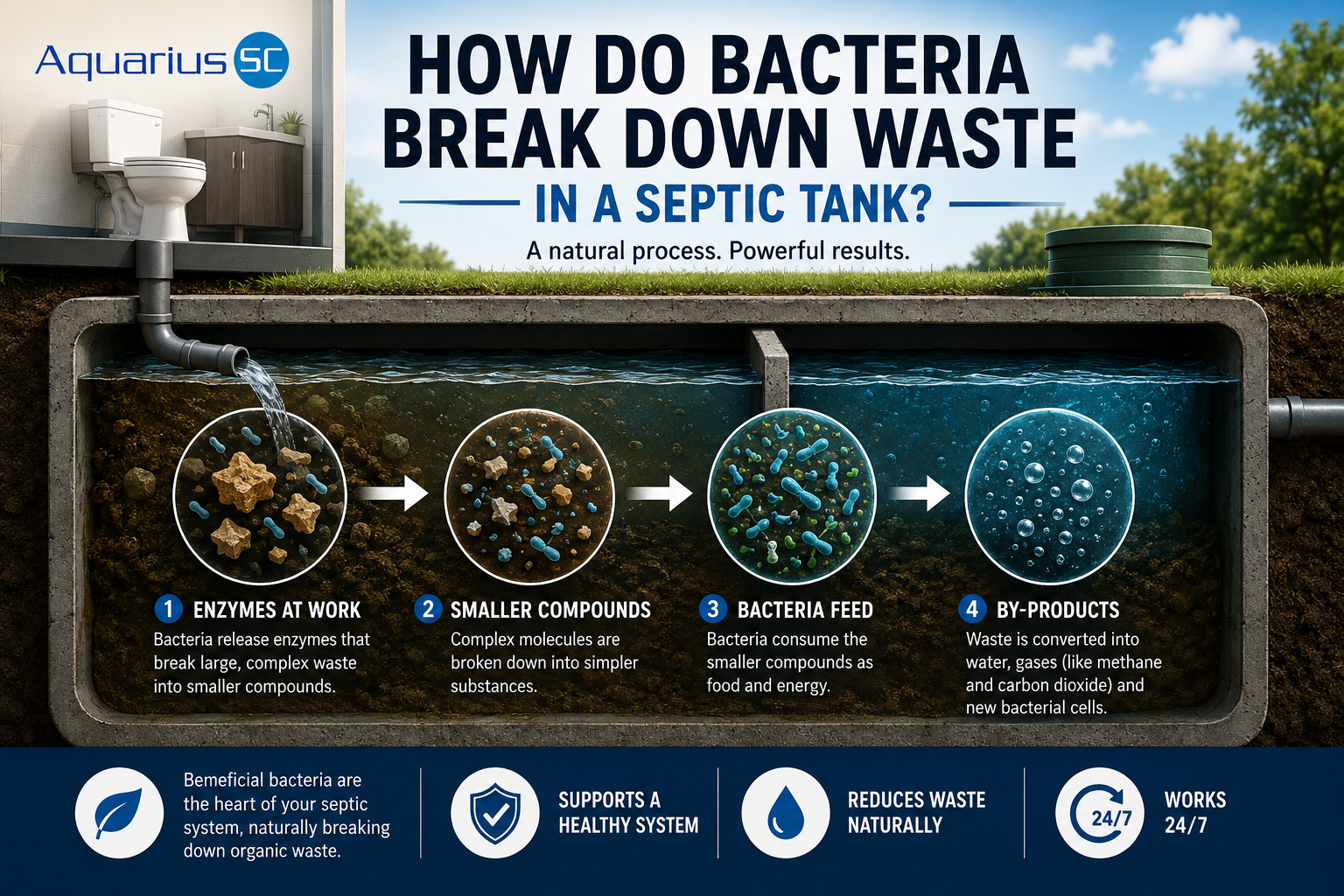
Bacteria in a septic tank break down organic waste by producing enzymes that convert complex materials into smaller compounds that microorganisms can use as nutrients and energy.
This biological decomposition happens alongside the physical separation of solids inside the tank. Bacteria can digest a proportion of the organic material entering the system, but they don’t make all solid waste disappear.
Understanding that distinction is important when looking at what septic bacteria actually do — and what they don’t.
Bacteria primarily act on biodegradable organic matter.
Household wastewater can contain materials such as:
Different organic materials require different enzymes to begin breaking them apart.
Proteins, for example, need different enzymatic processes from fats or starches. This is why wastewater contains diverse microbial populations rather than one single type of bacterium performing every job.
Commercial biological wastewater treatments can also use selected bacterial strains for this reason. UK wastewater specialist Bio Green, for example, describes bacterial cultures capable of metabolising cellulose, fats and oils, proteins and starches in its biological septic treatment.
Bacteria cannot simply consume large pieces of organic waste whole.
Instead, much of the process begins outside the bacterial cell.
Bacteria produce enzymes capable of acting on particular types of organic material.
Think of these enzymes as biological tools.
Different enzymes can act upon different substances. Examples include enzymes involved in breaking down:
This first stage makes larger organic molecules more accessible to microorganisms.
Once enzymes begin acting on the waste, complex organic material is converted into progressively smaller molecules.
This process is called hydrolysis.
Hydrolysis is particularly important because many large organic molecules cannot pass directly through bacterial cell membranes.
Breaking them down creates smaller, soluble compounds that bacteria can absorb and metabolise.
So when people talk about septic bacteria “eating waste”, the reality is more complex:
enzymes first break complex organic matter down, then microorganisms utilise the resulting compounds.
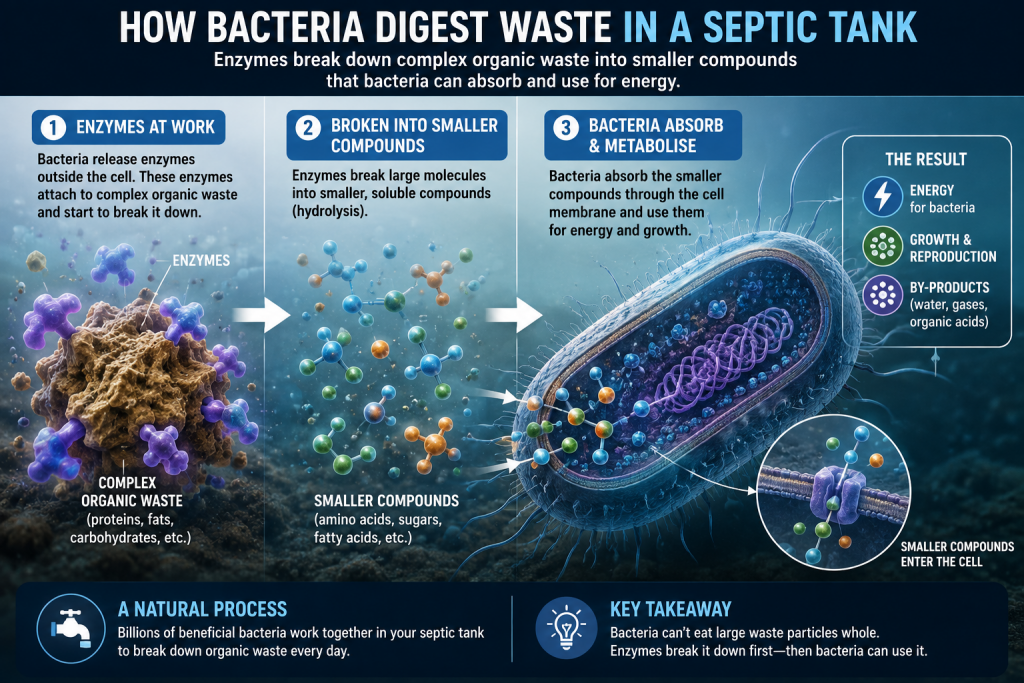
Once smaller compounds become available, bacteria can use them in their metabolism.
Under the low-oxygen conditions found in a conventional septic tank, this is predominantly an anaerobic process.
Rather than relying on oxygen in the same way as aerobic wastewater treatment, anaerobic microbial communities process organic material through a series of biological reactions.
The Centre for Alternative Technology notes that conventional septic tanks operate with anaerobic biological activity, although it also importantly points out that physical sedimentation remains a major part of how septic tanks function.
That distinction matters: bacterial digestion assists the treatment process, but a septic tank isn’t simply a giant biological digester.
Anaerobic digestion isn’t one reaction performed by one bacterium.
It’s a chain of microbial processes in which the products created by one group of microorganisms can become the raw materials used by another.
The process is commonly divided into stages.
Complex organic materials such as proteins, fats and carbohydrates are broken into smaller soluble molecules.
This makes the material accessible for further microbial degradation.
Other microorganisms convert those smaller organic compounds into substances including organic acids, alcohols, hydrogen and carbon dioxide.
Some of the products from acidogenesis are subsequently converted into compounds including acetate, hydrogen and carbon dioxide.
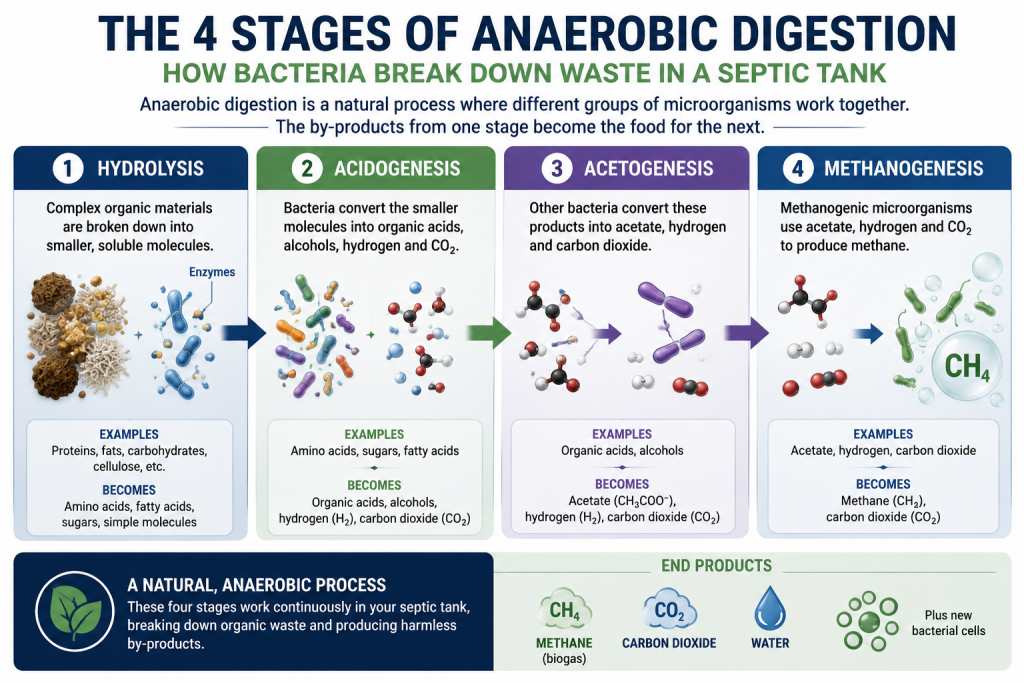
Specialised microorganisms known as methanogens can then use compounds produced during earlier stages to produce methane.
Methanogens are technically archaea rather than bacteria, but they form an important part of anaerobic microbial communities.
This is one reason gases are naturally produced during the decomposition of sewage and why septic systems require appropriate ventilation.
Ordinary toilet paper is made predominantly from cellulose fibres, which are biodegradable.
Microorganisms can therefore contribute to its breakdown.
However, toilet paper doesn’t instantly dissolve because bacteria are present. It first becomes saturated and physically breaks apart, while microbial and enzymatic activity contributes to further degradation of the cellulose.
This is also why toilet paper shouldn’t be treated as equivalent to wipes.
Many wipes and other sanitary products contain materials that don’t break down in the same way and shouldn’t be flushed simply because they’re marketed as disposable.
Bacteria can only digest materials that are biologically degradable under the conditions present.
Certain microorganisms can break down biodegradable fats and oils by producing enzymes called lipases.
Lipases help convert fats into smaller components that can be metabolised further.
However, that doesn’t mean a septic tank can safely be used to dispose of cooking oil or large quantities of grease.
Excessive fat can cool and solidify in pipework, accumulate within the system and create problems faster than microbial activity can deal with it.
Bacterial digestion should therefore never be viewed as permission to pour fats and cooking oils down the sink.
The bacteria can process some organic fats present in normal wastewater; they aren’t an unlimited grease-disposal system.
No.
This is one of the most important misconceptions surrounding septic tank bacteria.
Bacterial activity can reduce and transform biodegradable organic material, but not everything entering a septic tank can be biologically digested.
Inorganic material and resistant solids remain, while bacterial biomass itself also contributes material to the system.
Over time, sludge therefore accumulates at the bottom of the tank.
No bacterial treatment should be viewed as a permanent replacement for appropriate septic tank emptying.
This distinction is particularly important when evaluating claims that a product can make pumping or desludging completely unnecessary.
Biological activity can assist organic waste breakdown. It cannot make every solid entering a septic tank vanish.
Biological decomposition depends on microorganisms having suitable conditions in which to function.
Changes in their environment can therefore affect the rate at which organic material is processed.
Factors can include:
Temperature: Microbial metabolism generally slows as conditions become colder.
pH: Different microbial communities function best within particular pH ranges. Significant changes can inhibit biological activity.
Available organic material: Microorganisms require biodegradable material they can metabolise.
Chemical exposure: High concentrations of antimicrobial or caustic substances can suppress microbial populations.
Hydraulic conditions: Wastewater moving through the system too rapidly can affect settling and treatment conditions.
This is why bacterial activity isn’t a fixed quantity. The microbial community responds to the conditions inside the system.
The bacteria and other microorganisms responsible for decomposition in a conventional septic tank primarily operate under anaerobic conditions, meaning little or no free oxygen is available.
This differs from many modern sewage treatment plants, which deliberately introduce oxygen to support aerobic microorganisms.
Aerobic treatment can break down organic material more rapidly, which is one reason a sewage treatment plant and a conventional septic tank shouldn’t be treated as biologically identical systems.
Within the septic tank itself, however, anaerobic microbial activity is normal.
A functioning septic tank naturally develops microbial populations because microorganisms continuously enter with wastewater.
Biological septic treatments typically work by introducing selected microorganisms and, depending on the formulation, enzymes or nutrients intended to supplement this existing activity.
The principle is straightforward: increase or support populations capable of acting on particular forms of biodegradable organic matter.
However, biological treatment still depends on the conditions within the system and should complement rather than replace physical maintenance.
If you’re considering a biological treatment for routine septic care, our guide to choosing a septic tank cleaner explains the different types available and what to look for when comparing them.
The easiest way to understand septic tank bacteria is to separate biological digestion from the claims sometimes made about it.
Bacteria can:
Bacteria cannot:
Bacteria are therefore an important part of what happens inside a septic tank, but they’re only one part of the overall process.
Their real role is much more specific: they use enzymes and a sequence of microbial reactions to convert biodegradable organic waste into progressively simpler compounds.
Understanding that process makes it easier to distinguish genuine biological septic treatment from exaggerated claims about what bacteria can achieve.