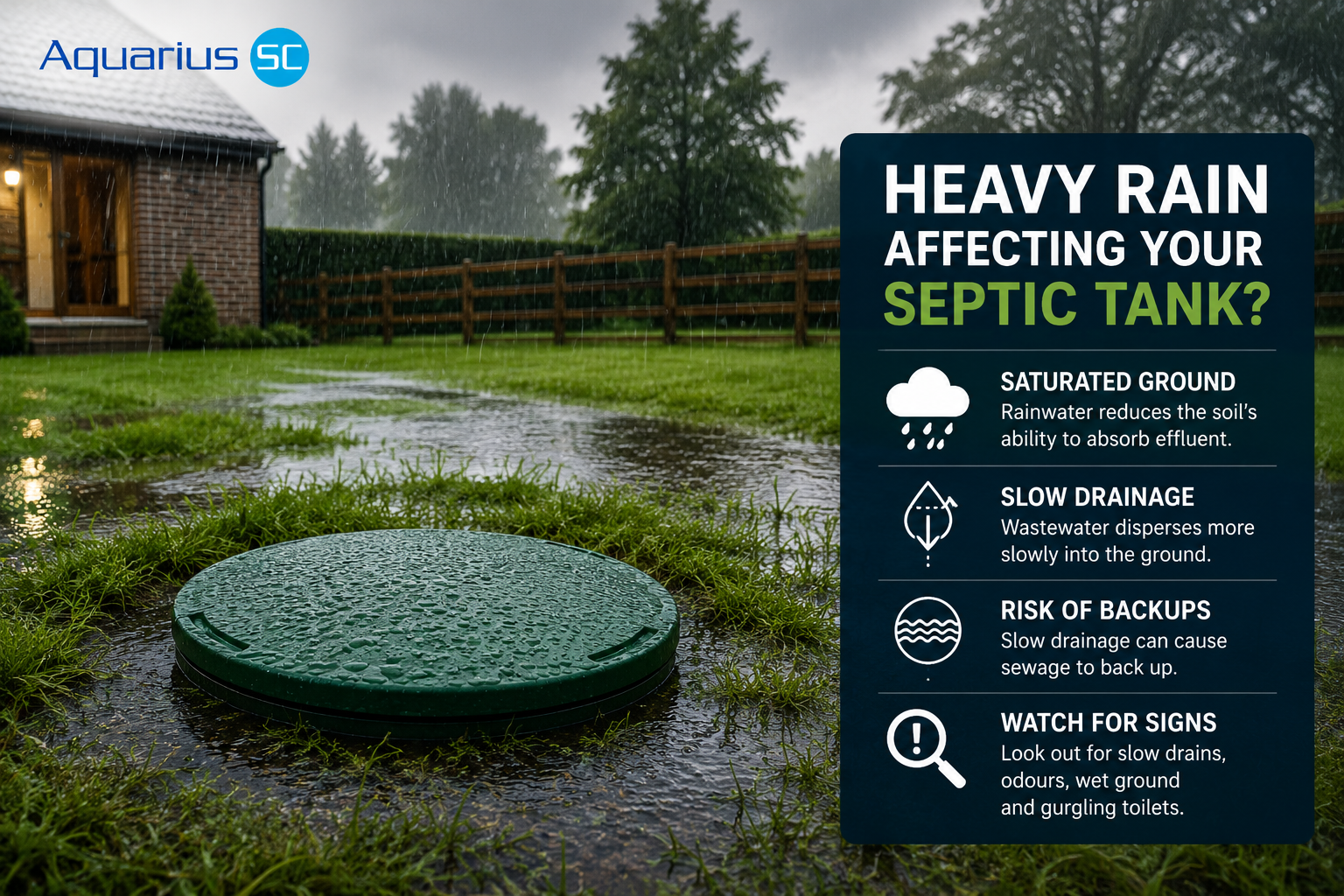

The clearest signs that a septic tank may need emptying are slow drainage throughout the property, persistent sewage smells, wastewater backing up, a high sludge level and problems appearing around the tank or drainage field.
However, these symptoms don’t always mean the septic tank itself is full. A blocked pipe or failing drainage field can cause very similar problems.
The best indicator is therefore not one symptom in isolation, but a combination of warning signs alongside the tank’s emptying history and actual sludge level.
One slow sink isn’t particularly strong evidence of a septic tank problem.
It could simply have a local blockage.
But if toilets, sinks, baths and showers throughout the property all start draining more slowly than usual, the restriction may be further downstream.
That could mean:
The key clue is multiple fixtures being affected together.
If only one fixture is slow, investigate that drain first. If the whole property is affected, the septic system becomes a much more likely place to look.
A strong sewage smell around the septic tank, inspection covers or drainage field is another sign that the system needs investigating.
Northern Ireland’s Environment Agency lists bad smells, slow drains and wet ground near the tank or soakaway as signs of potential problems with a private sewage treatment system.
Its guidance on private sewage treatment systems recommends seeking professional advice when these symptoms appear.
A smell doesn’t necessarily tell you which part of the system is responsible.
Possible causes include excessive sludge, blocked drainage, poor ventilation or problems with the drainage field.
But a persistent sewage odour isn’t something that should simply be considered normal.
This is one of the most serious warning signs.
You might notice sewage or dirty wastewater:
If wastewater physically starts coming back into the property, stop introducing unnecessary water into the drainage system.
Don’t repeatedly flush toilets or run taps in an attempt to force the blockage through.
The system needs investigating.
A tank requiring desludging is one possible explanation, but so is a blocked main drain.
The fact that sewage is backing up tells you the wastewater isn’t moving through the system correctly, not automatically what the underlying cause is.
Unusually wet ground can indicate that wastewater is reaching the surface rather than dispersing properly through the soil.
You might notice:
The Environment Agency advises owners to check private sewage systems for signs such as sewage smells, pools of water, sludge and unusually lush vegetation, as these can indicate the system isn’t operating correctly.
This doesn’t necessarily mean the septic tank needs emptying.
It may instead indicate a drainage-field problem.
That distinction matters because pumping out the tank won’t permanently repair a drainage field that is blocked, damaged or saturated.
This is the most direct way to establish whether a septic tank actually needs desludging.
Solid material gradually collects at the bottom of the tank.
As that sludge layer becomes deeper, there is less working space available between the sludge and the outlet.
Eventually, solid material can begin travelling towards the outlet instead of remaining inside the tank.
That is the situation you want to avoid.
A septic professional can measure or inspect the sludge level and determine whether the tank needs emptying.
This is much more reliable than waiting for a smell, blockage or sewage backup before taking action.
Solid material should remain inside the tank until it’s removed during desludging.
If solids are leaving with the effluent, the tank isn’t separating wastewater effectively.
That matters because solids can then enter the drainage field.
Once this happens, they can clog the soil and reduce the drainage field’s ability to accept wastewater.
The consequences can eventually include:
This is why tank emptying is preventative rather than simply reactive.
Ideally, sludge should be removed before it reaches the point where solids can escape through the outlet.
Sometimes the strongest warning sign is simply an unknown maintenance history.
If you’ve recently moved into a property and have no record of when the septic tank was last emptied, don’t assume everything is fine because there are no obvious symptoms.
A septic tank can accumulate substantial sludge without immediately causing a blockage or smell.
If the emptying history is unknown, having the tank inspected gives you a useful starting point.
You can then record future desludging dates and establish how quickly your particular household builds up sludge.
Sefton Council notes that solids accumulating at the bottom of septic tanks need to be pumped out periodically rather than being left indefinitely.
Yes.
This is one of the biggest sources of confusion.
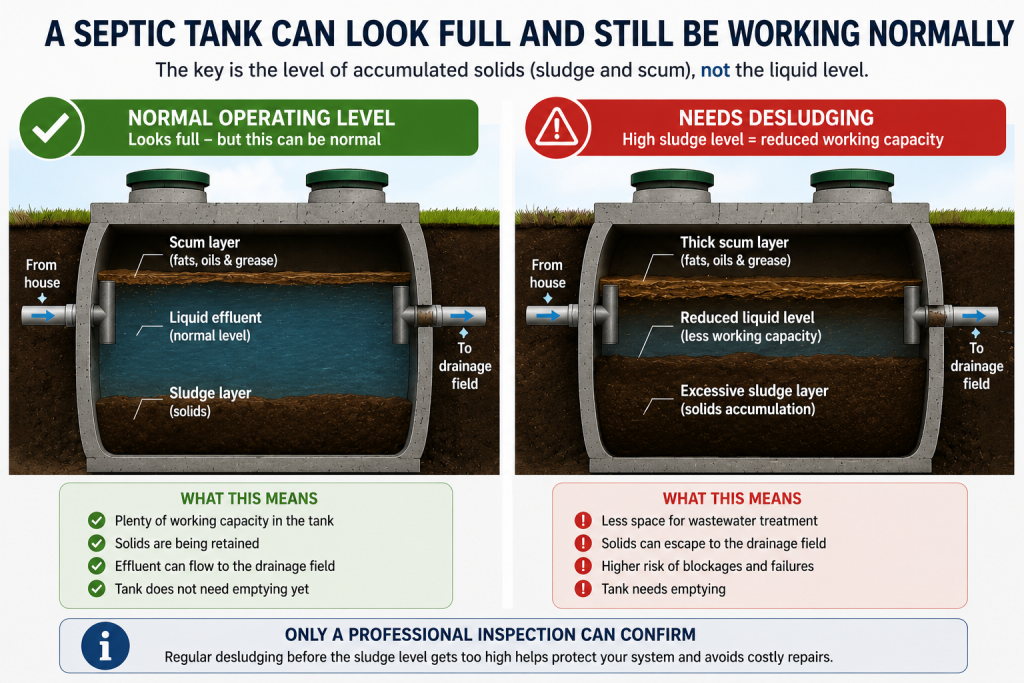
If you look into a septic tank and see liquid close to the normal operating level, that doesn’t necessarily mean it needs emptying.
A septic tank normally contains liquid.
What determines whether desludging is required is primarily the amount of accumulated sludge and scum, not simply whether water is visible inside.
This means opening the cover and thinking:
“It’s full of water, so it must need emptying”
isn’t a reliable diagnosis.
The tank may be operating at its normal liquid level.
What matters is whether excessive solids have accumulated or wastewater is no longer leaving the system correctly.
Never enter a septic tank to investigate it yourself. Hazardous gases can accumulate inside confined wastewater systems.
Yes.
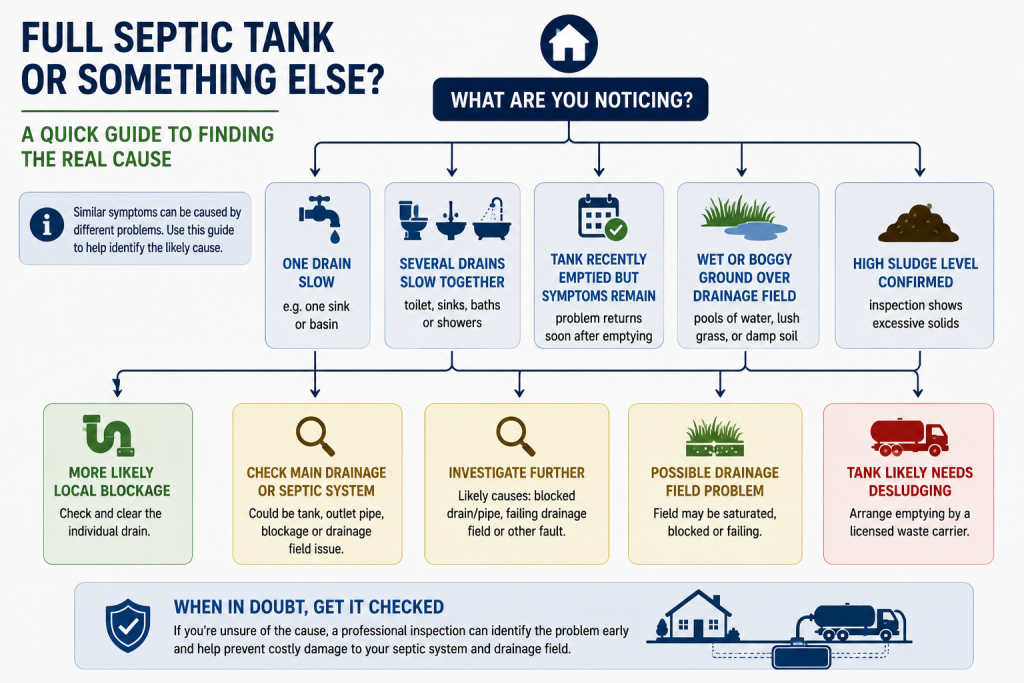
This is particularly important because several symptoms commonly blamed on a “full septic tank” also occur when ordinary household drains are blocked.
Adur & Worthing Councils note that a blocked drain can cause slow drainage, overflowing gullies and unpleasant smells.
A useful first distinction is therefore:
One fixture affected: more likely to be a local blockage.
Several fixtures affected: more reason to investigate the main drain or septic system.
If the septic tank has recently been emptied but the same drainage problem remains, that also makes another cause more likely.
Yes.
A septic tank can be perfectly capable of receiving wastewater while the drainage field struggles to disperse the liquid leaving it.
Possible clues include:
Scottish local-authority guidance warns that when a septic tank or soakaway isn’t functioning properly it can result in odour, flooding and pollution. Aberdeenshire Council’s septic tank guidance also stresses the importance of maintaining the wider drainage system rather than focusing solely on the tank.
If emptying gives only temporary relief, the rest of the system needs investigating.
No.
Ideally, you shouldn’t reach the point where sewage is backing up or wastewater is appearing at the surface.
These signs are useful for identifying a developing problem, but they’re not a substitute for routine desludging.
Once the maintenance pillar is complete, this will be the article’s only internal link:
Recognising the warning signs is useful, but regular septic tank maintenance is the best way to remove accumulated sludge before it begins affecting the rest of the system.
The goal is to empty the tank before excessive sludge causes symptoms, not after.
If several warning signs appear together, arrange for the system to be inspected.
Particular reasons to act include:
If the problem is excessive sludge, the tank can be desludged.
If the tank is emptied and the symptoms remain, don’t simply arrange another tanker visit.
That points towards another problem such as a blocked drain, damaged outlet or failing drainage field.
The important distinction is that “my septic tank is full” describes a symptom homeowners commonly suspect — it isn’t always the actual diagnosis.