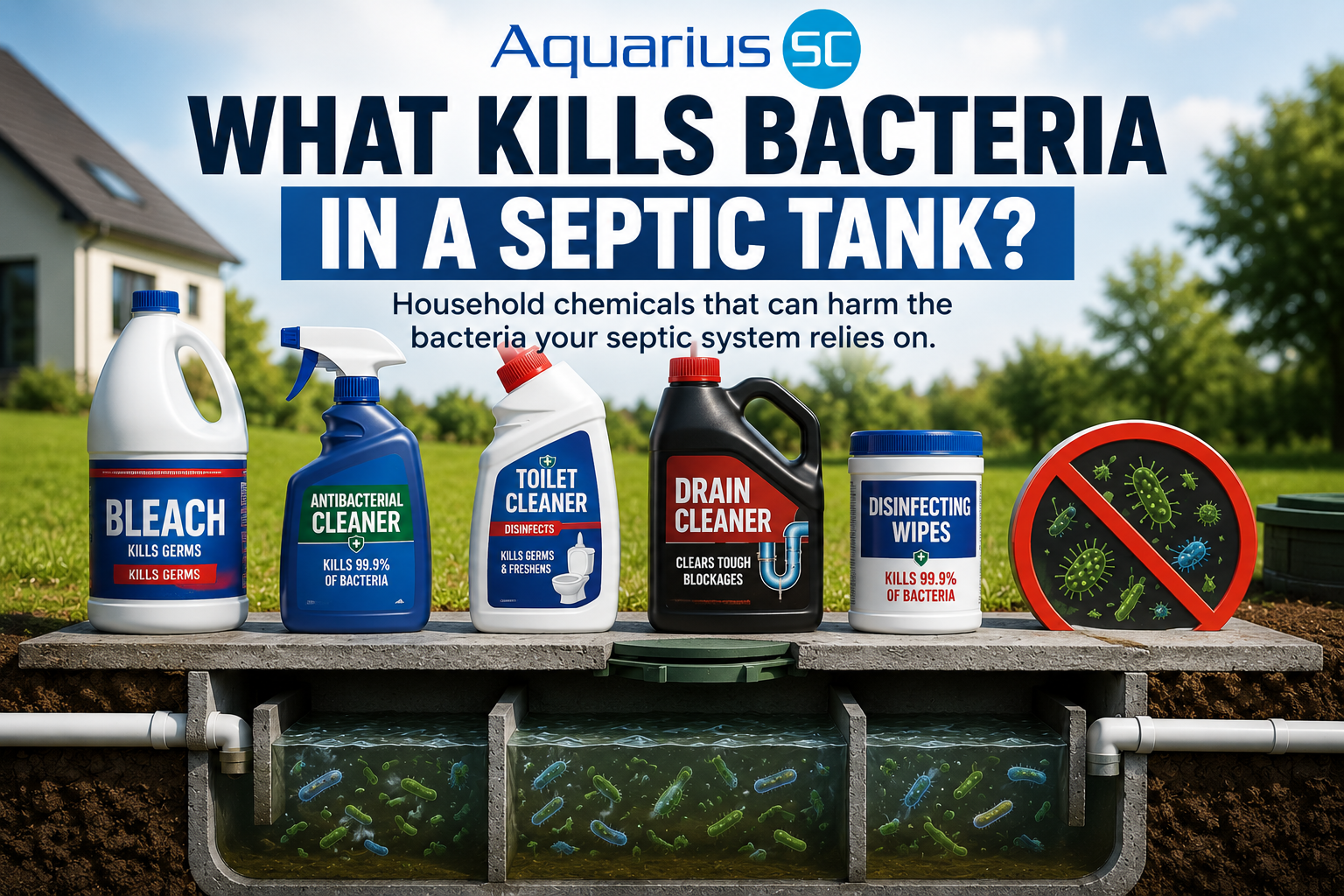
The main things that kill bacteria in a septic tank are bleach, antibacterial disinfectants, strong toilet cleaners and caustic drain cleaners, particularly when they’re used excessively or enter the tank in concentrated quantities.
This doesn’t mean you need to avoid normal household cleaning. The concern is repeatedly exposing a septic tank to products specifically designed to kill microorganisms or using powerful chemicals in quantities far beyond normal domestic use.
Below, we’ll look specifically at the household products most likely to affect septic tank bacteria and how you can reduce unnecessary exposure.
Bleach is one of the most common household products capable of killing septic tank bacteria.
Most household bleach contains sodium hypochlorite, a disinfectant used specifically because of its ability to destroy microorganisms. The UK Health Security Agency notes that household bleach typically contains around 5% sodium hypochlorite, although stronger formulations are available.
The important factor is how much bleach reaches the tank.
Occasional use of appropriately diluted bleach isn’t the same as regularly pouring concentrated bleach down a toilet or sink. Septic tanks contain a large volume of wastewater, so concentration makes a significant difference.
UK local-authority guidance reflects this distinction. Comhairle nan Eilean Siar advises that bleach and disinfectants can be used, but should be used sparingly because they can kill the beneficial bacteria within the tank.
If you use bleach:
Normal cleaning is one thing. Regularly exposing the tank to unnecessarily high concentrations of bleach is another.
Antibacterial and disinfectant products deserve particular attention because their intended purpose is to kill or inhibit microorganisms.
Common examples include concentrated disinfectant liquids, antibacterial surface cleaners, disinfecting floor cleaners and some bathroom products.
Again, normal household use doesn’t mean your septic tank will suddenly stop functioning.
The problem is unnecessary or excessive use.
For example, wiping a kitchen worktop with an antibacterial spray is very different from pouring a bucket containing a large quantity of concentrated disinfectant down the sink.
The Health and Safety Executive describes several commonly used disinfectant groups and their antimicrobial properties, including chlorine-releasing agents and other chemical disinfectants.
Those properties are useful when you’re trying to disinfect something. They’re less desirable when unnecessarily introduced into a biological wastewater system.
Where a strong disinfectant isn’t required, using a milder cleaning product can reduce the amount of antimicrobial chemicals entering household wastewater.
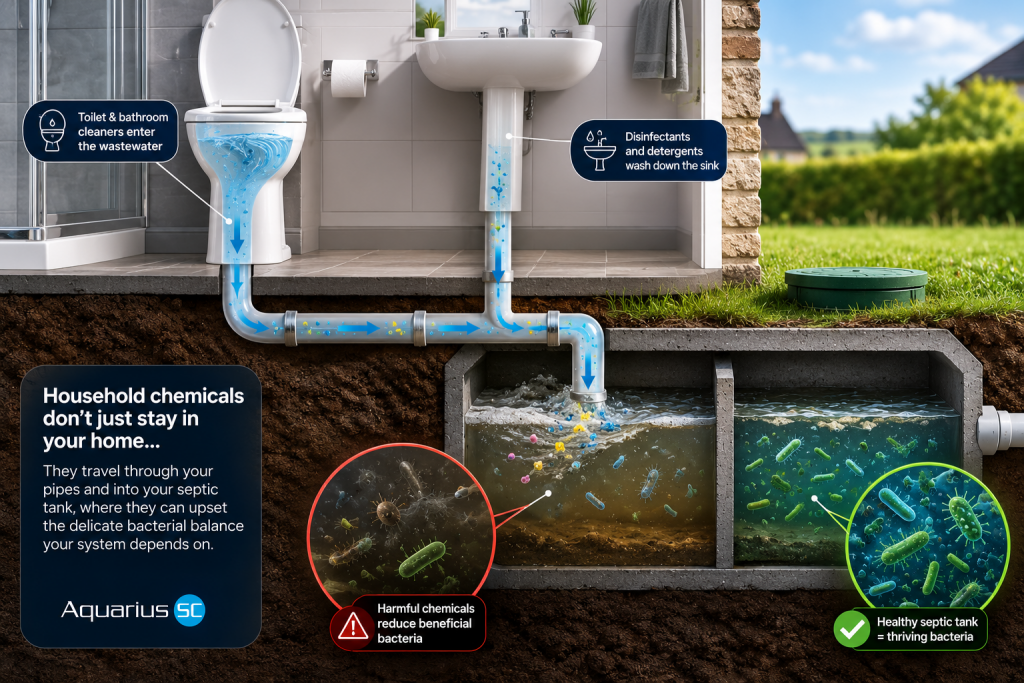
Toilet cleaning products are especially relevant because they’re used directly in a fixture connected to the septic system.
Some toilet cleaners contain strong acids, disinfectants or other ingredients intended to kill microorganisms and remove stubborn deposits.
Products that release cleaning chemicals every time the toilet is flushed deserve particular consideration.
Instead of an occasional exposure when the toilet is cleaned, continuous toilet blocks can introduce their ingredients into the wastewater repeatedly throughout the day.
Guidance from the US Environmental Protection Agency recommends limiting the disposal of household chemicals through septic systems, while EPA technical guidance has specifically cautioned against continuous-use toilet bowl cleaners in onsite wastewater systems.
You don’t need to stop cleaning your toilet.
A more sensible approach is to clean it when necessary, use an appropriate quantity of product and avoid continuously introducing powerful disinfecting chemicals where they aren’t needed.
Chemical drain cleaners are another product that can interfere with the conditions inside a septic tank.
Some drain-opening products contain sodium hydroxide (caustic soda) or other strongly alkaline or acidic ingredients. They’re formulated this way because they need to break down stubborn material inside blocked pipes.
Once the blockage clears, however, those chemicals continue through the wastewater system.
The US Environmental Protection Agency recommends avoiding chemical drain openers in properties with septic systems and using mechanical approaches, such as a drain snake, where appropriate.
This is particularly relevant when chemical drain cleaners are being used repeatedly.
If the same drain continually blocks, repeatedly pouring caustic chemicals through it isn’t solving the underlying problem. The blockage or drainage issue should be properly identified instead.
Usually, both matter.
There’s an enormous difference between a small quantity of diluted cleaning product entering a septic tank and disposing of a concentrated bottle of the same chemical down a sink.
Frequency matters too.
A single exposure may be diluted considerably by the wastewater already present within the system. Repeatedly introducing antimicrobial chemicals gives the bacterial environment less opportunity to recover between exposures.
That’s why statements such as “you can never use bleach with a septic tank” are too simplistic.
UK guidance generally takes a more practical approach: ordinary household cleaning products can be used appropriately, while powerful disinfectants such as bleach should be used sparingly.
A useful rule is:
Use normal household products normally. Use strong antimicrobial products only when necessary. Never use the septic system to dispose of unwanted cleaning chemicals.
Ordinary washing products aren’t the primary concern when they’re being used normally.
Mild detergents inevitably enter household wastewater through activities such as washing dishes and clothes.
That doesn’t mean they’re sterilising the septic tank.
For example, Comhairle nan Eilean Siar’s septic tank guidance states that mild detergents, fabric conditioners and washing powders or liquids can be used in moderation without upsetting the tank’s natural balance.
There’s therefore no reason to avoid ordinary washing products simply because you have a septic tank.
Use the manufacturer’s recommended quantity and avoid unnecessary overuse.
The substances deserving greater attention are strong antimicrobial, disinfecting and caustic products.
The effect depends on the chemical involved, its concentration, how much entered the tank and whether exposure is occasional or repeated.
If you’ve simply used an ordinary household cleaning product normally, there’s generally no reason to assume you’ve destroyed the bacterial population.
A significant accidental discharge of concentrated bleach or disinfectant is different.
If that happens, don’t attempt to “neutralise” it by pouring another chemical down the drain. Mixing household chemicals can itself be dangerous.
Instead, stop introducing the product and avoid further unnecessary chemical exposure.
If a substantial chemical spill has entered the system and you subsequently notice persistent problems with the septic tank, seek advice from an appropriate septic-system professional.
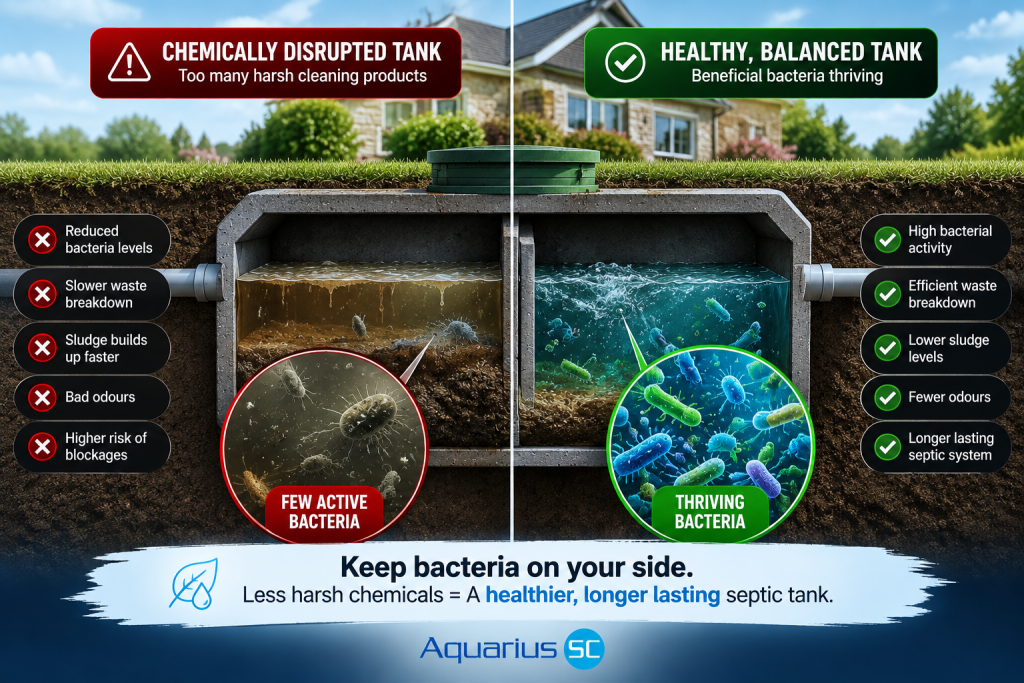
Bacterial populations can recover following some chemical exposures once the source of disruption is removed.
How quickly that happens depends on the severity of the exposure and the condition of the system.
A one-off introduction of a relatively small amount of disinfectant isn’t equivalent to repeatedly exposing the tank to concentrated antimicrobial chemicals.
If you’re concerned about the biological condition of your tank, avoid adding more aggressive cleaning products and return to normal wastewater use.
For routine septic care, you can also read our complete guide to choosing a septic tank cleaner, including the different types of treatment available and what to consider when selecting one.
You don’t need a complicated cleaning routine simply because your property uses a septic tank.
The most useful precautions are:
The objective isn’t to eliminate household cleaning products.
It’s to avoid unnecessarily exposing the septic tank to high concentrations of chemicals specifically designed to kill microorganisms.
For most households, that means concentrating on the products that genuinely matter: bleach, strong disinfectants, aggressive toilet cleaners and caustic drain-opening chemicals.