Most people searching for septic tank cleaner assume they need something that cleans a septic tank the same way bathroom cleaner cleans a toilet.
In reality, septic systems work differently.
A septic tank is designed to function as a living biological treatment system.
Its job is to:
Because of that, the strongest cleaner is not necessarily the best option.
In many situations, long-term septic performance comes from supporting biological balance rather than aggressively sanitising the system.
Understanding this section makes choosing a septic tank cleaner much easier.
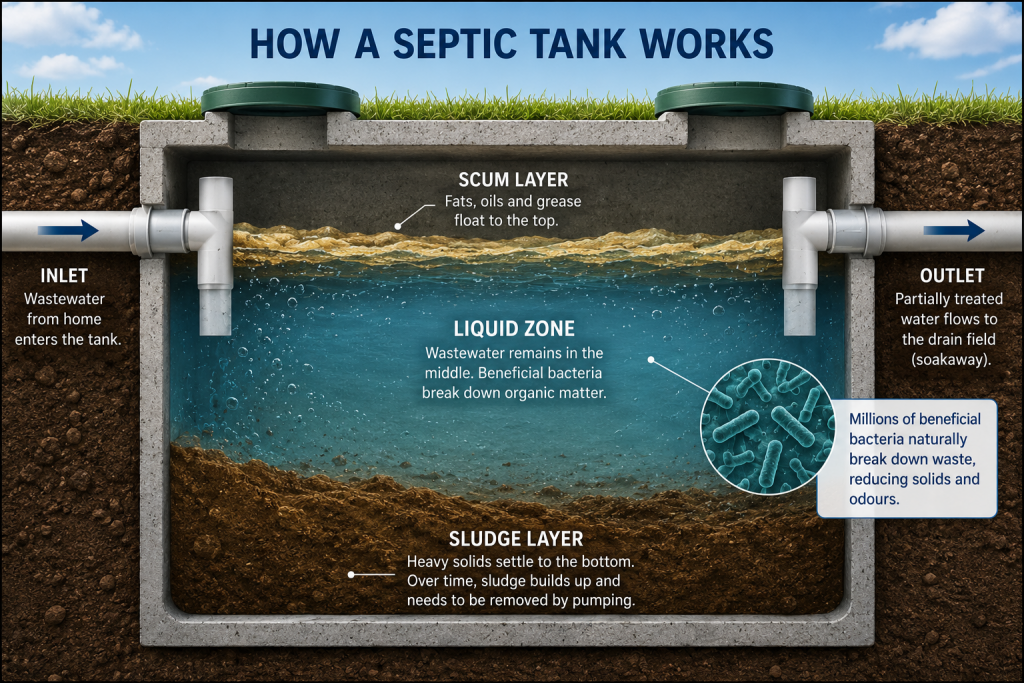
According to environmental guidance, septic tanks operate through three stages.
Incoming wastewater separates naturally.
Heavy solids settle.
Grease and oils float.
Liquid remains in the middle.
Microorganisms begin breaking down organic material.
This helps reduce:
Liquid leaves the tank and enters surrounding ground for further treatment.
Further reading:
https://www.netregs.org.uk/environmental-topics/water/septic-tanks/how-septic-tanks-work/
This is where many buying guides become misleading.
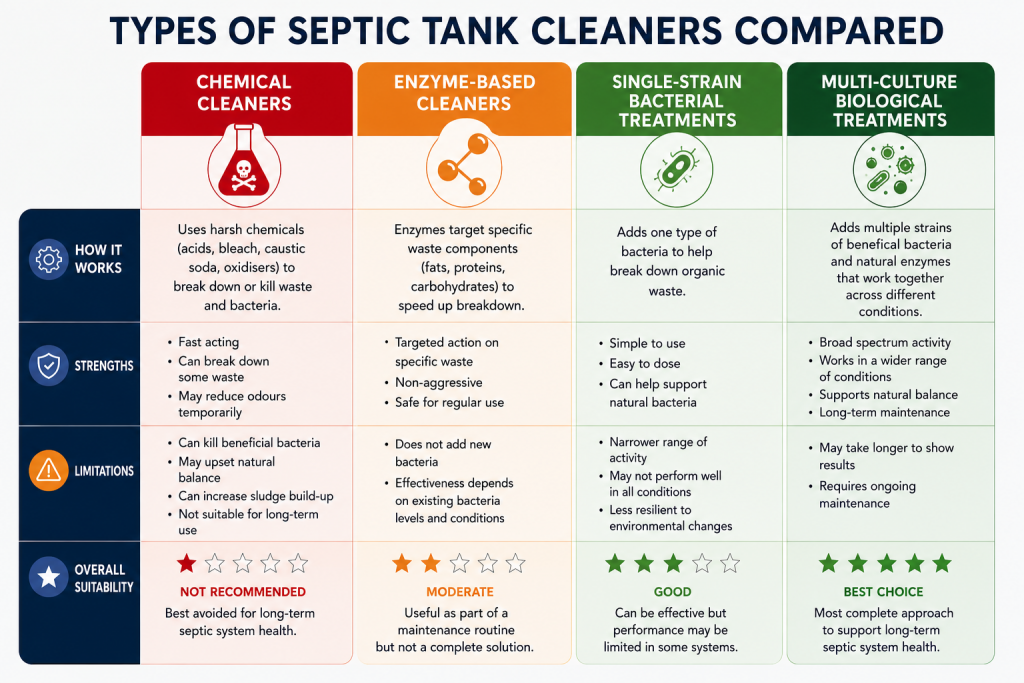
Not every septic tank cleaner works the same way.
These products often rely on:
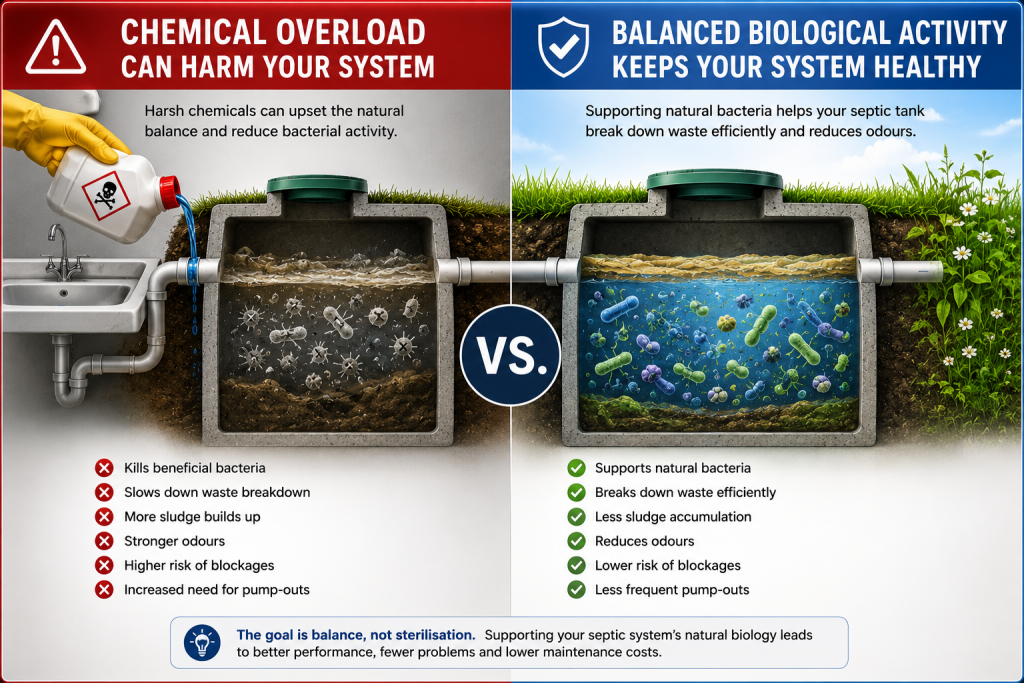
Chemical cleaners attempt to clean through aggressive reaction.
Biological systems rely on microorganisms.
Aggressive chemistry may reduce those populations.
Possible consequences:
EPA reference:
https://www.epa.gov/system/files/documents/2024-09/septictankadditivesfactsheet.pdf
These contain enzymes that support breakdown.
Examples:
They may not actively introduce additional microbial activity.
These contain one dominant microbial culture.
Different waste materials require different metabolic pathways.
These combine multiple microbial cultures and enzyme production.
The theory is simple:
Different organisms perform differently depending on:
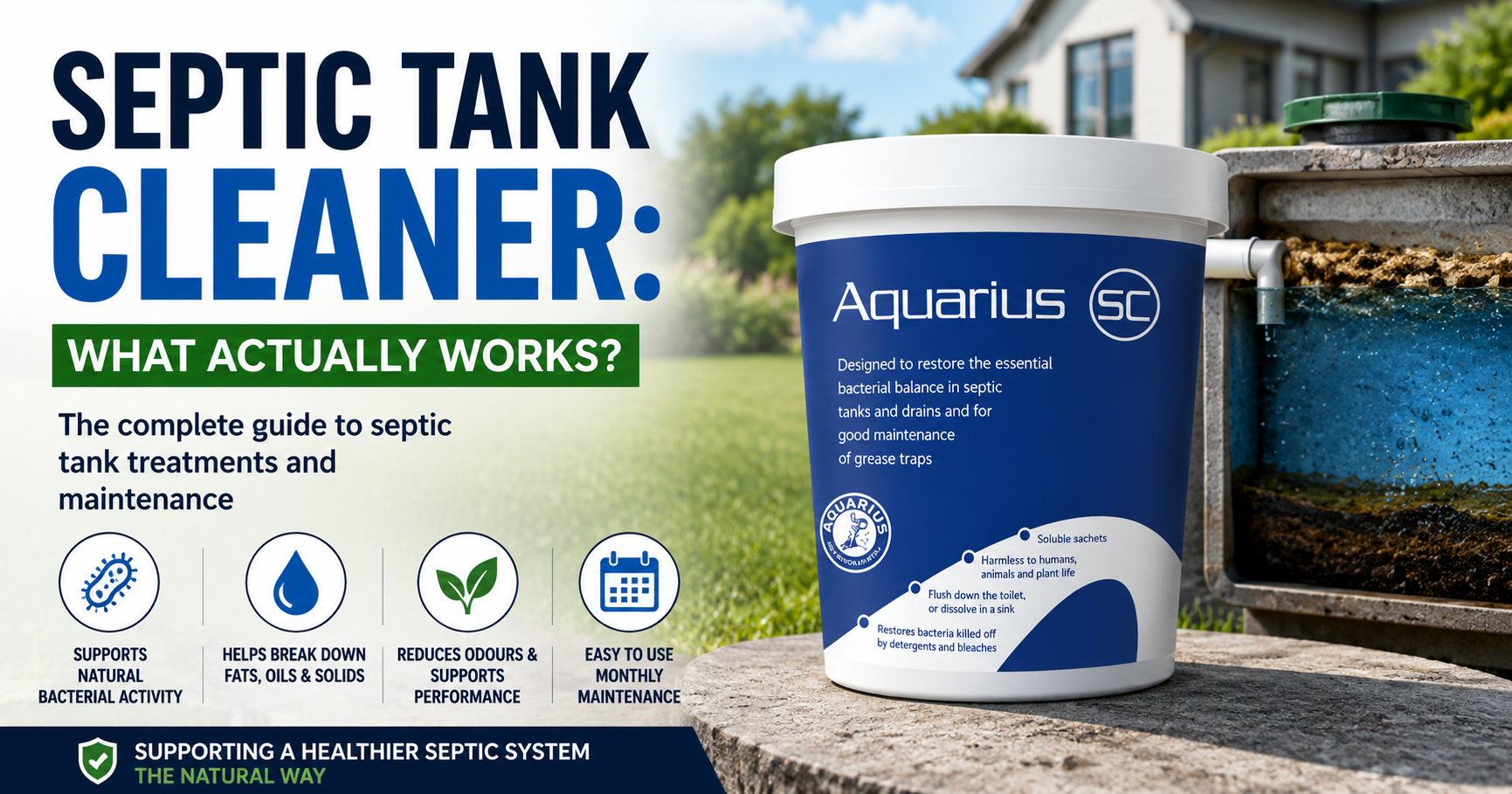
This category is where Aquarius SC is positioned.
This is one of the biggest misconceptions.
People often think:
“If it kills germs and cleans my bathroom, it must clean my septic tank.”
But septic systems are not bathrooms.
Large repeated use of:
may interfere with biological processes.
That does not mean normal household cleaning instantly destroys a septic system.
The concern is excessive loading over time.
Supporting guidance:
https://content.freshwaterhabitats.org.uk/2015/02/Septic-Tank-WEB.pdf
Possible warning signs include:
✔ stronger odours
✔ slower drainage
✔ reduced recovery after high usage
✔ more frequent servicing
The best septic tank cleaner should aim to:
✔ support natural breakdown
✔ fit into normal maintenance
✔ avoid aggressive chemistry
✔ provide realistic claims
✔ work consistently over time
Avoid products promising:
✖ never empty again
✖ instant repair
✖ permanent restoration
Healthy septic systems still require inspection and maintenance.
Government guidance:
https://www.gov.uk/permits-you-need-for-septic-tanks/you-have-a-septic-tank-or-small-sewage-treatment-plant
Aquarius SC approaches septic maintenance differently from traditional chemical cleaning.
Rather than attempting to sterilise the system, Aquarius SC is designed as a multi-culture biological maintenance treatment.
According to published product information, Aquarius SC contains:
Published enzyme activity includes:
Supports carbohydrate breakdown.
Supports protein digestion.
Contributes to decomposition of plant fibres.
Supports breakdown of fats and oils.
Helps process plant-derived compounds.
Supports decomposition of tougher organic proteins.
Aquarius SC also includes a culture capable of producing its own biosurfactant.
Biosurfactants can improve interaction between water and greasy waste, helping distribute biological activity.
According to product guidance, the objective is not simply adding bacteria.
The idea is creating broader biological capability across changing waste conditions.
Published product information:
https://aquarius4u.com/product/aquarius-sc-sachets
Aquarius SC is described as:
Typical domestic guidance:
Commercial dosing varies depending on loading.
Importantly:
Aquarius SC is still not intended to replace:
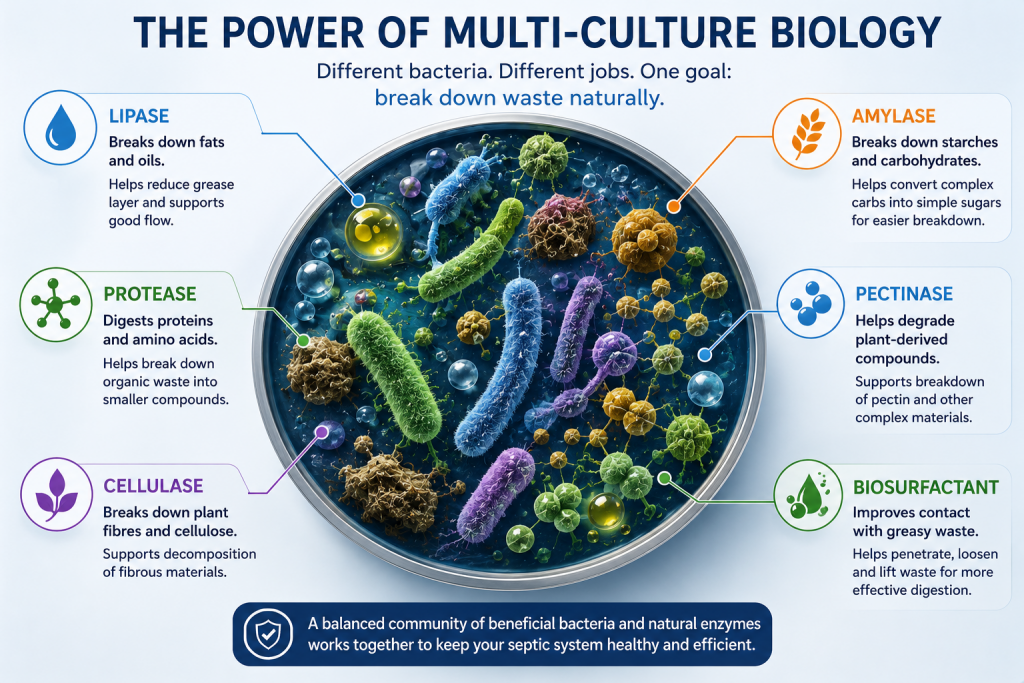
Image Brief:
Premium scientific illustration.
Different coloured bacterial groups surrounding fats, fibres and proteins.
Small labels:
No logos.
No.
Sludge accumulation remains normal and periodic servicing remains necessary.
Excessive loading may interfere with biological processes.
Most maintenance-focused products aim to support existing biological processes rather than replace them.
Follow manufacturer instructions and consider usage patterns.
The best septic tank cleaner is rarely the strongest.
Long-term septic performance usually comes from supporting the natural processes already happening inside the system.
Understanding how different treatments work — and choosing realistic maintenance strategies — generally delivers better results than relying on aggressive cleaning alone.