
If two or more properties use the same septic tank, who is legally responsible when something goes wrong? The short answer is that responsibility is generally shared between the properties using the system, even when the tank sits entirely within one neighbour’s garden. However, environmental obligations, property rights and the division of bills are not necessarily identical.
In England, the Environment Agency considers you an operator if your property uses a septic tank or sewage treatment plant shared with other properties. Operators are jointly responsible for meeting the applicable environmental requirements.
The official GOV.UK guidance on septic tank operator responsibilities explains who is responsible for private sewage systems, including shared installations and certain tenancy arrangements.
Where the discharge qualifies under England’s general binding rules, an individual environmental permit is usually unnecessary. But the system must still be correctly operated, maintained and capable of dealing with wastewater from every connected property. A septic tank must discharge through a suitable drainage field, not directly into a watercourse.
Joint environmental responsibility does not necessarily mean every household must pay exactly the same amount. The allocation of maintenance costs depends on relevant property deeds, contractual agreements and the particular circumstances.
For example, one agreement might split routine emptying equally between three households. Another might specify different proportions or distinguish between shared equipment and the private pipework serving each house. Do not assume that ownership of the land containing the tank decides who pays.
If the documents are unclear or neighbours disagree, a solicitor experienced in property law can explain the relevant rights and obligations.

Yes. A shared tank, drainage field or connecting pipe may sit outside the boundary of one or more properties it serves. This makes legal access particularly important.
Property documents may establish rights allowing owners or contractors to enter neighbouring land for inspections, emptying and repairs. Those rights should be checked rather than assumed. An informal understanding between previous neighbours may not provide the protection a new owner expects.
Look for the location of the tank, the route of the pipes, the drainage field and any access arrangements. Ask a conveyancer to investigate missing or conflicting details before buying a property served by shared drainage.
A shared system needs coordinated maintenance because neglect by one household can affect everyone connected to it. Owners should agree who contacts contractors, keeps records and organises access.
Typical responsibilities include arranging sludge removal at appropriate intervals, checking for damage or leakage, maintaining treatment equipment and addressing drainage problems promptly. For systems with electrical components, professional servicing and electricity costs may also need to be shared.
All households should know the symptoms of trouble, including persistent sewage smells, unusually slow drains and wastewater surfacing near the drainage field. Keep invoices, inspection reports and correspondence in a shared file. Good records make future repairs and property sales easier.
Start with the title deeds and any written maintenance agreement. Explain the problem, obtain an independent quotation and give the other owners a clear breakdown of the proposed work and costs.
Avoid simply refusing maintenance while a dispute continues. A blocked or leaking system may present an environmental or public health risk that needs urgent attention. The authorities may require corrective action where pollution occurs.
If discussion fails, consider mediation or legal advice before starting proceedings. The appropriate remedy depends on the contractual obligations, property rights and jurisdiction; there is no universal rule that lets one neighbour charge everyone an equal share automatically.

Yes. Environmental registration and consent systems vary across the UK, although shared operation remains an important principle.
In Wales, Natural Resources Wales states that where a permitted treatment plant serves several houses, the users are jointly responsible for proper operation. Its guidance on managing permitted sewage discharges explains how a single management system can cover a shared installation. Registration or permitting still depends on the discharge circumstances.
In Scotland, shared owners should investigate their title deeds and the required SEPA authorisation. Citizens Advice Scotland’s septic tank guidance specifically recommends checking deeds when neighbours dispute maintenance or emptying costs.
In Northern Ireland, the environmental regulator states that owners sharing a private sewage treatment system share responsibility, even when it is on someone else’s land. The Northern Ireland Environment Agency private sewage treatment guidance also outlines owners’ and occupiers’ duties concerning consent and maintenance.
Because these frameworks differ, obtain advice for the nation where the property is located rather than relying on England-only rules.
A property sale is an important opportunity to clarify obligations. Buyers should receive accurate information about the system serving the house and the arrangements for access and upkeep.
In England, operators selling a property must give the new operator written information about the sewage treatment and discharge system. Relevant details include its location, maintenance arrangements and available records.
A buyer should ask whether the installation is registered or authorised where necessary, whether costs are outstanding and whether the connected neighbours have a documented agreement. The sale of one house does not make the shared wastewater system a private responsibility of the remaining owners alone.
For the broader legal framework, see our Understanding UK Septic Tank Regulations: Navigating the Changes guide.
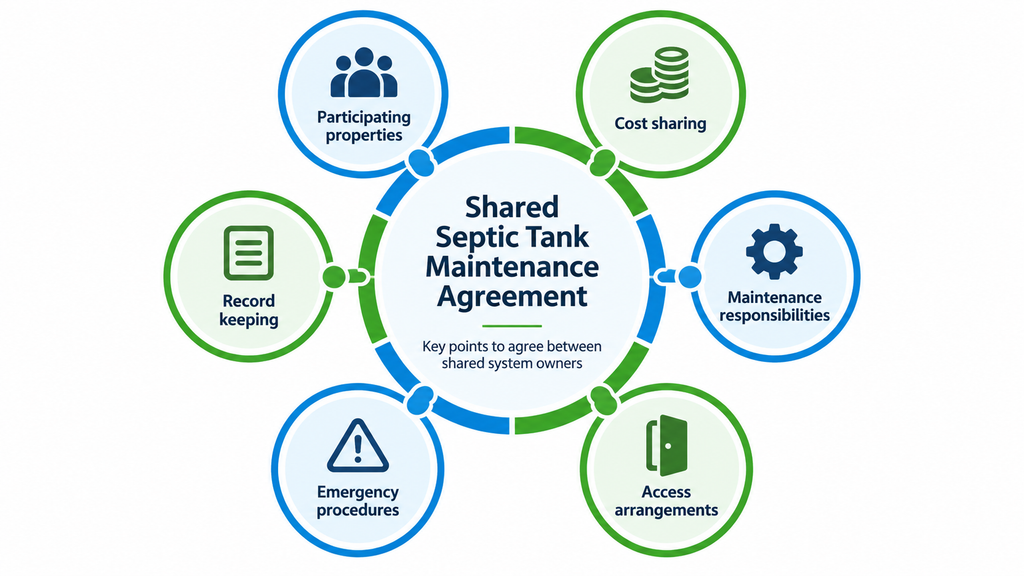
A clear written agreement is strongly advisable, especially where several unrelated households share one installation. It should be drafted or reviewed with appropriate legal advice where property rights are involved.
Useful provisions include:
An agreement is not a substitute for environmental compliance. It also cannot create land access rights automatically if the necessary legal arrangements are absent.
Not necessarily. In England, connected property owners can be jointly responsible as operators. Ownership of the surrounding land and responsibility for dividing costs should be checked separately.
Possibly, but an independent system may need permissions, suitable land and professional installation. Do not disconnect or redirect wastewater without checking regulatory and property requirements.
Environmental regulators may investigate the operators responsible for the discharge. The facts, applicable law and any individual permit conditions will determine enforcement decisions.
Shared septic tanks work best when all connected households understand their responsibilities before problems occur. Confirm who operates the system, who owns the land, what access rights exist and how costs must be shared. Keep records, maintain the installation and resolve uncertainty with professional advice. Clear arrangements protect neighbours, property transactions and the surrounding environment.