
Understanding UK septic tank regulations is vital for property owners. The 2020 changes remain the current legislation in 2026, continuing to promote compliance, sustainability and environmental protection.
Septic tanks are an essential component of many properties across the UK, especially in rural areas where connection to the main sewer system isn’t feasible.
However, managing a septic tank isn’t just about maintenance, it’s also about compliance with legislation.
In recent years, the UK septic tank regulations have seen significant changes in the legislation governing the use of septic tanks, aimed at improving environmental protection.
Since these reforms were introduced, the legislation itself has remained largely unchanged, although official guidance continues to be updated by the relevant environmental regulators. This guide reflects the current position and explains how the regulations apply today, helping homeowners, landlords and businesses understand their legal responsibilities without having to interpret the legislation themselves. The official guidance for England is published by the UK Government – General Binding Rules for small sewage discharges, with the statutory rules themselves contained within the General Binding Rules for Small Sewage Discharges publication.
Let’s dive into the details and unravel these regulations in a way that’s easy to grasp.
For most domestic properties, the legislation is based around the General Binding Rules for Small Sewage Discharges. These rules establish when a septic tank or small sewage treatment system can operate without an individual environmental permit, provided it meets the required legal conditions. If your system complies with the General Binding Rules, you will not normally require an environmental permit, although systems that fall outside these conditions may require one. The Government also provides dedicated guidance explaining when permits are required and when the General Binding Rules apply.
Understanding these regulations is particularly important if you’re purchasing a property with a septic tank, replacing an older system or making changes to an existing installation. Although most homeowners won’t need to apply for permits or interact directly with environmental regulators, knowing which rules apply to your property can help avoid unexpected costs and ensure your wastewater system continues operating within the current legal framework.
This guide has been reviewed and updated to reflect the current UK septic tank regulations and supporting guidance. The following editorial changes have been made since the previous version.
Legislative status updated: References to the 2020 reforms have been updated to clarify that they remain the current legislation in 2026, rather than implying they were newly introduced. This reflects the current legal position.
Source: https://www.gov.uk/guidance/general-binding-rules-small-sewage-discharge-to-the-ground
General Binding Rules guidance expanded: Additional information has been included to explain when the General Binding Rules apply, when an environmental permit may be required, and where official guidance can be found.
Source: https://www.gov.uk/guidance/general-binding-rules-small-sewage-discharge-to-the-ground
Inspection requirements corrected: The previous wording stated that regular inspections and certification were mandatory for all septic tanks. This has been corrected to reflect the current legislation, which places responsibility on operators to maintain compliant systems but does not impose a universal requirement for routine certified inspections of every domestic septic tank.
Source: https://www.gov.uk/guidance/general-binding-rules-small-sewage-discharge-to-the-ground
Scottish legislation expanded: Additional information has been added to explain the role of the Controlled Activities Regulations (CAR) and the Scottish Environment Protection Agency (SEPA), reflecting Scotland’s separate regulatory framework.
Source: https://www.sepa.org.uk/regulations/water/
The principal legislation governing the use of septic tanks in England, Wales and Northern Ireland is the General Binding Rules for Small Sewage Discharges in England and Wales, together with the equivalent legislation in Northern Ireland.
The UK septic tank regulations were significantly updated in 2020 to replace older, less stringent regulations.
Capacity Limits: Septic tanks must cater to the size of the household and should not exceed the sewage discharge limit of 2,000 litres of treated sewage per day.
Maintenance Requirements: Owners are responsible for the maintenance of their septic tanks, ensuring they are in good working condition and do not cause pollution.
Ban on Direct Discharges: Septic tanks can no longer discharge directly to surface water such as rivers and streams. Discharges must be made to a drainage field.
Ongoing Responsibility: Property owners are responsible for ensuring their septic tank continues to operate correctly and complies with the applicable legislation. While the General Binding Rules do not require routine certified inspections for every domestic septic tank, systems should be inspected, serviced and repaired whenever necessary to prevent pollution and maintain compliance.
Conversion or Replacement: If a septic tank cannot meet the new standards, it must be replaced or upgraded.
Registration and Approval: Some discharges may require registration and approval from the Environment Agency.
The changes made to the UK septic tank regulations primarily target the reduction of pollution, particularly to local watercourses.
In practice, most domestic septic tank owners do not need to apply for an environmental permit, provided their system complies with the General Binding Rules. However, where a discharge falls outside those rules, an environmental permit may be required before the system can continue operating lawfully. The Environment Agency provides guidance on determining whether a permit is required, while Natural Resources Wales and the Northern Ireland Environment Agency publish equivalent guidance for their respective countries.
The shift from direct discharge to a drainage field is a major move towards environmental protection, as it ensures that the effluent is adequately treated before being released into the ground.
Scotland follows its own set of rules under the Scottish Environment Protection Agency (SEPA). The regulations in Scotland are outlined in the Controlled Activities Regulations (CAR). Here’s what you need to know:
Registration Requirement: All private sewage systems, including septic tanks, must be registered with SEPA.
Maintenance and Upkeep: Owners must ensure that their septic tanks are well-maintained and regularly emptied.
Pollution Control: It’s illegal to cause pollution, and systems must be designed and operated in ways that prevent contamination of the environment.
Capacity and Construction Standards: Septic tanks must meet specific capacity requirements and construction standards to ensure they function effectively and safely.
Consent for Larger Systems: Systems serving 15 or more people must obtain a Consent to Discharge from SEPA.
Unlike England and Wales, Scotland regulates private sewage systems through the Controlled Activities Regulations (CAR) rather than the General Binding Rules. This means homeowners should always refer to SEPA guidance when installing, replacing or making significant changes to a septic tank or private sewage treatment system, as the authorisation process and regulatory requirements differ from those elsewhere in the UK.
Further information is available from the Scottish Environment Protection Agency:
• Scotland – SEPA: Private sewage systems and water regulations
The evolution of the UK septic tank regulations represents a significant step towards better environmental stewardship. Here are the major changes you need to be aware of:
Stricter Pollution Controls: The updated regulations introduced stricter controls on how wastewater can be discharged. Direct discharges from septic tanks into surface water are no longer permitted in most circumstances, helping to reduce the risk of pollution to rivers, streams and other watercourses.
Routine Inspections: Regular inspections and maintenance are an important part of responsible septic tank ownership, helping identify potential issues before they lead to pollution or non-compliance.
Increased Responsibility for Owners: The onus is now more on the owner to ensure compliance with environmental standards.
One of the biggest misconceptions surrounding the 2020 reforms is that every septic tank installed before the legislation changed automatically became illegal. This isn’t the case. Many existing septic tanks remain compliant and can continue operating without replacement, provided they satisfy the applicable legal requirements. The legislation primarily affected how wastewater is discharged and the standards systems must meet, rather than requiring every older septic tank to be replaced. The Environment Agency explains when an existing system can continue operating under the General Binding Rules and when improvements may be necessary.
Environmental Protection: To reduce pollution in rivers, streams and groundwater.
Public Health: To mitigate the risks of contaminated water supplies.
Sustainability: To encourage more sustainable sewage treatment practices.
These reforms also provide greater clarity for homeowners, drainage professionals and prospective property buyers. Before the introduction of the General Binding Rules, there was often uncertainty surrounding private sewage systems and the standards they were expected to meet. The current framework provides clearer guidance, making it easier to determine whether an existing installation is likely to comply or whether further investigation may be required.
For homeowners and business owners in the UK, navigating the UK septic tank regulations can be daunting. Here are some practical steps to ensure compliance:
Understand Your System: Know the type, capacity and discharge point of your septic tank.
Regular Maintenance: Schedule regular check-ups and clean-ups.
Seek Professional Advice: Consult with experts to ensure your system meets current standards.
Stay Informed: Regulations can change, so keep abreast of the latest information.
If you’re purchasing a property with a septic tank, it’s advisable to establish what type of system is installed, where it discharges and whether any documentation relating to servicing, repairs or previous improvements is available. Having this information before completing a purchase can help identify potential issues early and provide reassurance that the private drainage system has been responsibly managed.
Similarly, if you’re planning an extension, converting a building or significantly increasing the number of people using the property, it’s worth seeking professional advice before carrying out any work. Changes in occupancy or wastewater volume may affect whether an existing system remains suitable for the property it serves.
Further guidance on buying or selling a property with a private sewage system is available from:
Understanding the legislation is only one part of responsible septic tank ownership. Once you know which regulations apply to your property, the next step is ensuring your system continues to operate efficiently throughout its lifespan.
Many compliance issues arise not because homeowners deliberately ignore the regulations, but because problems develop gradually and go unnoticed until they become more serious. Regular attention to your septic tank can help identify potential issues before they affect the performance of the system or require costly remedial work.
A well-maintained septic tank should operate quietly in the background without drawing attention to itself. Changes in performance are often the first indication that further investigation may be required.
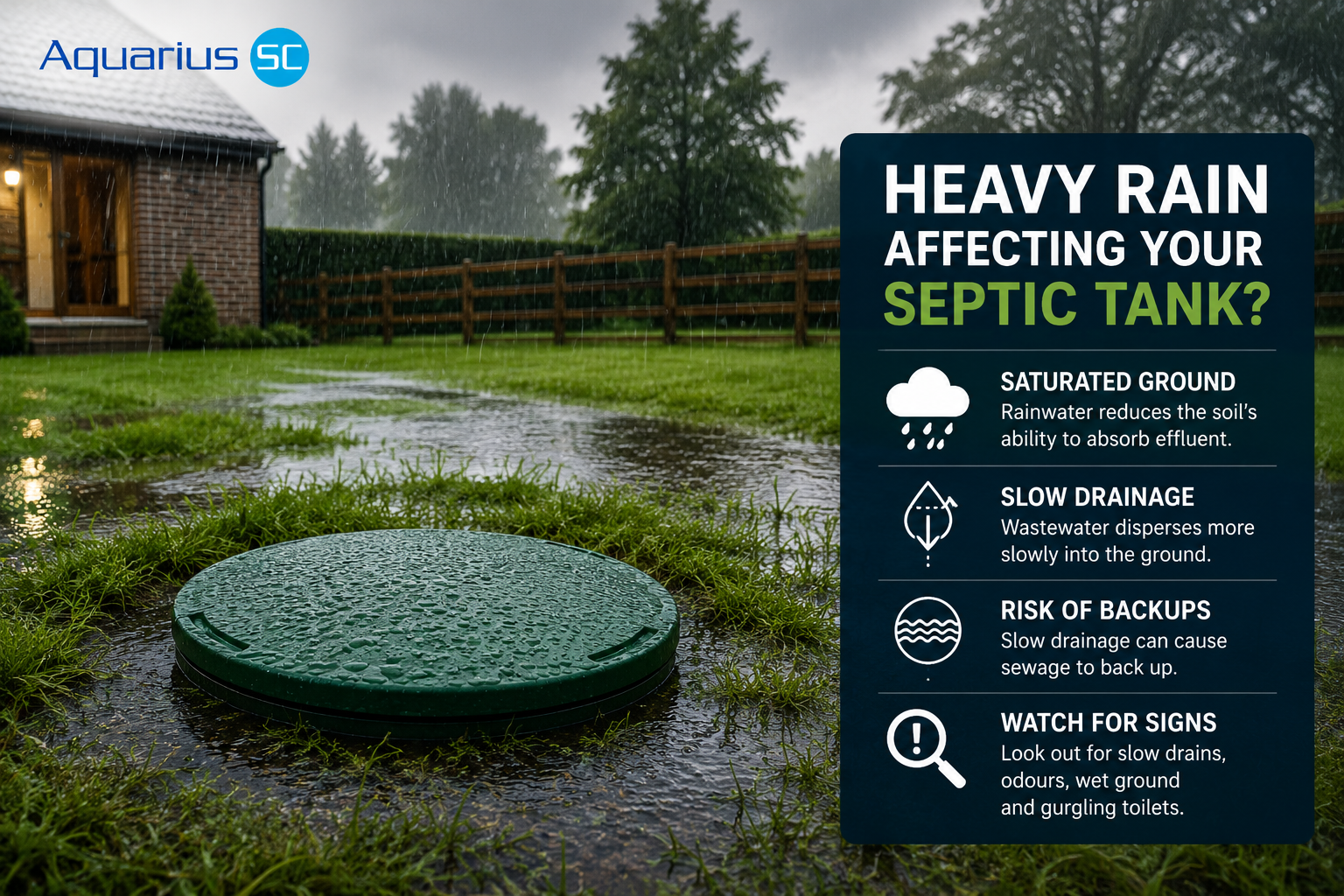
Common warning signs include:
While these issues don’t necessarily mean your system is non-compliant, they should never be ignored, as they may indicate that maintenance or repairs are required.
Good day-to-day habits can significantly reduce unnecessary strain on a septic tank and help maintain its long-term performance.
Simple measures include:
These measures won’t replace routine servicing, but they can help reduce avoidable problems and support the efficient operation of the system.
Although routine maintenance can often be managed by the property owner, there are situations where professional advice is recommended.
These include:
A qualified drainage contractor can assess the condition of the system, identify any underlying issues and recommend appropriate remedial work where necessary.
The British Water Code of Practice – Flows and Loads also provides useful industry guidance on the design and sizing of private sewage systems:
Environmental legislation and official guidance can change over time. Even where the core regulations remain unchanged, government agencies may publish revised guidance to clarify existing requirements or reflect changes in best practice.
For this reason, it’s good practice to check the latest guidance from your relevant environmental regulator before making significant alterations to your septic tank or private drainage system.
Doing so helps ensure any future work is carried out in accordance with the most up-to-date guidance available.
Yes. The legislation introduced in 2020 remains the current legal framework in 2026. However, this does not mean every septic tank installed before 2020 must be replaced. Many existing systems continue to comply with the regulations provided they meet the relevant legal requirements and do not require an environmental permit.
Yes. Having a septic tank does not prevent the sale of a property. Buyers should be informed that the property is served by a private drainage system, and any available information relating to its operation, servicing or improvements should be provided during the conveyancing process. This helps ensure the buyer understands the system they are taking responsibility for.
Yes. The regulations apply to both domestic and commercial properties that use private sewage systems. However, larger commercial systems, higher discharge volumes or systems serving multiple properties may be subject to additional requirements or require an environmental permit.
The overall objective is the same, but the legislation differs depending on where the property is located.
England is regulated by the Environment Agency, Wales by Natural Resources Wales, Scotland by the Scottish Environment Protection Agency (SEPA) and Northern Ireland by the Northern Ireland Environment Agency (NIEA). Each regulator publishes its own guidance explaining how private sewage systems should be managed.
The most up-to-date information is available directly from the relevant environmental regulator.
These resources are updated whenever guidance changes and should always be used as the primary reference for regulatory information.
Navigating the UK septic tank regulations may seem challenging, but understanding your responsibilities is essential for protecting both your property and the wider environment.
By understanding how the regulations apply, keeping your septic tank properly maintained and seeking professional advice when required, property owners can reduce the risk of unnecessary problems while ensuring their private sewage system continues to operate effectively.
Whether you’re in England, Wales, Scotland or Northern Ireland, staying informed about the latest guidance will help you make confident decisions about your septic tank and remain compliant with the current legislation.
Remember, when in doubt, refer to the relevant environmental regulator or speak to a qualified drainage professional. Taking a proactive approach today can help avoid more significant issues in the future.
Whether you’re in England, Wales, Northern Ireland or Scotland, staying informed about the UK septic tank regulations is key to responsible septic tank ownership.
The current legislation provides a clear framework for managing private sewage systems while helping to protect public health and the natural environment. Understanding the rules, knowing where to obtain official guidance and taking appropriate action when changes are required will help ensure your septic tank continues to serve your property safely and effectively for years to come.