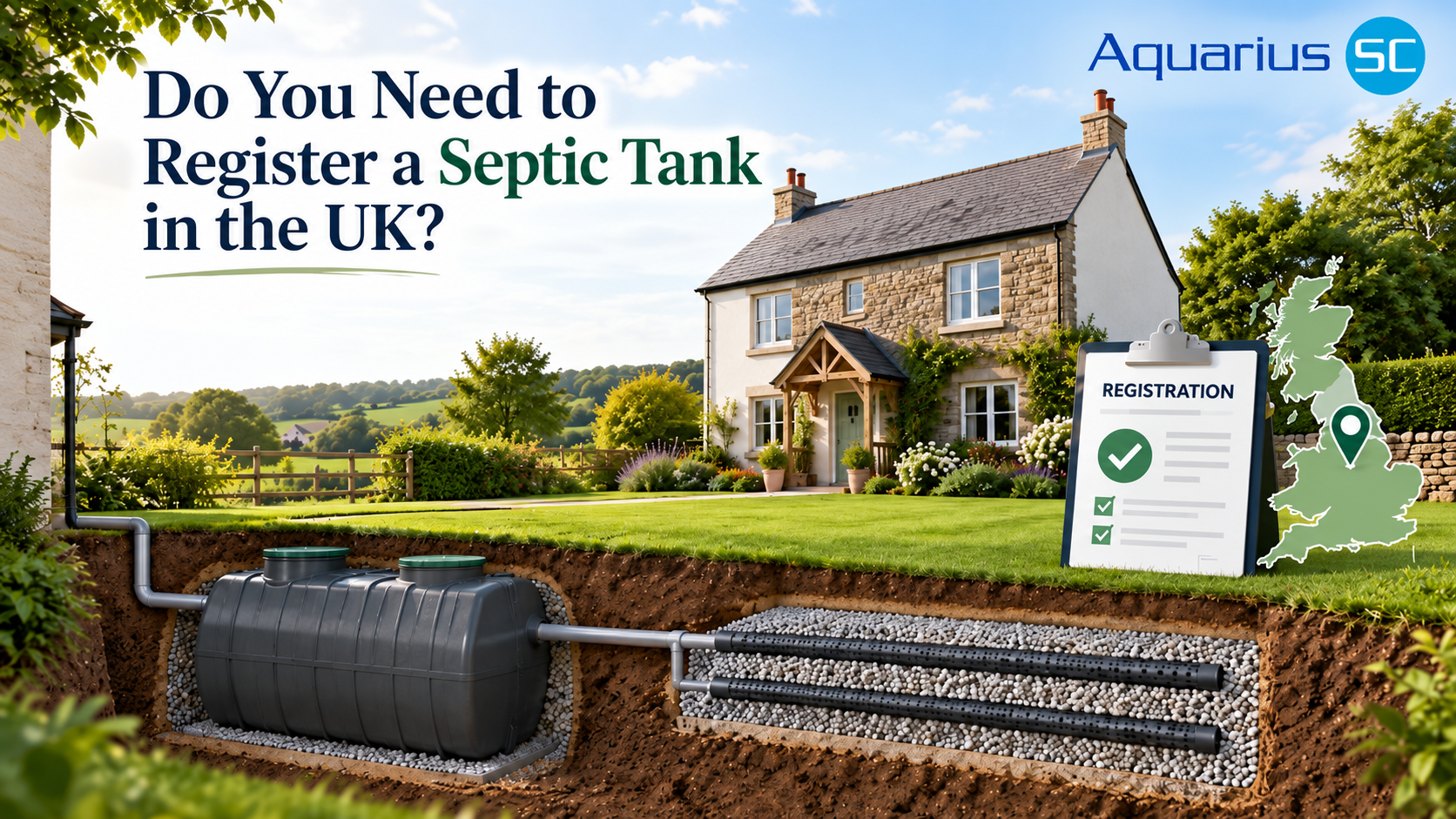
If your property relies on a septic tank rather than mains drainage, you may be wondering whether you need to register it with an environmental regulator. The answer depends on where you live. England, Wales, Scotland and Northern Ireland operate different systems, and registration is not the same as obtaining an environmental permit or discharge consent.
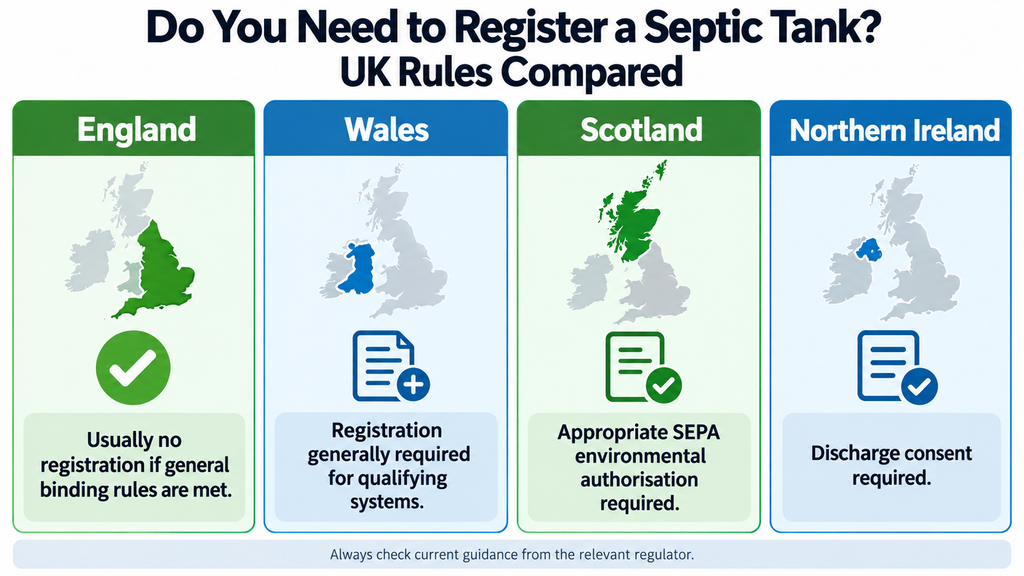
No. There is no single UK-wide septic tank register that applies in the same way to every property. England generally allows qualifying small sewage discharges without individual registration or an environmental permit. Wales normally requires registration, Scotland requires the appropriate environmental authorisation, and Northern Ireland requires consent for sewage discharges.
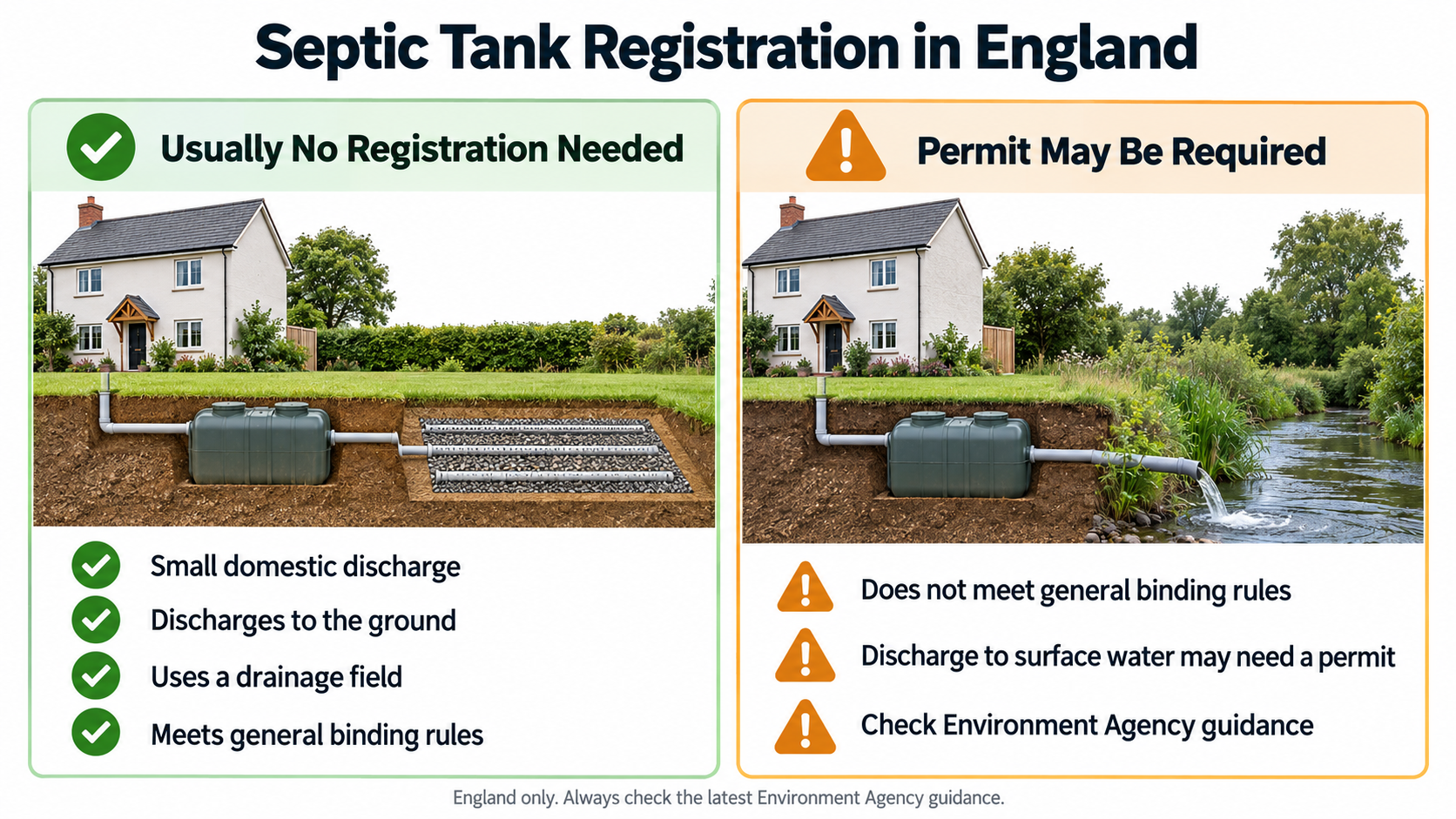
In England, you do not usually need to register a domestic septic tank or apply for an environmental permit if its discharge complies with the Environment Agency’s general binding rules.
These rules cover small domestic sewage discharges and specify how systems must be installed, operated and maintained. For discharges to the ground, they generally apply where no more than 2,000 litres of domestic sewage is discharged daily and all applicable conditions are met.
The discharge must go through a suitable drainage field rather than directly into a river or stream.
You can check the official requirements in the Environment Agency’s general binding rules for discharges to the ground.
If your system cannot meet the applicable rules, you may need an environmental permit or changes to the installation. Do not assume that an old tank is exempt simply because it has operated for decades.
In Wales, Natural Resources Wales normally requires owners to register septic tanks and small sewage treatment plants. Many qualifying domestic systems can be registered once, free of charge.
Eligibility depends on several factors, including the discharge destination, volume, system design and location. Natural Resources Wales generally sets a threshold of less than 2,000 litres per day for qualifying discharges to a drainage field and less than 5,000 litres per day for qualifying treatment plant discharges to a watercourse.
Not every system qualifies for free registration. Installations near protected sites, drinking-water sources or public sewers may face additional restrictions or require an environmental permit.
To check eligibility and the application process, see Natural Resources Wales’ septic tank registration guidance.
Remember that a standard septic tank and a package treatment plant are different. A septic tank cannot simply discharge its effluent directly into a stream because the property has been registered.
Scotland has its own environmental authorisation arrangements, administered by the Scottish Environment Protection Agency, known as SEPA. Private sewage treatment discharges require the appropriate authorisation, which may take the form of registration or another authorisation depending on the circumstances.
If you are purchasing a property, check whether its existing system is already authorised before submitting a new application. SEPA provides a service to check the registration status of private sewage treatment systems.
Use the SEPA septic tank registration check to investigate an existing system. If no authorisation can be found, contact SEPA to establish what action is required.
Northern Ireland does not follow England’s general binding rules system. Sewage discharges from private treatment systems require consent from the Northern Ireland Environment Agency, part of the Department of Agriculture, Environment and Rural Affairs.
The requirement covers discharges to waterways and underground water, including existing systems. Property owners should check whether consent has already been granted and whether the relevant details remain accurate.
You can find application information through DAERA’s domestic discharge consent guidance. Existing consents can also be checked through the department’s public register.
Consent is a legal requirement, not simply a voluntary registration scheme. If documentation is missing, clarify the position with the regulator rather than assuming the system is covered.
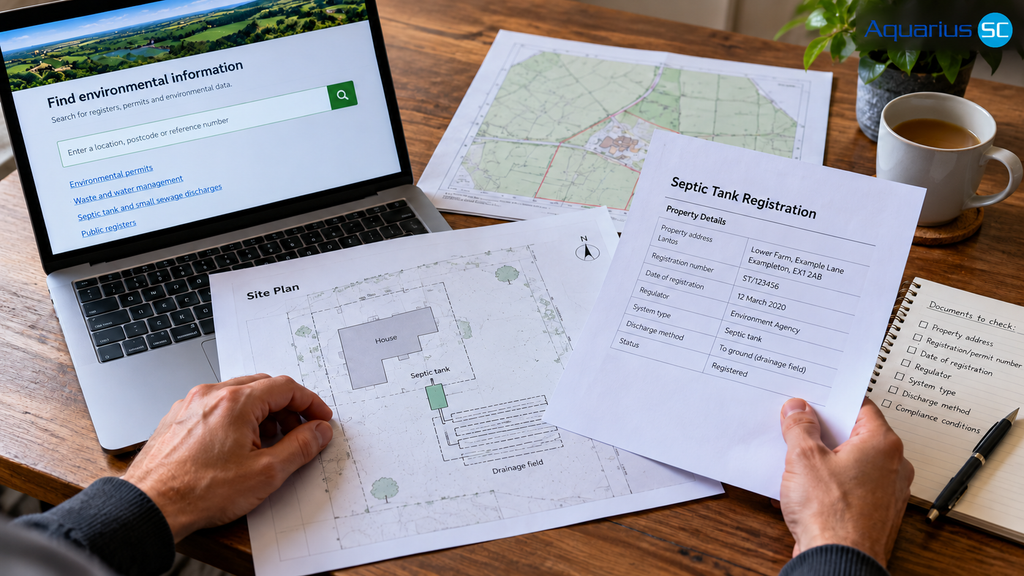
Start by establishing which environmental regulator covers your property. Then gather any paperwork relating to the private drainage system. Useful documents include original installation records, discharge authorisations, previous owner information, servicing records and plans showing the drainage field.
If you have recently purchased the property, ask your conveyancer or seller whether details of the system were supplied during the sale. If you are unsure where the wastewater discharges, a suitably qualified drainage professional can help identify the arrangement.
Before contacting the regulator, try to establish:
Not necessarily. Registration or consent does not guarantee that a system is functioning correctly today. A septic tank can develop blockages, structural defects or drainage field problems after the original paperwork was issued.
Likewise, a system in England may be lawfully operated without registration while still being subject to the general binding rules. Compliance is about meeting the applicable legal requirements, not simply holding a certificate.
Our Understanding UK Septic Tank Regulations: Navigating the Changes guide explains the wider rules governing private sewage systems and how they affect property owners.
First, check whether one is actually required in your country and for your type of discharge. If paperwork is missing, it may be possible that the system already has an authorisation under an earlier owner.
Contact the appropriate environmental regulator for advice on verifying existing records, submitting an application or correcting an unauthorised discharge. You may also need specialist advice if the system fails current standards or creates a pollution risk.
Avoid making alterations without establishing the relevant requirements. Replacing a tank, redirecting its outlet or increasing the number of properties served can change the permissions needed.
Age alone does not determine the answer. The rules in your country, the discharge location and the system’s compliance status matter more than the installation date. Existing authorisations should be checked before applying again.
Qualifying registrations in Wales are generally free. Elsewhere, the process may involve a different type of authorisation and associated charges. Check the relevant regulator’s current guidance before applying.
No. Environmental authorisation concerns the discharge and its effect on the environment. Planning permission and building regulations approval are separate considerations that may also apply to installations or alterations.
Whether you need to register a septic tank in the UK depends primarily on your location and the nature of the discharge. England generally relies on general binding rules, Wales operates a registration scheme, Scotland requires appropriate environmental authorisation, and Northern Ireland requires discharge consent.
The safest approach is to identify your system, check any existing paperwork and follow your regulator’s current guidance before taking any further action. That helps protect local waterways and reduces the risk of problems when maintaining, changing or selling your property.