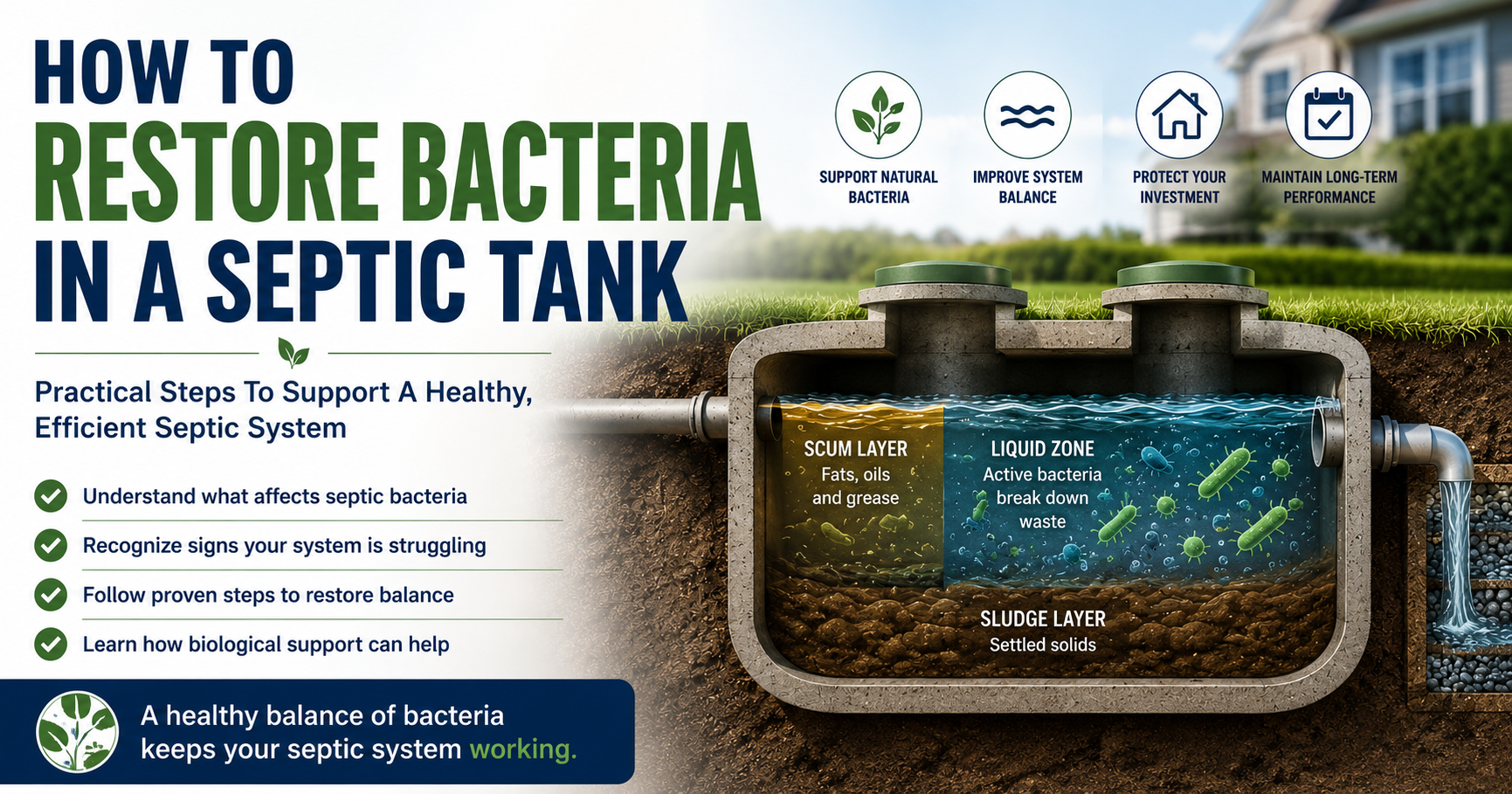
If you are trying to restore bacteria in a septic tank, the goal is usually not adding the highest possible dose of bacteria.
In many situations, septic systems already contain bacteria.
The bigger question is:
What reduced biological activity in the first place?
Restoring performance often means:
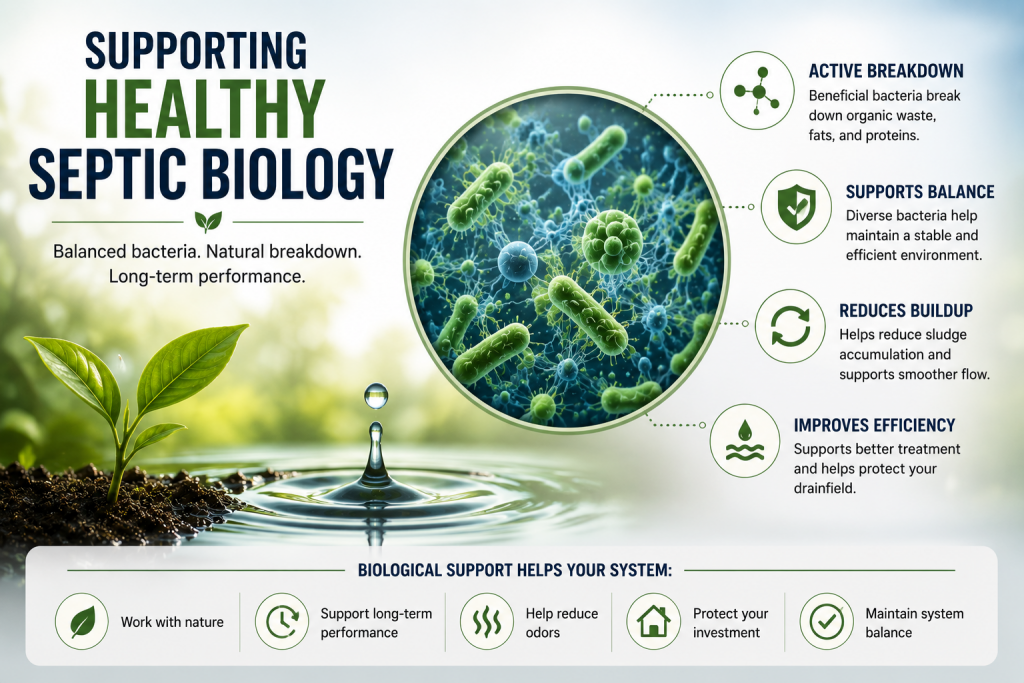
A septic tank behaves more like a small biological ecosystem than a storage container.
Understanding that difference usually leads to better long-term results.
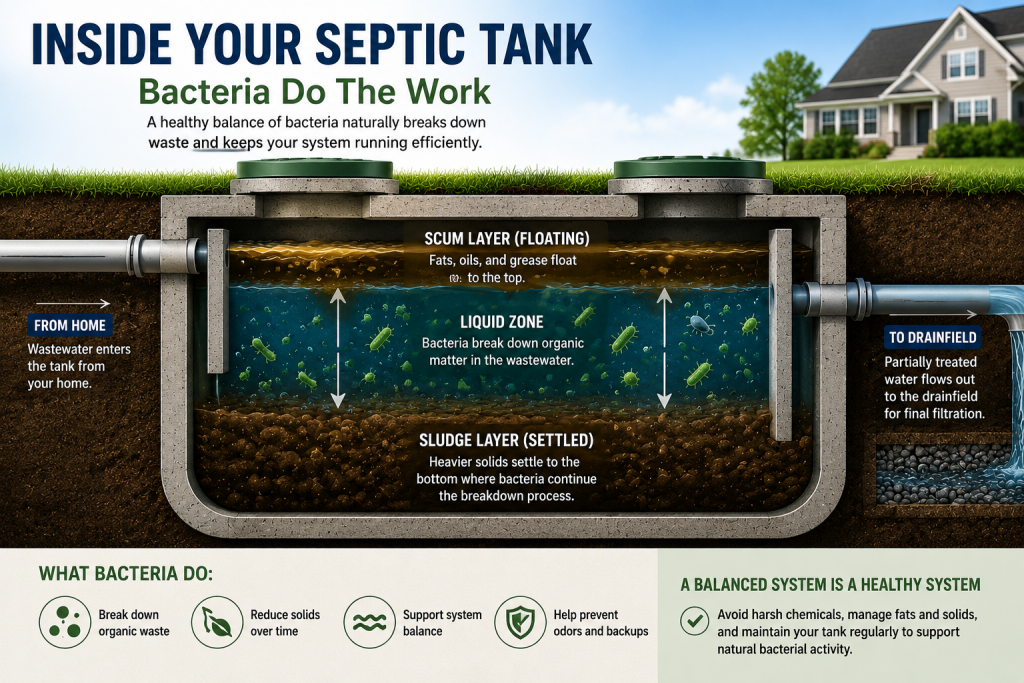
Many homeowners imagine a septic tank simply stores waste.
That is only part of the process.
A functioning septic system relies on ongoing biological activity.
Inside the tank:
These microorganisms help process organic matter and contribute to reducing accumulation over time.
Without biological activity:
This is why maintenance approaches that work in standard drainage systems are not always ideal for septic systems.
Supporting reference:
https://www.netregs.org.uk/environmental-topics/water/septic-tanks/how-septic-tanks-work/
This question rarely gets explained properly.
Septic tanks are not powered by one type of bacteria.
They contain a changing environment influenced by:
Microorganisms present in treatment systems may contribute differently depending on conditions.
Some support:
Organic fats and oils.
Food waste and biological material.
Organic plant material.
Supporting broader biological reactions.
The important takeaway:
Healthy septic systems are normally diverse environments rather than single-strain systems.
People often jump straight to additives.
Usually it makes more sense to identify the cause first.
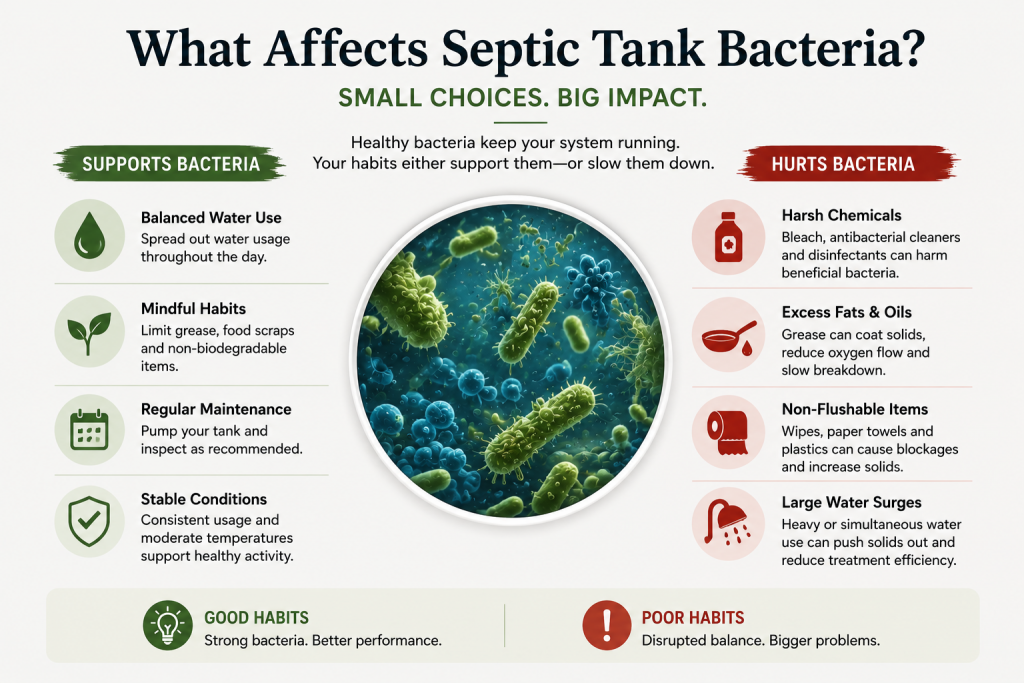
Repeated exposure to:
may affect biological conditions.
This does not mean occasional cleaning immediately destroys a system.
The concern is repeated cumulative loading.
Supporting reference:
https://content.freshwaterhabitats.org.uk/2015/02/Septic-Tank-WEB.pdf
Grease changes how waste behaves.
Excess loading may affect efficiency.
Holiday homes.
Seasonal properties.
Vacant homes.
Low inflow changes biological conditions.
Very heavy water discharge may affect stability.
Examples:
Many products promise:
✖ instant repair
✖ permanent restoration
✖ no servicing required
Healthy systems still require inspection.
Symptoms rarely appear immediately.
Potential indicators include:
✔ stronger odours
✔ reduced recovery after heavy use
✔ slower drainage
✔ increased sludge
✔ more frequent maintenance needs
None of these automatically prove bacteria are depleted.
Inspection remains important.
In many situations:
Yes.
If conditions improve.
Biological recovery may happen through:
This is one reason why instantly adding more and more products is not always the first step.
Think of it less like replacing engine oil and more like improving the conditions for a living system.
This is where most homeowners actually see benefit.
Moderation usually matters more than elimination.
Reduce:
Treatment products do not replace servicing.
Government guidance:
https://www.gov.uk/permits-you-need-for-septic-tanks/you-have-a-septic-tank-or-small-sewage-treatment-plant
Some homeowners choose biological maintenance products intended to support ongoing biological conditions.
When bacterial activity has been disrupted, the first priority is improving the conditions inside the system.
That means reducing avoidable chemical pressure, managing fats and solids, spreading out heavy water use and keeping up with normal maintenance.
Biological maintenance products can form part of that routine, but they should not be treated as a shortcut around servicing or inspection.
The important distinction is that a biological treatment approach is designed to support the living processes inside a septic tank, whereas chemical cleaning focuses more on immediate surface-level action.
This is why choosing the right septic tank cleaner matters: the product should work with the system’s biology, not against it.
Aquarius SC is one example of a biological maintenance treatment used for septic systems, drains and grease traps. It is positioned around supporting bacterial balance rather than sterilising the tank.
Normal servicing, desludging and drainage checks still remain part of responsible septic tank ownership.
Recovery depends on system conditions and maintenance practices.
Biological maintenance is not a substitute for repair or servicing.
Not necessarily.
Conditions still matter.
Repeated heavy chemical loading may affect biological conditions.
Restoring bacteria in a septic tank is usually less about adding something new and more about removing the factors limiting biological activity.
Healthy systems rely on balance.
Maintenance habits still matter.
Understanding how biological treatment works — and how different approaches compare — often produces better long-term results than relying on aggressive cleaning or unrealistic promises.