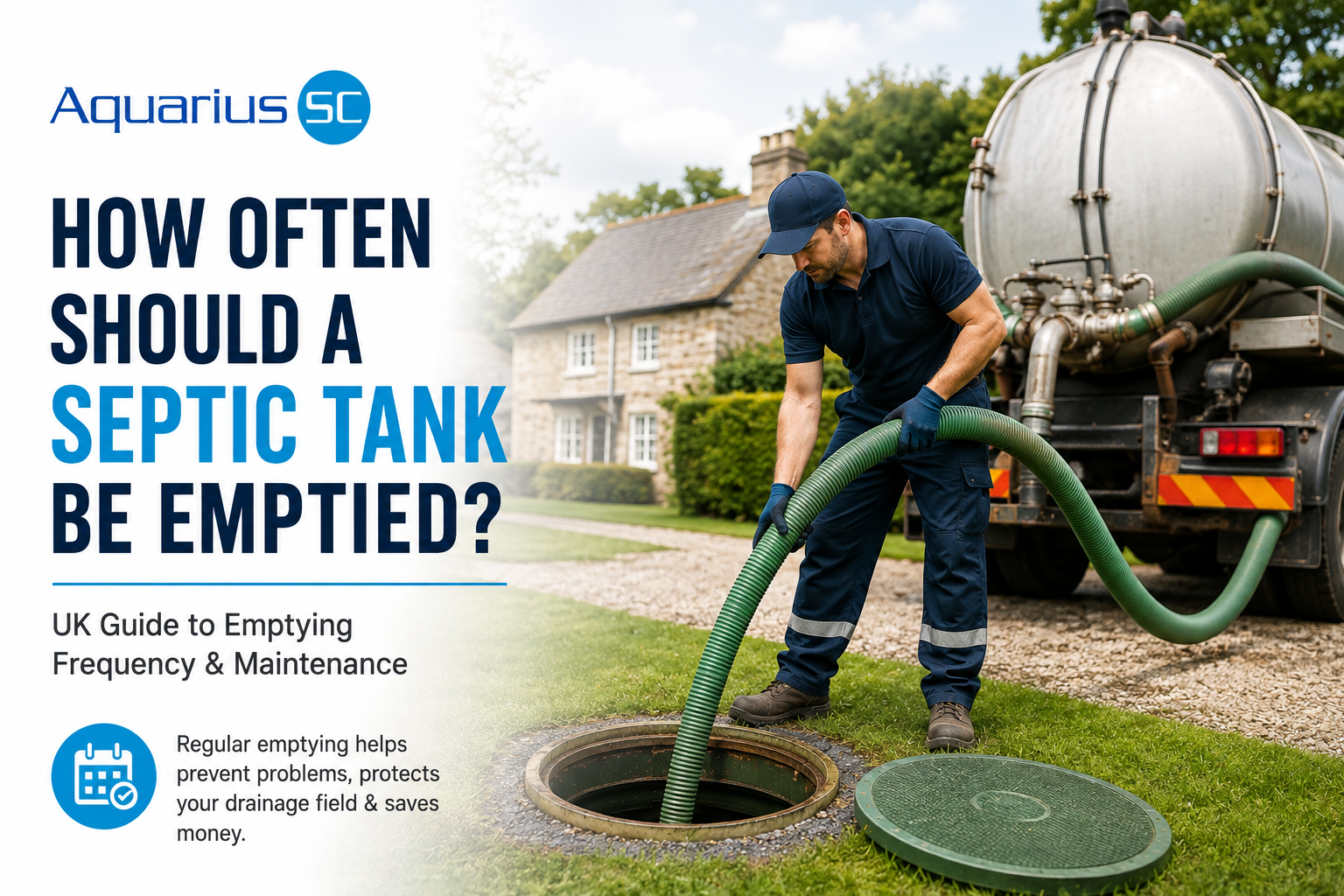
A septic tank should generally be emptied at least once a year, although the exact frequency depends on the tank, the number of people using it, how quickly sludge accumulates and the manufacturer’s instructions.
For septic tanks in England, the Environment Agency says accumulated sludge must be removed before it exceeds the tank’s maximum capacity and recommends desludging at least once a year or in accordance with the manufacturer’s instructions.
The important point is that septic tanks aren’t emptied simply because they’re “full” of wastewater. They’re emptied to remove the sludge and solids that gradually accumulate at the bottom of the tank.
For a typical domestic system, annual emptying is a sensible baseline, but you should always consider the requirements of your particular tank.
Current Environment Agency guidance on small sewage discharges says sludge must be removed before it exceeds the system’s maximum capacity. For systems in England, it recommends doing this at least once a year or according to the manufacturer’s instructions.
Guidance isn’t identical across every part of the UK.
For example, Natural Resources Wales recommends emptying a septic tank every one to two years, while still emphasising that sludge needs to be removed regularly.
This is why there isn’t a single emptying interval that can be applied blindly to every septic tank in the country.
The condition and usage of the individual system matter.
Two identical tanks can accumulate sludge at different rates.
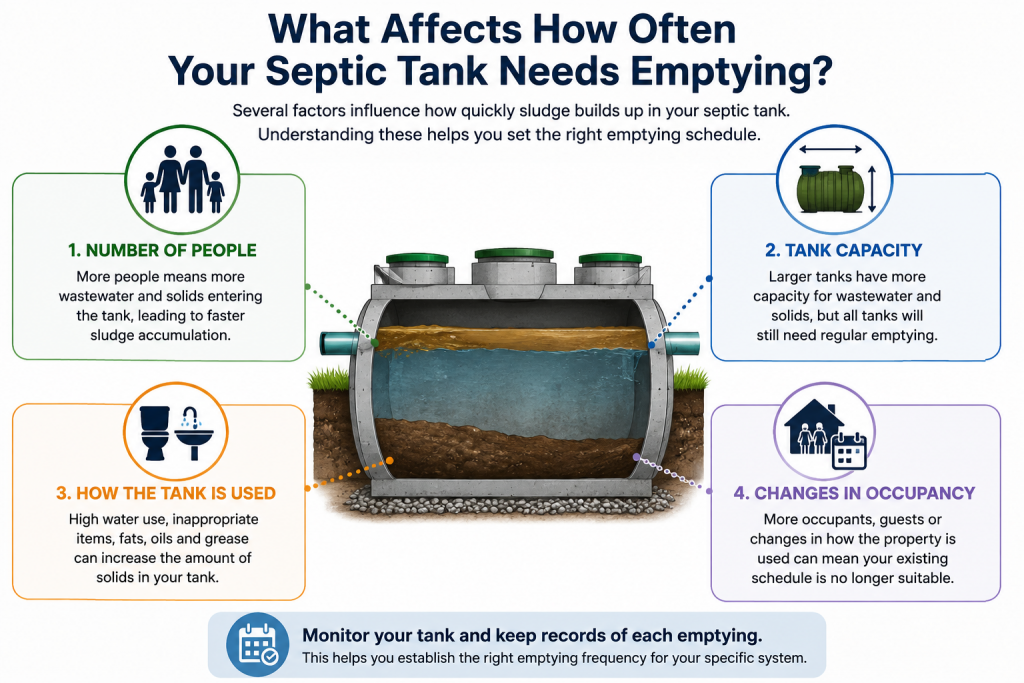
The main factors affecting emptying frequency are relatively straightforward.
The more people using a septic system, the more waste it has to process.
A tank serving two occupants will normally accumulate solids more slowly than the same tank serving a household of five or six.
This means a previously suitable emptying schedule may need to change if occupancy increases significantly.
If you’ve recently bought a property, don’t automatically assume that the previous owner’s schedule will suit your household.
Tank size also affects how quickly sludge reaches a problematic level.
A correctly sized system should have sufficient capacity for the property it serves, but capacity doesn’t remove the need for desludging.
Even a large tank will gradually accumulate material that needs to be physically removed.
If you don’t know the size or specification of your tank, check any documentation supplied with the property or ask a competent septic tank contractor to identify it.
Household behaviour can also influence sludge accumulation.
Materials that shouldn’t be flushed can increase the amount of solid material retained inside the tank.
This includes items such as wipes, sanitary products and other non-biodegradable waste.
Fats and grease can create additional problems within the drainage system and tank.
A septic tank receiving only normal domestic wastewater is therefore likely to behave differently from one regularly receiving inappropriate waste.
It’s also worth considering how consistently a property is occupied.
A permanently occupied family home has a very different wastewater pattern from a holiday property used only occasionally.
Likewise, a property that changes from two permanent occupants to six will place considerably greater demand on the same tank.
Emptying frequency should reflect how the system is actually being used rather than relying solely on a schedule established years earlier.
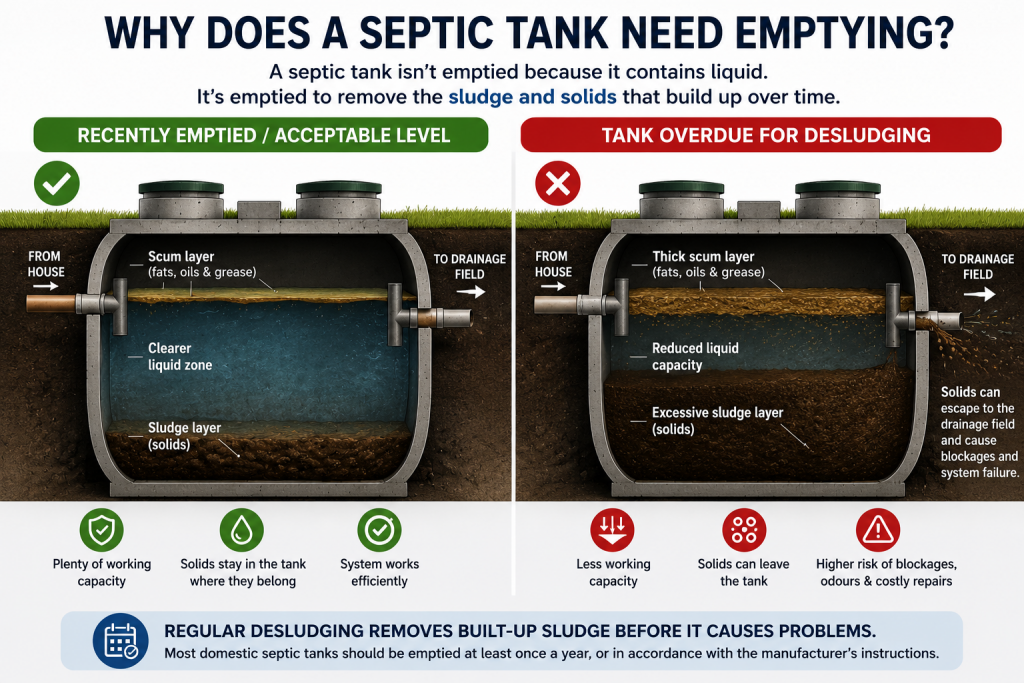
A septic tank separates solid material from wastewater.
Some organic material is biologically broken down, but this process does not make all solids disappear.
Sludge therefore gradually accumulates at the bottom of the tank.
As the sludge layer grows, the available working capacity inside the tank decreases.
If sludge is allowed to accumulate excessively, solids can begin leaving the tank with the liquid effluent and entering the drainage field.
That’s the situation routine desludging is intended to prevent.
Natural Resources Wales warns that sludge and solids build up over time and affect system performance, which is why regular desludging forms an important part of running and maintaining private sewage systems.
Once excess solids reach a drainage field, simply emptying the tank may no longer solve the resulting problem.
Potentially, but not automatically.
A larger tank has greater capacity, but the required emptying interval still depends on factors such as occupancy, usage and sludge accumulation.
It’s therefore better to think in terms of sludge level rather than tank size alone.
A large tank serving a heavily occupied property could require attention sooner than a smaller tank serving one or two people.
Manufacturer guidance should always take priority where it’s available.
No.
This is one of the most misleading ways of thinking about septic tank emptying.
A functioning septic tank normally contains liquid. It isn’t supposed to sit empty between tanker visits.
The issue is the amount of accumulated sludge, not simply whether the tank contains wastewater.
Waiting for obvious symptoms can mean waiting until the system is already struggling.
Instead, desludging should be planned as preventative maintenance.
A regular schedule also makes costs easier to anticipate and reduces the temptation to keep postponing emptying because the system appears to be working normally.
If you’re unsure how often your particular septic tank needs emptying, start with its maintenance documentation.
The manufacturer may specify a recommended desludging interval.
If that information isn’t available, a septic tank contractor can inspect the tank and assess how much sludge has accumulated.
This is particularly useful if:
Once the tank has been inspected and emptied, start recording each tanker visit.
Over time, you’ll have a much clearer picture of the appropriate interval for your particular system.
Yes.
A simple record of when the tank was emptied helps prevent maintenance from being forgotten and makes it easier to establish how frequently your tank needs desludging.
Keep details such as:
This is particularly useful when selling a property.
It gives the next owner evidence of how the system has been maintained rather than leaving them to guess when it was last emptied.
Septic sludge needs to be removed using appropriate tanker equipment and disposed of correctly.
This isn’t a normal household DIY job.
Use a reputable waste contractor who is appropriately authorised to transport the sludge.
In Northern Ireland, for example, NI Water provides a dedicated septic tank desludging service for eligible domestic properties and offers one free desludge within a twelve-month period subject to its conditions.
Elsewhere in the UK, private waste contractors commonly provide septic tank emptying services.
When booking a tanker, tell the contractor what type of system you have and make sure there is safe access to the tank.
No — and this makes a major difference to emptying frequency.
A septic tank allows liquid effluent to leave the tank for further treatment through an appropriate drainage system.
A cesspool is sealed and has no outlet.
Everything entering a cesspool therefore remains inside until it’s removed by tanker.
As a result, cesspools need emptying far more frequently than septic tanks — potentially every few weeks depending on their size and usage.
If your system requires extremely frequent emptying, make sure you know whether the property actually has a septic tank or a cesspool.
Biological treatments can support the breakdown of biodegradable organic material inside a septic tank, but they don’t eliminate the need for desludging.
Not everything entering a septic tank can be biologically broken down.
Sludge will therefore continue accumulating over time.
A treatment should be viewed as part of the wider care of a septic system rather than as a replacement for physical emptying.
For a complete overview of inspections, desludging and preventative care, see our septic tank maintenance guide.
For most homeowners, the simplest approach is to start with an annual schedule and adjust it according to the manufacturer’s instructions and the actual rate of sludge accumulation.
If your tank needs emptying sooner, shorten the interval.
If you’re unsure when it was last emptied, arrange an inspection rather than waiting for a problem to develop.
Most importantly, don’t use sewage smells, blocked drains or wastewater backing up as your reminder that it’s time to call a tanker.
Routine emptying is preventative maintenance.
The objective is to remove sludge before excessive accumulation starts affecting the operation of the tank or allows solids to reach the drainage field.
Keeping a record of each emptying will gradually give you a schedule based on your actual property and septic system rather than a generic estimate.