
Buying a house with a septic tank can be straightforward, but the drainage system deserves the same attention as the roof, electrics and heating. Unlike a property connected to mains sewerage, the home relies on private equipment to collect and treat wastewater. Before exchanging contracts, establish what system is installed, where it discharges and who is responsible for maintaining it.
This guide explains the questions to ask, documents to request and legal issues to investigate when buying a property with a septic tank in the UK.
First, establish whether the property has a septic tank, a package sewage treatment plant or a cesspool. These systems operate differently and have different discharge arrangements. An estate agent’s description may not be sufficiently precise, so ask for the manufacturer’s details, installation plans and any available service records.
Find out exactly where the tank, connecting pipes, drainage field and discharge point are located. An underground tank may be easy to identify, while the drainage field can extend across a substantial part of the garden. Knowing its location matters if you intend to build an extension, landscape the grounds or install a driveway.
In England, the Environment Agency’s rules require a seller to inform the new operator in writing about the sewage discharge. This information should describe the treatment and drainage systems, locate their principal components, explain changes and include available maintenance instructions and records.
The official Environment Agency guidance on septic tank discharges explains these obligations and the wider general binding rules. The rules described on that page apply to England, not automatically to every UK nation.
For purchases in England and Wales, conveyancers commonly use the TA6 property information form to collect information from sellers. The Law Society guidance on the TA6 form explains its role in residential transactions. Ask your conveyancer to follow up on incomplete or contradictory answers rather than relying solely on a ticked box.

A working septic tank is not necessarily a compliant one. In England, qualifying small domestic sewage discharges can operate without an individual environmental permit when all applicable general binding rules are satisfied. These include requirements relating to pollution prevention, system design, capacity and discharge arrangements.
A conventional septic tank must discharge through an appropriate drainage field. Direct discharge from a septic tank into a river or stream is not permitted under England’s general binding rules. If a property has this arrangement, seek specialist advice about the necessary changes before committing to the purchase.
You should also ask whether modifications, extensions or increased occupancy have affected the system’s capacity. Older installations should not automatically be assumed compliant or exempt.
For a wider explanation of the legal framework, read our Understanding UK Septic Tank Regulations: Navigating the Changes pillar guide.
Yes. The relevant environmental regulator depends on the property’s location, and the paperwork needed is not identical throughout the UK.
In Wales, owners normally need to register their septic tank or small sewage treatment plant, with qualifying systems eligible for free registration. Check the existing registration and whether the discharge arrangement qualifies. Natural Resources Wales registration guidance provides the applicable criteria.
In Scotland, private sewage discharges require appropriate authorisation from SEPA. Ask for the authorisation details and confirm they match the property and installation.
In Northern Ireland, domestic sewage discharges require consent from the Northern Ireland Environment Agency. The department provides a public register of domestic discharge consents that prospective buyers can use when checking records.
Never assume that a document issued in one part of the UK satisfies another nation’s requirements.
A specialist drainage survey is a sensible precaution, particularly for older systems or properties with missing records. A standard homebuyer’s survey may not investigate underground tanks, buried pipework or the condition of a drainage field.
Ask the drainage specialist what their inspection includes. Depending on access and circumstances, they may check the tank’s structural condition, inlet and outlet arrangements, signs of leakage, drainage performance and available maintenance records.
A survey cannot always establish the full condition of concealed drainage infrastructure. Request a written report identifying limitations, observed defects and recommended further investigation. This provides useful evidence when discussing repairs or costs before exchange.
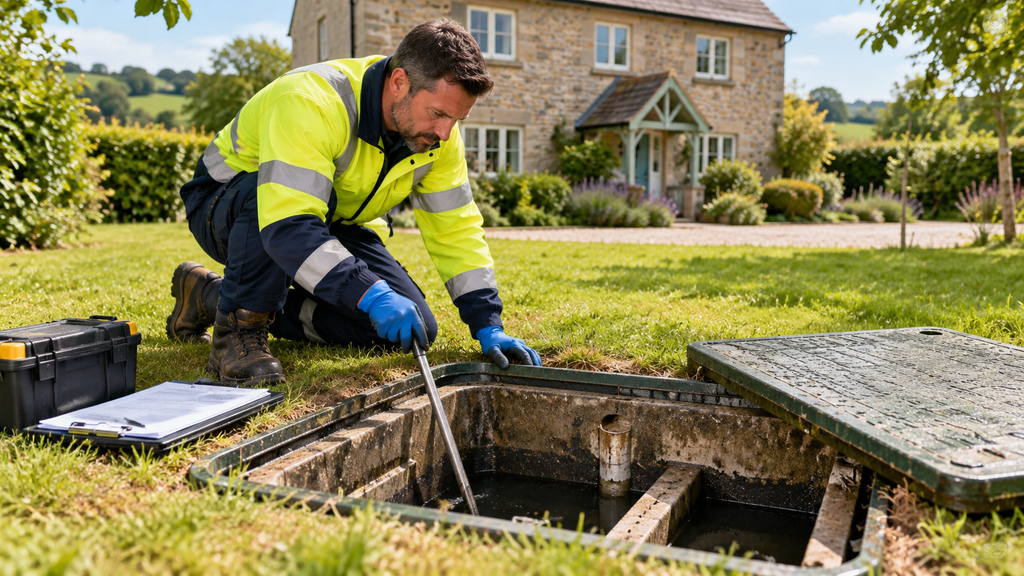
Do not assume the entire system lies within the property’s boundaries. The tank or drainage field may be on neighbouring land, or several homes may share one installation.
Ask your conveyancer to investigate ownership, rights of access, easements and responsibilities for repair, emptying and replacement. Where a system is shared, find out how costs are divided and whether arrangements are documented.
Access matters because contractors need to reach the tank for maintenance. A working system may still create problems if the legal right to inspect or repair essential components is unclear.
Private drainage brings ongoing responsibilities beyond the purchase price. Budget for routine emptying, inspections, repairs and possible replacement of worn components. Treatment plants may also require electricity and servicing.
Ask when the tank was last emptied, who carried out the work and whether invoices are available. Repeated blockages, persistent smells, saturated ground or unusually frequent emptying warrant investigation rather than optimistic assumptions.
If a survey identifies non-compliance or substantial defects, obtain written quotations before negotiating. An apparently modest repair may involve excavation, drainage field replacement or wider alterations, depending on site conditions.
Use this checklist when speaking to the seller, conveyancer and drainage specialist:
Resolve important uncertainties before exchange, when your options for renegotiating or withdrawing are generally more limited after becoming contractually committed.

Buying a property with a septic tank is not automatically risky, but insufficient information can turn private drainage into an expensive surprise. Confirm the system type, its discharge route, legal permissions, physical condition and access rights. Check which nation’s rules apply, request proper documentation and obtain specialist advice where necessary.
With these checks completed, you can make a more informed purchase and plan for the long-term responsibilities of owning a home with private wastewater treatment.