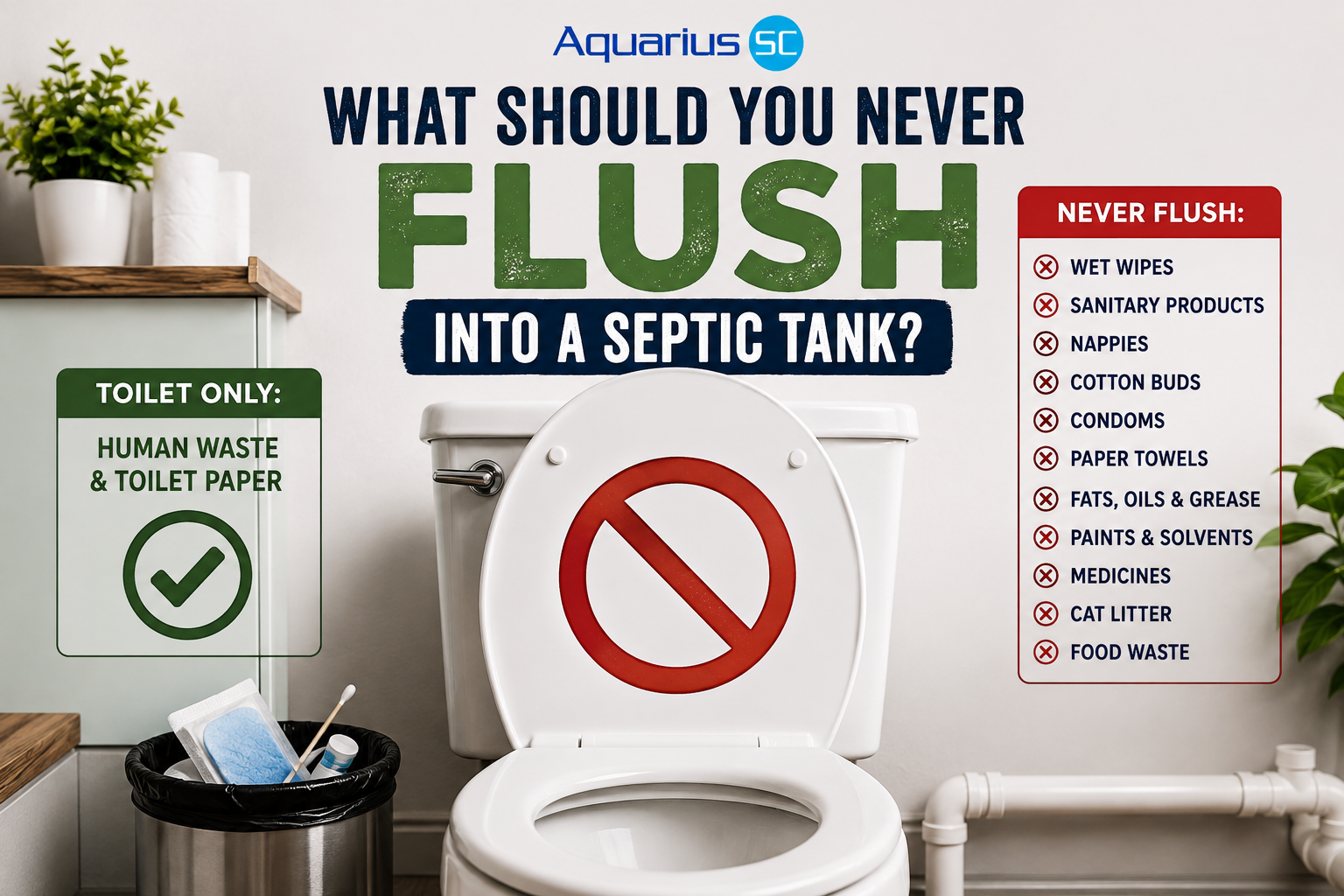
If your property uses a septic tank, the safest rule for the toilet is straightforward: only human waste and toilet paper should be flushed.
Wet wipes, sanitary products, nappies, cotton buds, condoms and other solid items should go in the bin. You should also be careful about what enters the septic system through sinks and other household drains. Fats, oils, paint, solvents and unwanted medicines all need another disposal route.
The issue isn’t that every unsuitable item instantly damages a septic tank. Different materials cause different problems. Some can block the pipework before reaching the tank, some remain as unwanted solids, and others can interfere with wastewater treatment or pass further through the system.
For the toilet:
Human waste and toilet paper. That’s it.
Natural Resources Wales specifically recommends never flushing anything other than human waste and toilet paper and also advises keeping oils, chemicals, fats and solvents out of household drains.
That simple rule is much easier to follow than trying to decide whether every individual bathroom product is genuinely suitable for flushing.
Wet wipes shouldn’t be flushed into a septic system.
That includes:
The important difference between a wipe and toilet paper is how the material behaves when wet.
Toilet paper is designed to lose its structure quickly. Wipes need to remain strong enough to perform their intended job while damp, so they can remain intact considerably longer.
Even the word “flushable” shouldn’t automatically be taken as permission to put a wipe down a septic toilet. Water UK advises that even plastic-free wipes marketed as flushable can take a long time to break down and can contribute to pipe blockages.
For a septic property, the simplest approach is:
Used wipe = bin, not toilet.
Sanitary products should never be treated like toilet paper.
Pads are specifically designed to absorb and retain liquid. They don’t disintegrate simply because they’ve entered a toilet.
Tampons are also designed to retain their structure while absorbing liquid.
Flushing either introduces unnecessary solid material into the drainage system and creates an avoidable blockage risk.
Used sanitary products should be wrapped and disposed of with the appropriate household waste.
Nappies should never go down the toilet.
The same applies to:
These products contain absorbent materials designed to hold significant quantities of liquid.
Even attempting to flush one can create a blockage in the toilet or household drainage before it gets anywhere near the septic tank.
Comhairle nan Eilean Siar’s septic tank guidance specifically advises homeowners that nappies, sanitary items, plastics and similar materials should be bagged and binned rather than put into the septic system.
Their small size doesn’t make them suitable for flushing.
Cotton buds can become caught in drainage pipework and don’t disintegrate in the same way as toilet tissue.
Cotton wool is similarly designed to remain intact while absorbing liquid.
Both should simply go in the bin.
The same applies to cosmetic pads, make-up remover pads and similar bathroom products.
Dental floss may look insignificant, but it’s another item that has no reason to enter a septic system.
It’s a long, strong material designed not to break while being pulled between teeth.
Dispose of it in the bin rather than flushing it.
This also illustrates why judging something purely by its size isn’t particularly useful. A small item can still be persistent and capable of becoming caught elsewhere in the drainage system.
Condoms should always be disposed of in the bin.
They’re manufactured specifically to be strong, flexible and resistant to breaking.
Those characteristics make them particularly unsuitable for flushing.
A condom doesn’t become harmless when it disappears around the U-bend. You’ve simply transferred an intact piece of material into your drainage system.
They’re made from paper, but they’re not substitutes for toilet paper.
Kitchen roll is deliberately manufactured to remain relatively strong while wet. Otherwise, it wouldn’t be particularly useful for wiping up spills.
Toilet paper is designed to behave differently.
The same rule applies to:
If you’ve run out of toilet paper and temporarily use another paper product, dispose of it in the bin rather than flushing it.
These are more likely to enter a septic system through the kitchen sink than the toilet, but they’re still worth including because the end destination is the same drainage system.
Don’t pour leftover cooking fat, grease or large quantities of oil down the sink.
As fats cool, they can accumulate inside drainage pipework and contribute to blockages.
Instead, remove as much grease as practical from cookware before washing it.
Liquid cooking oil should be collected and disposed of appropriately rather than deliberately poured into the drainage system.
A septic tank isn’t a food-waste disposal system.
Avoid deliberately washing things such as:
down the sink.
A simple sink strainer can capture much of this material before it enters the drain.
Scraping plates into your food-waste or household-waste container before washing them is another easy preventative measure.
Never use a septic tank as a convenient way to get rid of leftover DIY products.
That includes:
These materials aren’t ordinary domestic wastewater and shouldn’t be poured into toilets or sinks.
Check the product’s disposal instructions and use the appropriate local household-waste facility where required.
Leftover weedkillers, pesticides and other concentrated garden chemicals shouldn’t be poured into a septic tank either.
Follow the disposal instructions supplied with the product.
Aberdeenshire Council’s guidance confirms that normal household products such as mild detergents and washing liquids can be used in moderation while garden chemicals, pesticides, paints, solvents, fats and oils should be kept out of septic systems.
This distinction matters because owning a septic tank doesn’t mean eliminating every household cleaning product. It’s inappropriate disposal and excessive use that you need to avoid.
Don’t flush unwanted medication down the toilet or pour it into a sink.
This applies to both septic properties and homes connected to mains sewerage.
The NHS advises that out-of-date or unwanted medicines should be taken to a pharmacy for safe disposal rather than flushed down the toilet.
That includes unused prescription medication as well as unwanted over-the-counter medicines.
There’s no benefit to introducing pharmaceuticals into household wastewater when pharmacies already provide an appropriate disposal route.
Cat litter shouldn’t be flushed into a septic system.
This applies even if the product is described as biodegradable.
Cat litter is designed to absorb liquid and introduces unnecessary solid material into the drainage system.
Used litter should be disposed of according to the manufacturer’s instructions and your local household-waste arrangements.
Yes, normal, moderate household use of bleach doesn’t need to be completely avoided simply because you have a septic tank.
This is an area where online advice can become unnecessarily extreme.
There’s a significant difference between cleaning a toilet with an appropriate amount of household bleach and deliberately pouring large quantities of concentrated bleach down the drain.
Use cleaning products according to their instructions and avoid excessive quantities.
If you’re purchasing a new cleaner and the manufacturer specifically identifies it as suitable for septic tanks, that’s an easy option.
Yes.
Having a septic tank doesn’t mean you can’t use a washing machine, washing powder or liquid detergent.
Again, normal household use is different from disposing of concentrated cleaning products through the drain.
Use the recommended amount rather than assuming that more detergent produces cleaner clothes.
The same principle applies to dishwashers.
Ordinary household wastewater from washing machines and dishwashers is expected to enter domestic septic systems.
Normal toilet cleaning is also compatible with owning a septic tank.
The sensible approach is appropriate products used at their recommended quantities.
You don’t need to leave your toilet uncleaned because you’re worried that any cleaning product will immediately damage the septic system.
What you should avoid is treating the toilet as a chemical disposal route.
If you have unwanted concentrated chemicals, dispose of them properly rather than tipping them down the toilet.
This deserves slightly more caution.
If a sink or toilet is blocked, repeatedly pouring strong chemical drain cleaner into it doesn’t necessarily address what’s causing the blockage.
The obstruction might be:
If a blockage persists, finding the actual cause is more useful than repeatedly adding increasingly large quantities of drain cleaner.
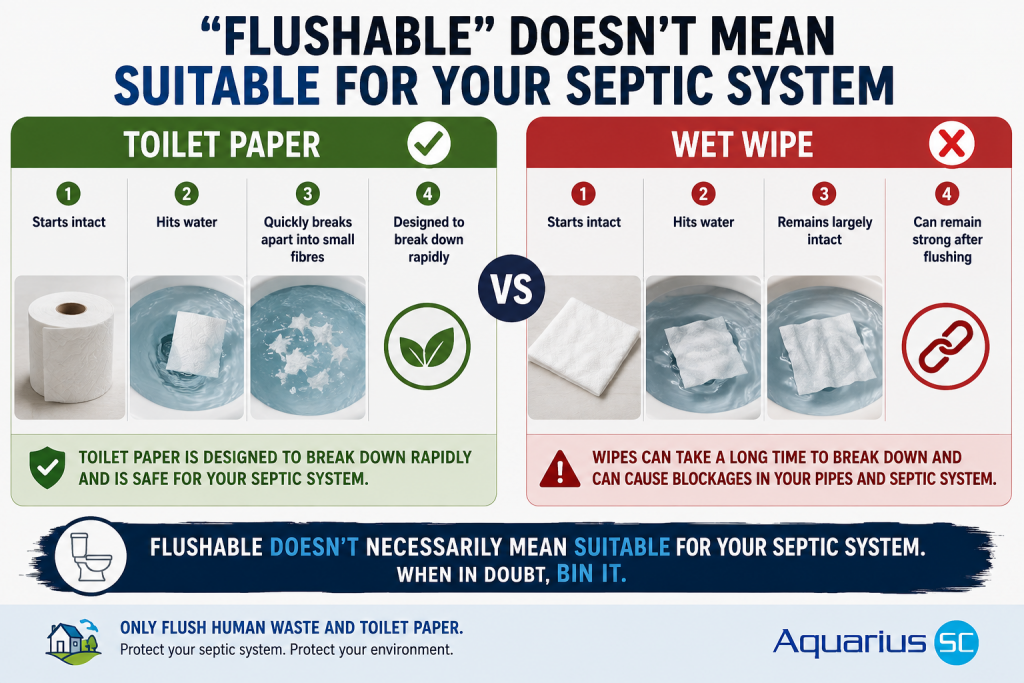
Don’t rely on the word “flushable” alone.
There’s an important difference between:
Can physically pass through the toilet
and
Should be put into your septic system.
A wipe might disappear when you flush, but that tells you nothing about how quickly it breaks apart afterwards.
For a septic toilet, you don’t actually need to make this judgement every time.
The simplest rule remains:
Anything else can usually go in a bin or through the appropriate alternative disposal route.
One accidentally flushed item doesn’t automatically mean you need to call a septic contractor.
What happens depends on the object.
If something relatively large has been flushed, watch for signs that it has become lodged in the drainage system, such as:
If everything continues operating normally, the item may have passed through the household pipework.
Don’t repeatedly flush the toilet in an attempt to force through an obvious obstruction.
If the problem remains, investigate the blockage.
If you’ve accidentally disposed of a significant quantity of a hazardous chemical, follow the safety information for that particular substance and seek appropriate professional advice rather than adding another chemical in an attempt to neutralise it.
You don’t need a huge list stuck next to every drain in the house.
A straightforward system works:
| Where? | What belongs there? |
|---|---|
| Toilet | Human waste and toilet paper |
| Sink/drain | Normal household wastewater |
| Bin | Wipes, sanitary products, nappies, cotton buds, condoms, paper towels and other solid waste |
| Appropriate disposal route | Medicines, paints, solvents, pesticides and other specialist waste |
The Environment Agency’s rules are based around septic systems receiving domestic sewage from normal household activities such as toilets, bathrooms, showers and kitchens, rather than becoming a disposal route for unusual substances.
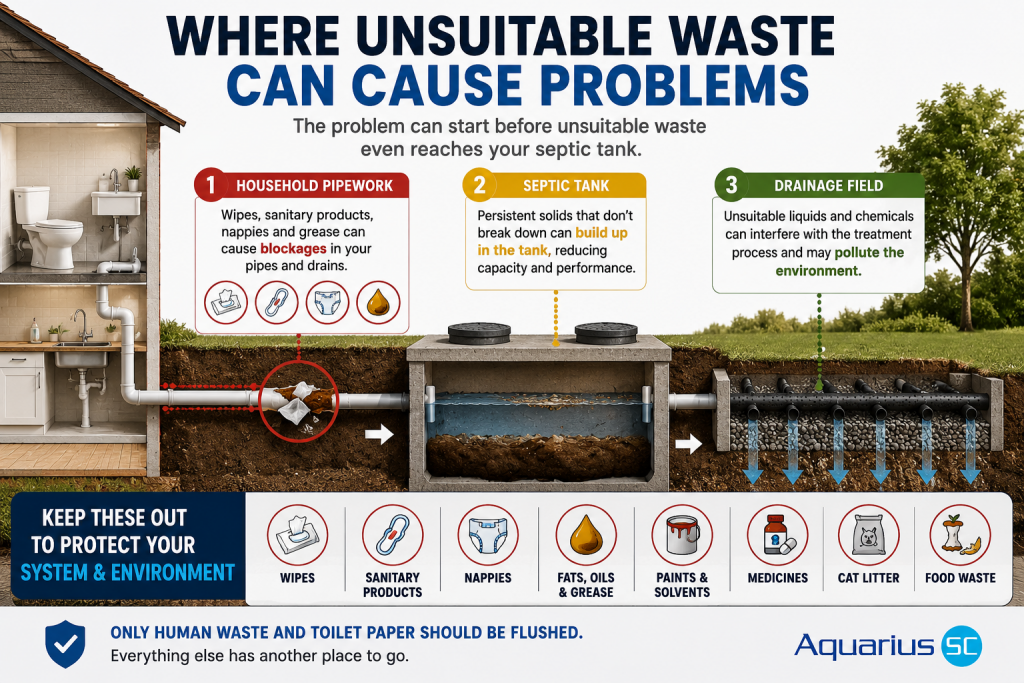
Unsuitable materials create different problems depending on what they are.
Wipes and sanitary products can remain intact and contribute to physical blockages.
Fats and grease can accumulate inside drainage pipes.
Food waste introduces unnecessary solids.
Paints, solvents and pesticides aren’t appropriate components of domestic wastewater.
Medicines have a dedicated safe disposal route through pharmacies.
Keeping these materials out of the septic system is considerably easier than dealing with the drainage problems they can cause afterwards.
This is where the article’s only internal link should go:
Being careful about what enters your system is an important part of effective septic tank maintenance and can help prevent avoidable blockages and unnecessary problems.
For the toilet, remember:
Human waste and toilet paper only.
Wet wipes, sanitary products, nappies, cotton buds, condoms, kitchen roll and other solid household waste belong in the bin.
The same thinking should extend to other household drains. Don’t deliberately pour fats, oils, paint, solvents, pesticides or unwanted medicines into the septic system.
And there’s no need to overcomplicate normal cleaning.
You can still use your washing machine, dishwasher and appropriate household cleaning products. The objective is to keep unsuitable waste and excessive quantities of chemicals out of the system, not to eliminate normal household wastewater.