

In 2026, septic tank emptying typically costs around £175–£300 for a standard domestic tank in the UK, although larger tanks and more complicated jobs can reach £400 or more.
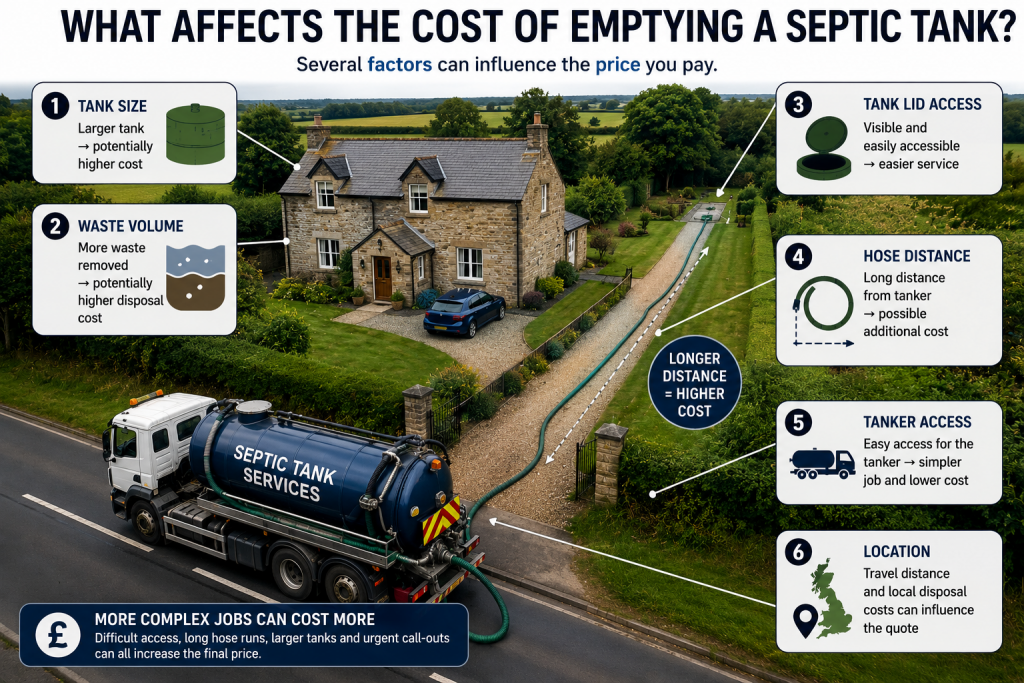
The actual amount you pay depends on the size of the tank, how much waste needs removing, where you live, how easily the tanker can access the property and whether the visit is scheduled or urgent.
Current UK pricing data puts the average domestic empty at around £225, making £200–£300 a sensible budget for many straightforward jobs.
Current UK septic tank emptying cost data from Checkatrade gives an average of approximately £225, with typical prices varying according to tank size.
| Septic tank size | Typical cost |
|---|---|
| Small | £150–£195 |
| Medium | £175–£225 |
| Large | £200–£250 |
| Extra large | £225–£400 |
These aren’t fixed national prices. They’re useful estimates for budgeting.
A straightforward domestic tank with good access might therefore cost around £200 to empty, while a large tank or difficult job could cost £300–£400 or more.
The most accurate price will always come from a local contractor quoting for your particular property.
The tanker isn’t the only thing you’re paying for.
A septic tank emptying service involves travelling to the property, pumping out the waste, transporting it and disposing of it appropriately.
Several factors can therefore affect the quote.
Larger septic tanks generally cost more to empty because they can contain a greater volume of waste.
A contractor may therefore ask for the tank’s capacity before providing a quote.
If you know whether your tank holds 3,000, 4,500 or 9,000 litres, provide that information when booking.
If you don’t know the capacity, don’t guess. Tell the contractor that the size is unknown.
Tank capacity and the actual amount removed aren’t necessarily identical.
Depending on how the contractor prices the service, the volume pumped into the tanker can affect the final bill.
Greater volumes mean more material has to be transported and disposed of, which increases operating costs.
This becomes particularly relevant with unusually large domestic systems or tanks serving multiple properties.
Access is one of the biggest practical factors affecting septic tank emptying.
The easiest arrangement is a tanker that can park safely relatively close to the tank.
Things become more complicated when:
Tell the company about these issues before they arrive.
A contractor can then determine whether its equipment can reach the tank and whether additional charges will apply.
Quite a lot.
There isn’t a universal UK surcharge for difficult access because companies have different equipment and pricing structures.
However, accessibility is significant enough that it forms part of the conditions used by major desludging services.
For example, Scottish Water’s 2026/27 septic tank desludging charges specifically consider factors including tank position, distance and height from the tanker, vehicle access, parking and the accessibility of the tank lid.
That makes it worth checking access before obtaining quotes.
If you have to explain on the day that the tank is 60 metres behind the house and the tanker can’t enter the driveway, the price you were originally given may no longer apply.
Usually, yes.
A routine visit can be scheduled into a contractor’s normal workload.
An emergency call-out may require rapid attendance, changes to the tanker schedule or work outside normal operating hours.
This can significantly increase the price.
A useful official example comes from Scottish Water’s current 2026/27 tariff:
Scheduled visit: £254.40
Unscheduled visit: £353.10
Urgent response: £509.70 or actual cost if higher.
These aren’t national UK prices, but they demonstrate the potential difference between planned maintenance and urgent attendance.
For a homeowner arranging private emptying elsewhere in Britain, the exact emergency premium will depend on the contractor.
A routine septic tank emptying quote will commonly cover:
However, companies don’t necessarily structure their quotes in exactly the same way.
Before booking, ask whether the quoted amount includes:
VAT – Is the advertised figure the final amount you’ll actually pay?
Waste volume – Is there a maximum volume included?
Disposal – Are waste treatment charges included?
Travel – Is your property within the company’s standard service area?
Hose length – Does an unusually long hose run cost extra?
Getting these answers beforehand makes comparing quotes much easier.
Emptying the tank and repairing the septic system are different jobs.
You could therefore face additional charges for:
Don’t assume these services are included in a standard emptying price.
If you’re booking because you’re already experiencing drainage problems, tell the contractor what is happening.
That allows them to determine whether you need a straightforward emptying or additional drainage work.
Potentially.
Imagine the tanker arrives but can’t reach the septic tank because the access cover is buried, the driveway is blocked or the vehicle can’t safely get close enough.
The contractor has still incurred travel and labour costs.
Some operators may therefore charge for an unsuccessful visit.
This is another reason to establish the tank’s location and access requirements beforehand.
Clear vegetation from around the access point, unlock necessary gates and make sure vehicles aren’t preventing tanker access on the day.
Yes.
Rural location can influence:
This means somebody in one part of the UK could receive a noticeably different quote from somebody with an identical tank elsewhere.
National averages are therefore useful for budgeting, but local quotes are much more useful when you’re actually booking the work.
There is one particularly important regional difference.
Eligible domestic properties in Northern Ireland can receive one free septic tank desludging service within a 12-month period, subject to the conditions of the service.
The Northern Ireland government guidance on septic tank desludging explains eligibility and how householders can arrange the service.
Homeowners elsewhere in the UK will generally need to arrange and pay for their own emptying, although local arrangements vary.
The easiest way isn’t to postpone emptying.
It’s to make each necessary emptying as straightforward as possible.
Don’t wait until wastewater is backing up before looking for a tanker.
Routine bookings give you time to compare quotes and avoid paying for urgent attendance.
You should be able to show the contractor where the access point is.
Having a tanker crew searching around a garden for a buried tank wastes time and could lead to additional work.
Avoid permanently covering the tank lid with:
The contractor needs safe access to the tank.
If the tanker can’t park close to the tank, say so when requesting the quote.
Give an approximate distance if possible.
That allows the company to determine whether its hoses can reach before sending a vehicle.
When obtaining several quotes, make sure you’re comparing the same service.
Rather than simply asking:
“How much do you charge to empty a septic tank?”
ask:
“What is the total price including waste disposal, travel and VAT?”
You can then identify whether a seemingly cheap quote actually has additional charges attached.
Not necessarily.
The price matters, but so does what you’re actually being quoted for.
For example:
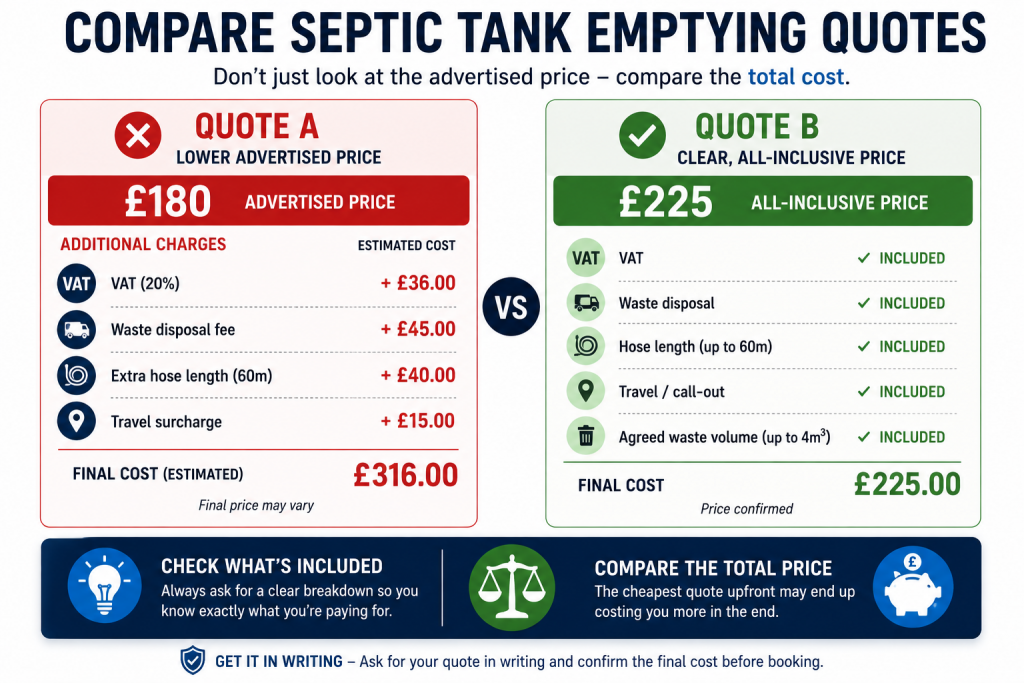
Company A: £180 plus disposal and VAT.
Company B: £225 including disposal and VAT.
Company B may actually be cheaper once everything is included.
You should also establish how much waste the quote covers and whether there are additional charges for access or hose length.
A clear all-inclusive quote is much easier to compare than a low starting price with several possible additions.
If your tank requires annual emptying and a routine visit costs approximately £200–£300, that’s a reasonable figure to include in your household maintenance budget.
Breaking that down:
£200 per year = about £16.67 per month
£250 per year = about £20.83 per month
£300 per year = £25 per month
Treating septic emptying as a predictable property expense is generally easier than finding several hundred pounds unexpectedly when a problem develops.
This is also where our future pillar article will naturally fit:
Factoring emptying into your regular septic tank maintenance schedule makes the cost predictable and helps prevent routine desludging from becoming an emergency call-out.
That will be the article’s only internal link, with septic tank maintenance linking to the maintenance pillar once we’ve created it.
For a normal domestic septic tank in the UK, around £200–£300 is a sensible budget for routine emptying in 2026, with current market data showing an average of roughly £225.
Smaller straightforward jobs can cost less, while large tanks, difficult access, additional work or urgent attendance can push the bill substantially higher.
When asking for a quote, give the contractor as much useful information as possible:
Most importantly, ask for the total price rather than simply the advertised emptying rate.
That gives you a much clearer idea of what you’ll actually pay.