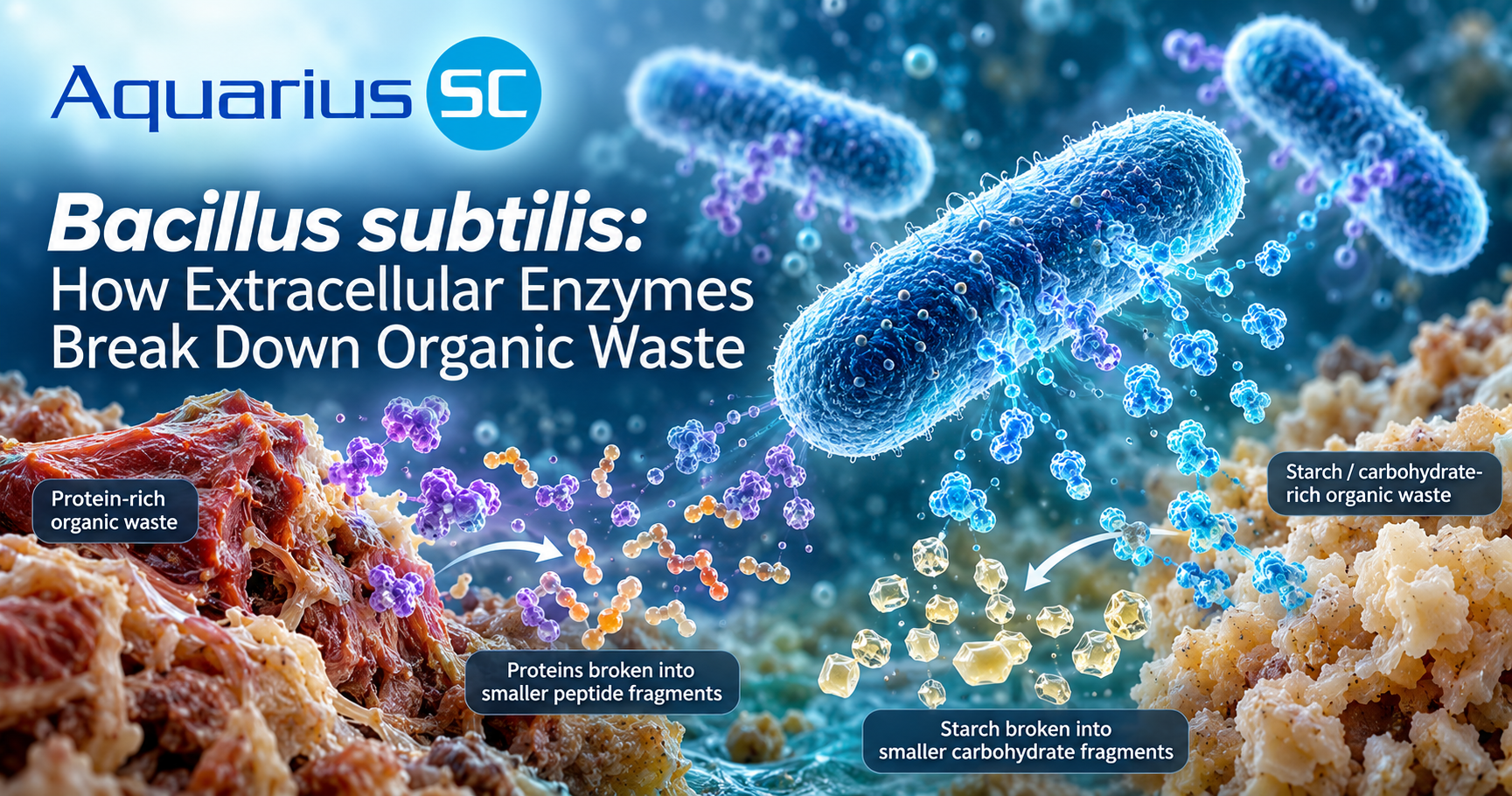
Organic waste often contains molecules that are too large for bacteria to absorb directly. Proteins, starches and plant-derived fibres must undergo chemical changes before their nutrients can become available to microorganisms.
Bacillus subtilis is a well-studied bacterial species capable of producing extracellular enzymes that contribute to these changes.
Rather than relying on a single enzyme, the bacterium can release different proteins that act on specific organic substances. This makes it particularly interesting in research involving nutrient recycling, food waste and biological waste treatment.
Understanding how Bacillus subtilis obtains nutrients from its surroundings provides an insight into the microbial processes involved in organic matter decomposition.
Bacillus subtilis is a Gram-positive, rod-shaped bacterium commonly associated with soil, vegetation and decomposing organic material.
It is widely studied because of its ability to manufacture and secrete proteins, including enzymes that degrade substances outside the bacterial cell.
The species can use a range of organic nutrients, although its precise biochemical capabilities vary between strains.
Of particular importance is its ability to respond to available nutrients by producing enzymes that act on complex materials in its surroundings.
This behaviour allows the bacterium to access nutrient sources that would otherwise be unavailable for direct absorption.
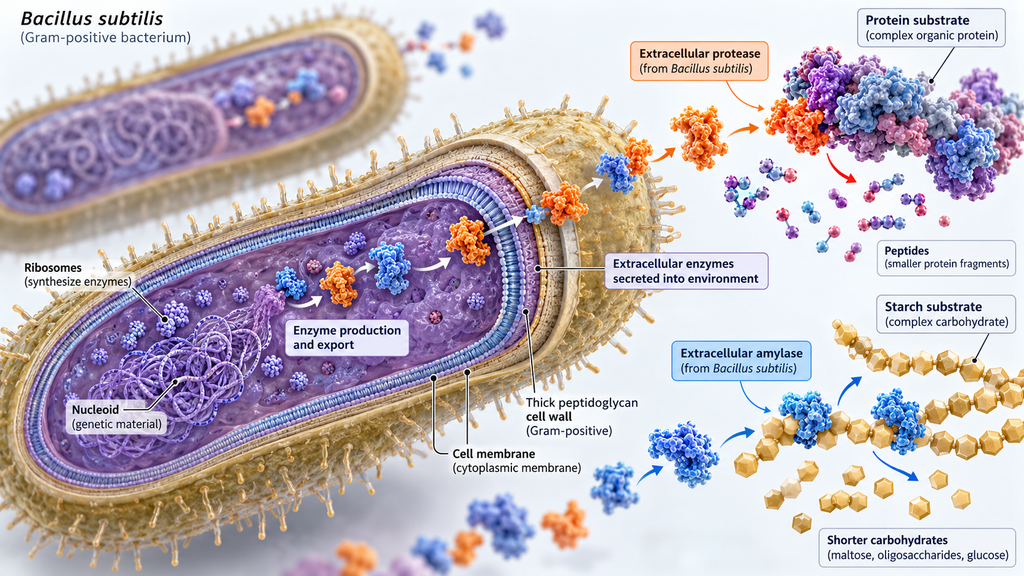
One of the most important characteristics of Bacillus subtilis is its extracellular protein secretion system.
Many digestive reactions need to occur outside the cell because larger organic molecules cannot readily pass through the bacterial membrane.
The bacterium manufactures suitable enzymes internally before transporting them across its cell membrane and cell wall.
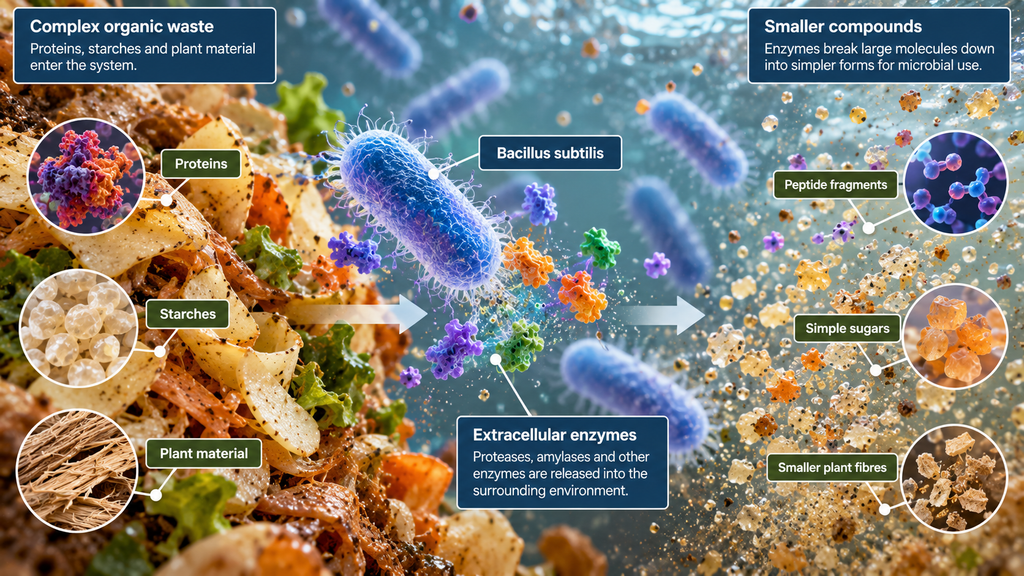
Once released, these enzymes can encounter proteins and carbohydrates in the surrounding material.
A review published in FEMS Microbiology Reviews describes how some Bacillus subtilis cells specialise in producing degradative enzymes, effectively accessing nutrients locked within complex organic substances.
This behaviour is discussed in research into extracellular signalling and enzyme production in Bacillus subtilis.
The resulting breakdown products may become available not only to the producing bacterium but also to other microorganisms sharing the environment.
Proteins are common constituents of food residues, biological waste and other materials entering wastewater systems.
They contain amino acids joined together by peptide bonds, forming molecules that often require enzymatic processing before their components become readily accessible.
Bacillus subtilis produces several extracellular proteases capable of hydrolysing peptide bonds.
A particularly well-known example is subtilisin, a serine protease associated with the species.
Another important extracellular protease is NprE, a metalloprotease.
These enzymes contribute to the breakdown of protein-containing substrates into smaller peptide fragments. Additional enzymatic processing can release amino acids that microorganisms may absorb and metabolise.
The biological importance extends beyond reducing the size of the original protein molecules.
Released amino acids provide nitrogen and carbon-containing compounds that support cellular growth and metabolism.
In mixed organic waste, this activity contributes to the broader recycling of nutrients contained within protein-rich residues.
Many waste materials contain a mixture of proteins and carbohydrates rather than a single organic substance.
Food-processing residues, for example, may contain starch from cereals and vegetables alongside protein from other ingredients.
Bacillus subtilis can produce extracellular amylases that act on accessible starch molecules.
This allows suitable strains to obtain nutrients from carbohydrate-rich materials while proteases process protein components.
The importance of these combined activities has been demonstrated experimentally.
In a study examining Bacillus subtilis UO-01 grown using brewery waste, researchers investigated simultaneous amylase and protease production.
The research, published in the Brazilian Journal of Microbiology, demonstrated that the organism could produce both enzyme activities while growing on an industrial organic waste substrate.
Under the investigated experimental conditions, the researchers also recorded a substantial reduction in the waste’s chemical oxygen demand.
The study of simultaneous amylase and protease production in brewery waste provides a practical example of bacterial enzyme production occurring alongside changes in organic waste composition.
Chemical oxygen demand is a measure of the oxygen equivalent required to chemically oxidise substances within a water sample. A reduction can indicate a decrease in the material contributing to that measurement, although it does not establish complete decomposition of every organic compound.
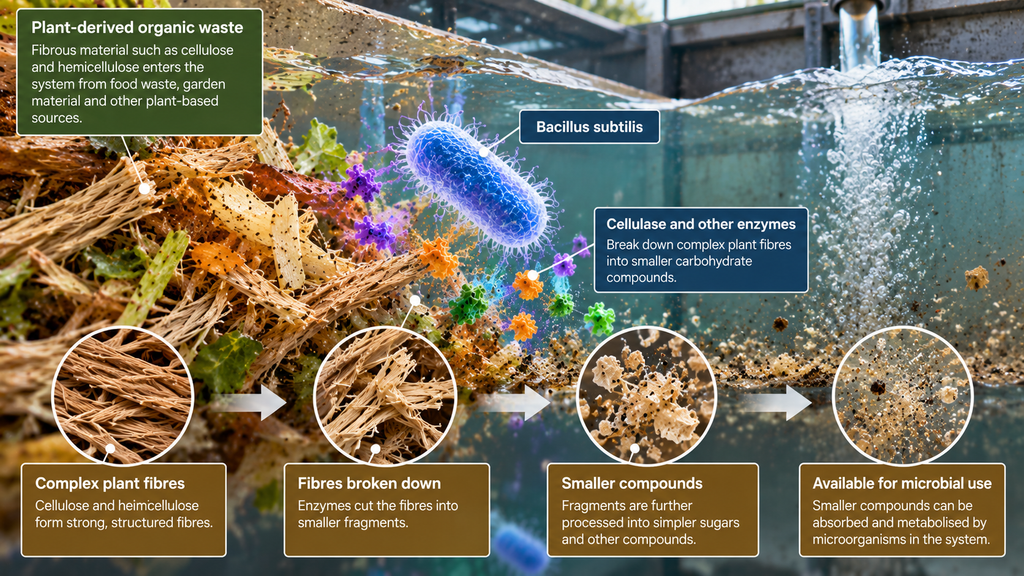
Although Bacillus subtilis is particularly well known for protease and amylase production, certain strains have also demonstrated cellulase activity.
This is relevant because plant-derived waste contains structural fibres that differ from readily accessible food starches.
Researchers have investigated Bacillus subtilis strains capable of producing both amylase and cellulase.
One example is strain ZIM3, isolated during research involving tobacco leaves.
The researchers identified extracellular enzyme activities associated with starch and cellulose degradation and investigated their contribution to the processing of plant material.
The findings demonstrate that particular strains can act on different carbohydrate substrates within the same organic material.
However, this capability should not be assumed to be equally developed in every Bacillus subtilis strain.
Extracellular digestion is only part of the decomposition process.
Once suitable organic molecules have been converted into smaller compounds, microorganisms can transport some of those products into their cells.
Inside the cells, metabolic reactions can use the absorbed compounds to generate energy, manufacture cellular components and support microbial growth.
For example, sugars obtained from carbohydrate degradation can enter metabolic pathways, while amino acids released during protein processing can contribute to cellular protein synthesis or other metabolic reactions.
The eventual products depend on the microorganism and the surrounding conditions.
This distinction matters because extracellular enzymes do not necessarily convert organic waste directly into its final decomposition products.
Instead, they help make complex substances accessible for further biological processing.
The ability of selected Bacillus subtilis strains to produce several extracellular enzymes has encouraged research into recovering useful compounds from agricultural and food-processing residues.
A 2025 study investigated strain YCXW-01, isolated from tobacco leaves, and identified activities involving cellulase, protease, amylase and xylanase.
Researchers also examined the strain’s ability to process tobacco stem material.
The findings, described in research into the multi-enzyme capabilities of Bacillus subtilis YCXW-01, illustrate how extracellular enzymes can contribute to the degradation of mixed plant-derived substrates.
This provides another example of the relationship between bacterial enzyme secretion and organic matter processing.
It also highlights why researchers examine the capabilities of individual strains rather than assuming every member of a species produces an identical enzyme profile.
Wastewater contains a changing mixture of dissolved and suspended organic substances.
Some compounds are readily available to microorganisms, while others require extracellular processing before their nutrients can be absorbed.
The enzyme-secreting capabilities of Bacillus subtilis provide a useful example of how bacteria can contribute to the first stages of organic matter degradation.
Proteases can act on protein-containing material, amylases can process accessible starch, and additional enzymes produced by suitable strains may act on other complex substrates.
These processes help explain the importance of biological treatment systems that rely on microbial activity.
However, the rate and extent of degradation depend on the specific microorganisms present, the characteristics of the waste and the conditions under which biological processing occurs.
Aquarius SC is a biological treatment product using selected microbial cultures associated with several organic waste-degrading enzyme activities.
The behaviour of Bacillus subtilis illustrates an important principle behind such treatments: microorganisms can release enzymes into their surroundings to make complex organic substances more accessible for biological processing.
Protease and amylase activity are particularly useful examples because both are among the enzyme activities associated with Aquarius SC.
These processes contribute to the broader concept of how beneficial bacteria, enzymes and biosurfactants work together to process organic waste.
The specific inclusion of Bacillus subtilis in Aquarius SC sachets is not established by the information considered here, so the species is used to explain the relevant biological mechanisms rather than to identify a confirmed product strain.
Bacillus subtilis demonstrates how bacteria can obtain nutrients from complex organic substances by secreting enzymes outside their cells.
Its investigated protease, amylase and other strain-dependent activities show how proteins and carbohydrates can be converted into smaller compounds for subsequent microbial metabolism.
The most important feature is not simply the number of enzymes a bacterium can produce, but how those enzymes enable microorganisms to access nutrients trapped within organic waste.
This relationship between extracellular digestion and microbial nutrient uptake is a fundamental part of biological organic matter decomposition.