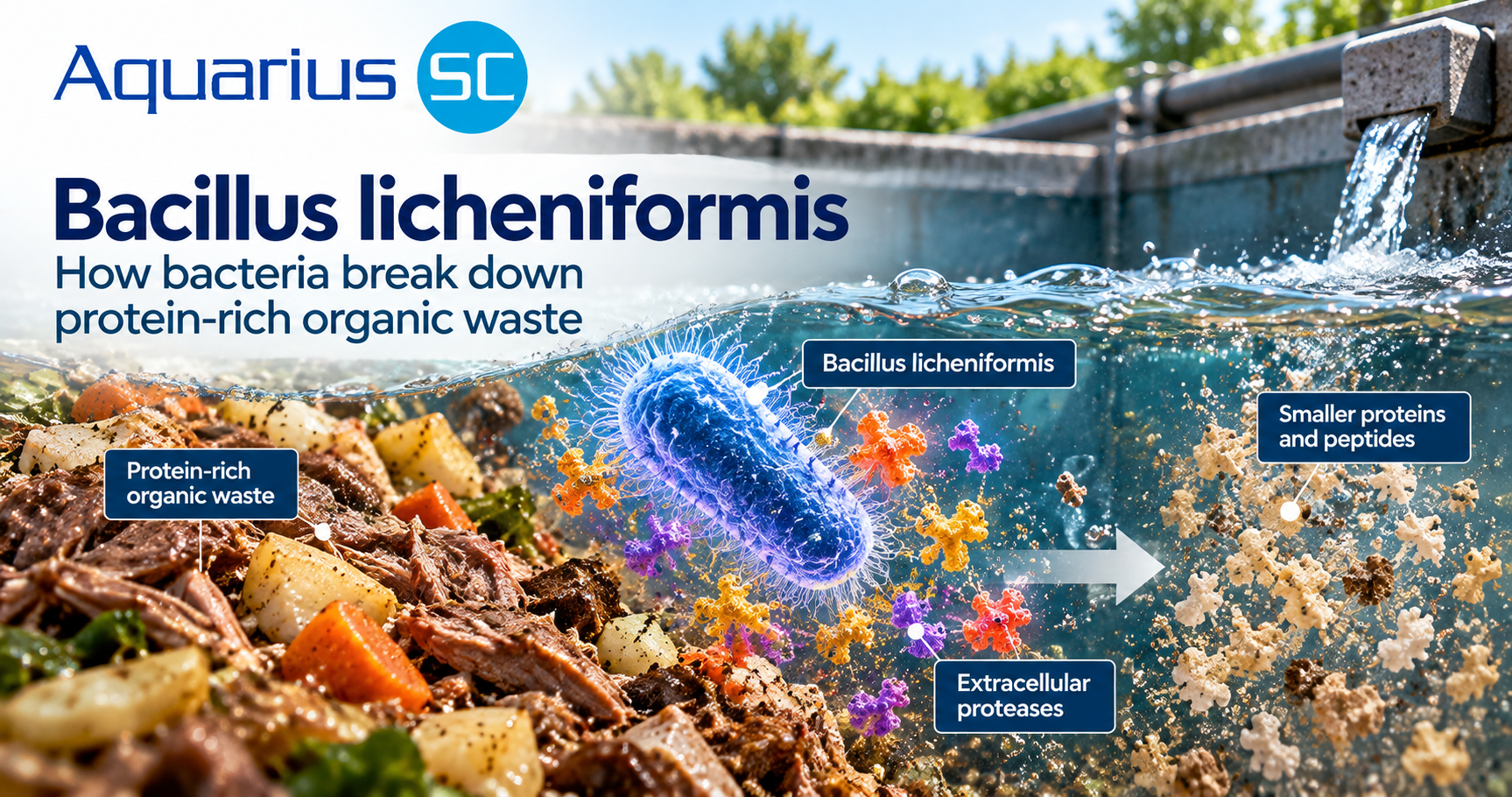
Protein-rich organic waste can be surprisingly difficult to process. Food residues, biological solids and other waste materials contain proteins with different structures, some of which are readily degraded while others resist ordinary microbial activity.
Bacillus licheniformis is a bacterial species studied for its ability to produce protein-degrading enzymes, including proteases capable of acting on a range of organic substrates.
Research involving wastewater sludge and resistant biological materials has demonstrated how particular strains can contribute to the conversion of complex proteins into smaller compounds.
These activities provide an insight into how microorganisms participate in organic waste decomposition.
Bacillus licheniformis is a Gram-positive, rod-shaped bacterium found in soil, decaying vegetation and other environments containing organic material.
Its biochemical capabilities have attracted considerable scientific interest, particularly the production of extracellular proteases.
These enzymes allow suitable strains to act on proteins located outside the bacterial cell.
Different strains can produce enzymes with different characteristics, meaning their ability to process particular substrates is not necessarily identical.
One of the species’ most important characteristics is its capacity to utilise complex protein-containing materials as nutrient sources.
Proteins are present in many forms of organic waste, including food scraps, biological residues and suspended solids in wastewater.
Their amino acid chains can fold into complex three-dimensional structures, sometimes associating with fats, carbohydrates and other substances.
Consequently, proteins do not always exist as freely accessible molecules.
Some are trapped within particles, while others form part of tissues or relatively resistant structural materials.
Before microorganisms can efficiently utilise these resources, enzymatic reactions often need to make their components more accessible.
This is where the proteolytic capabilities of Bacillus licheniformis become relevant.
Certain Bacillus licheniformis strains produce extracellular proteases that hydrolyse peptide bonds within protein molecules.
During hydrolysis, water participates in breaking specific chemical bonds, converting large protein structures into smaller polypeptides and peptides.
Further processing can release individual amino acids.
These smaller compounds may subsequently become available to microorganisms capable of transporting and metabolising them.
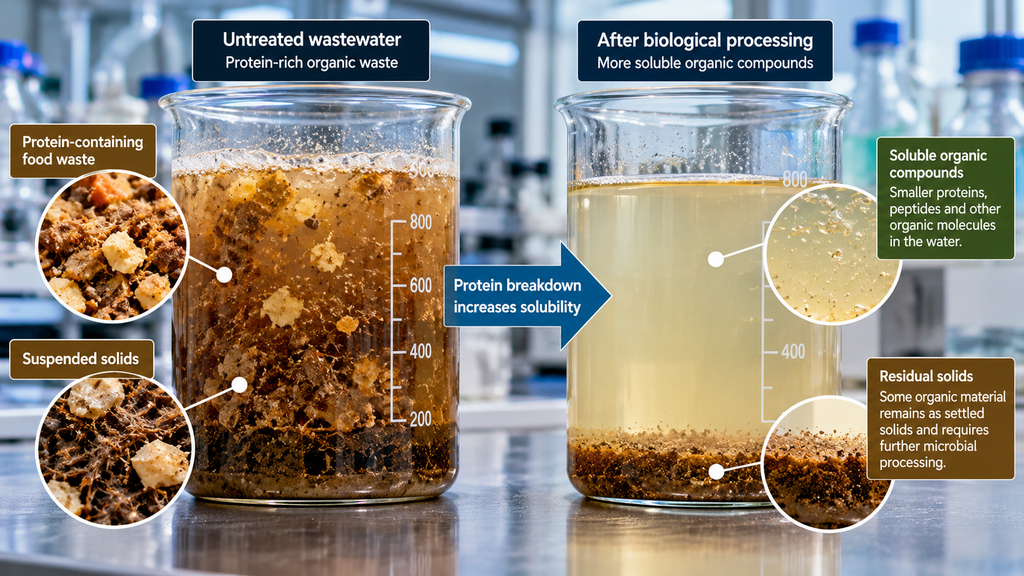
The process is important because it changes the physical and chemical form of organic material.
An initially complex protein-containing solid may gradually release more soluble organic compounds as degradation proceeds.
However, solubilisation does not necessarily mean complete mineralisation. The dissolved products can still require additional microbial processing.
An important stage of biological waste treatment involves transferring organic substances from relatively inaccessible solids into the surrounding liquid.
Protein degradation can contribute to this process.
As suitable proteases act on exposed protein structures, smaller fragments may separate from larger waste particles.
These fragments can increase the concentration of soluble organic compounds available for further biological reactions.
Some microorganisms may absorb and metabolise those compounds, while others may process them through additional extracellular reactions.
This distinction helps explain why the breakdown of a solid material and the eventual removal of its organic content are not necessarily the same event.
The first can make substances accessible; the second depends on subsequent microbial metabolism and the wider treatment environment.
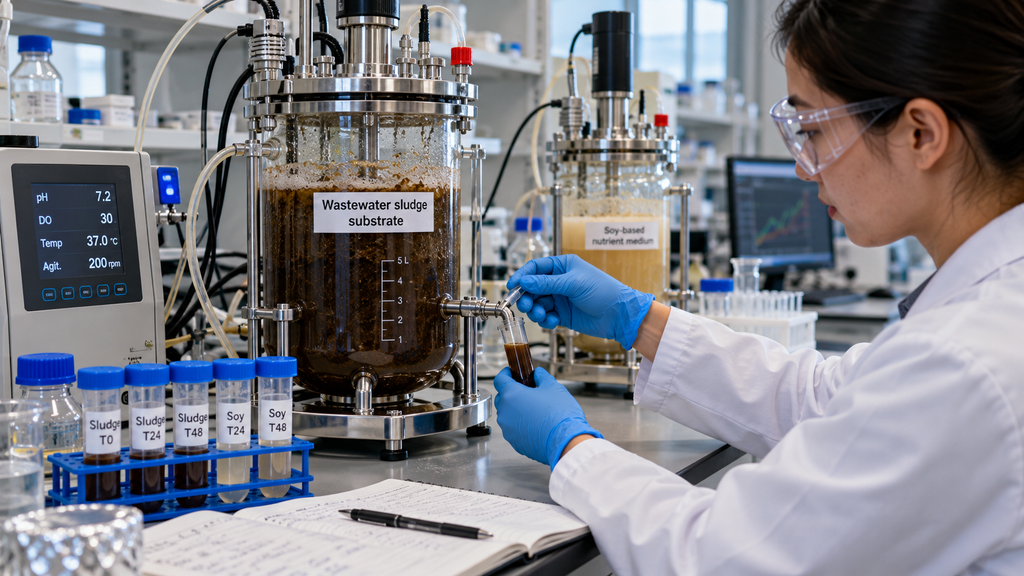
Scientists have directly investigated Bacillus licheniformis protease production using wastewater sludge.
In one study, researchers compared three strains — ATCC 21415, ATCC 21417 and ATCC 21424 — grown using wastewater sludge and a synthetic soy-based medium.
All three produced extracellular protease activity under the investigated conditions.
The researchers also found that enzyme production differed according to cultivation methods, with higher activities observed in fermenters than in shake flasks.
Strain ATCC 21424 was identified as a promising candidate for protease production using sludge-derived nutrients.
The findings are described in this study comparing Bacillus licheniformis protease production using wastewater sludge.
This research demonstrates that wastewater-derived organic materials can provide nutrients supporting the production of bacterial enzymes.
It does not, by itself, establish the performance of a particular septic tank treatment product.
Not all proteins are equally susceptible to degradation.
Keratin, which occurs in materials such as hair and feathers, is especially resistant because of its densely organised structure and chemical cross-links.
Certain Bacillus licheniformis strains can produce enzymes with keratin-degrading activity.
A notable example is strain PWD-1, originally isolated from a feather-degrading microbial culture.
Researchers demonstrated that this strain could grow using feather material and release compounds resulting from protein breakdown.
Subsequent investigations isolated and characterised its keratin-degrading enzyme.
The original research describing Bacillus licheniformis PWD-1 keratinase established an important example of bacterial activity against a resistant protein substrate.
This demonstrates that the proteolytic capabilities of certain strains extend beyond readily accessible food proteins.
Research into keratin degradation has also revealed an interesting distinction between enzyme activity and the activity of whole microbial cells.
In some experiments, effective degradation involved more than the presence of a protein-degrading enzyme.
Living bacterial cells contributed additional biochemical processes that helped make resistant protein structures accessible.
For example, research involving Bacillus licheniformis RG1 found that bacterial attachment to feather structures and reactions involving disulphide bonds played important roles in keratin degradation.
This highlights an important principle of microbial decomposition: the activity of an isolated enzyme does not always reproduce everything that occurs when living microorganisms interact with complex waste.
The detailed chemistry of keratin breakdown is covered separately in the keratinase article; the relevance here is the contribution of whole bacterial cells to difficult substrate degradation.
Breaking down proteins creates opportunities for further metabolic activity.
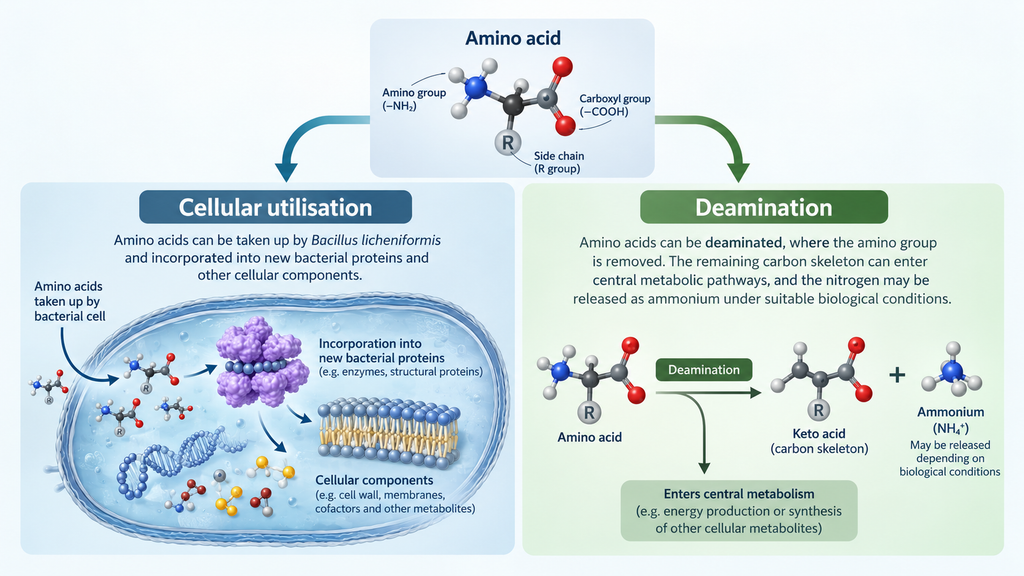
Once suitable peptides and amino acids become available, microorganisms may use them for growth, cellular repair and energy-generating reactions.
Amino acids contain nitrogen as well as carbon, making them potentially valuable nutrient sources.
During their metabolism, nitrogen-containing compounds may be transformed or released into the surrounding environment.
For example, microbial deamination of amino acids can contribute to ammonium formation.
However, protein breakdown does not automatically mean that nitrogen has been removed from wastewater.
Further nitrogen transformations depend on other microbial processes and environmental conditions.
This illustrates how protein decomposition contributes to a broader network of biological reactions rather than producing one universal end product.
Real wastewater rarely contains proteins in isolation.
Protein-rich materials may occur alongside carbohydrates, oils, suspended solids and other substances.
Different microbial populations can therefore contribute different biochemical activities.
A protease-producing bacterium may help make protein-derived nutrients available, while organisms with other enzyme capabilities act on different components of the waste.
This creates opportunities for complementary microbial processing.
It also explains why understanding the characteristics of individual bacteria matters: different species and strains can contribute distinct activities within an organic waste-degrading community.
Aquarius SC uses selected microbial cultures associated with several organic waste-degrading enzyme activities, including protease and keratinase.
Research into Bacillus licheniformis demonstrates biological mechanisms relevant to these activities.
Its investigated proteases can process protein-rich substrates, while certain specialised strains can contribute to the degradation of more resistant structural proteins.
These capabilities illustrate one part of how beneficial microorganisms and their enzymes contribute to the breakdown of different organic materials in wastewater.
The precise Bacillus licheniformis strains, if any, present in Aquarius SC sachets have not been established by the product information considered here. The species is therefore discussed as a scientific example of the biological processes involved.
Bacillus licheniformis provides an important example of how bacteria contribute to the decomposition of protein-containing organic waste.
Its studied protease activities demonstrate how complex proteins can be converted into smaller compounds that become accessible to further microbial processing.
Research involving wastewater sludge illustrates the connection between organic residues and bacterial enzyme production, while investigations into resistant proteins reveal how microbial cells can contribute additional biochemical capabilities.
Together, these findings explain why protein degradation is an important part of biological organic waste treatment.