
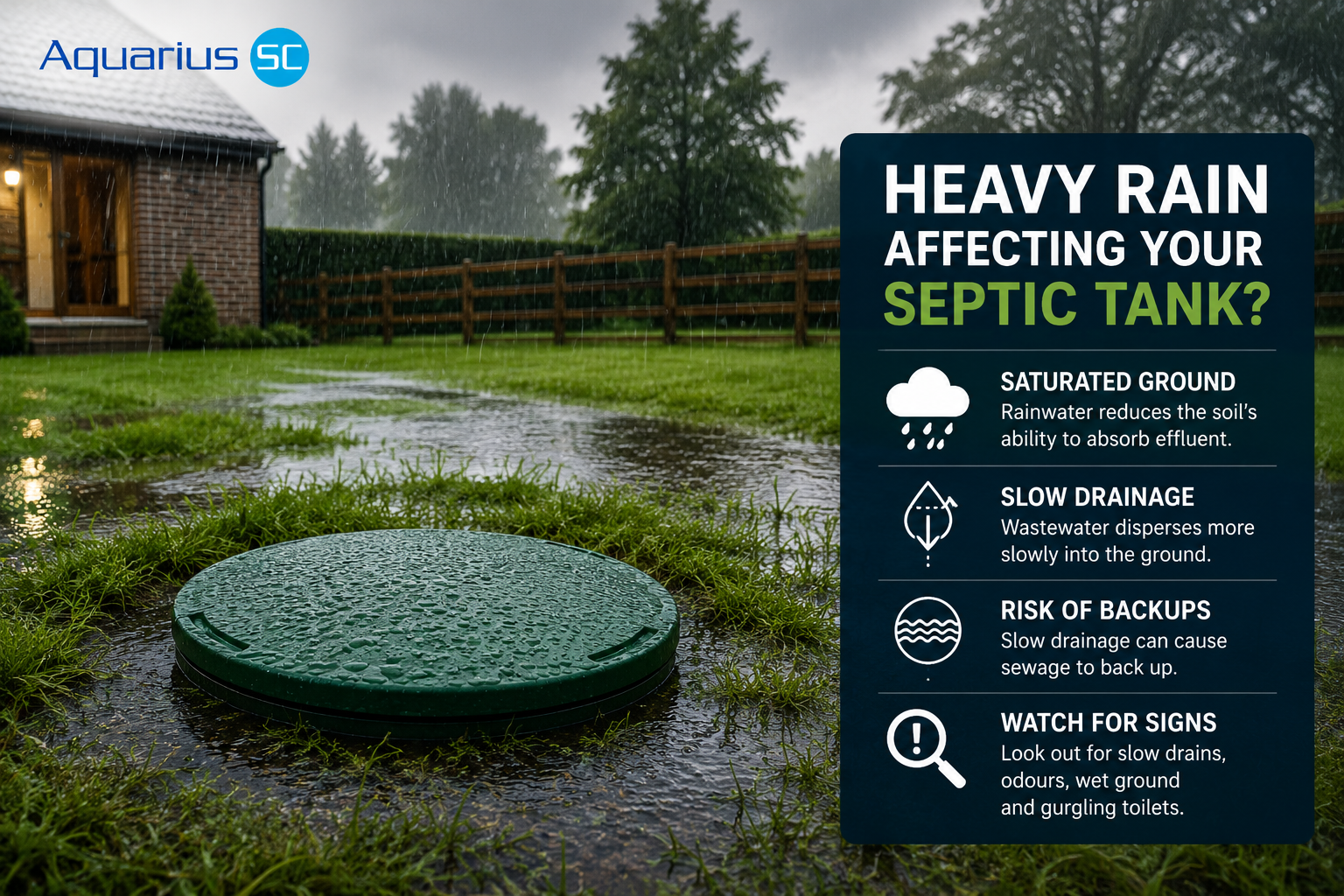
Yes. Heavy or prolonged rain can affect a septic tank system, particularly when the soil around the drainage field becomes saturated. Waterlogged ground has less capacity to accept the liquid effluent leaving the septic tank, which can cause the whole system to drain more slowly.
During particularly wet conditions, you may notice slow drains, gurgling toilets, sewage smells, unusually wet ground or even wastewater backing up.
The important distinction is that heavy rain doesn’t necessarily mean there is a problem with the septic tank itself. In many cases, the problem is the drainage field and the saturated ground surrounding it.
A septic system relies on the ground surrounding the drainage field being able to accept wastewater.
During prolonged rainfall, that same soil is also absorbing large quantities of rainwater.
Eventually, the ground can become saturated.
When this happens, wastewater leaving the septic tank has fewer places to go and may disperse much more slowly than it normally would.
The Environment Agency states that drainage fields should not be located in areas known to suffer from flooding, as flooding can increase pollution and health risks.
This is why septic problems are often more noticeable after several days of persistent rainfall rather than after one brief shower.
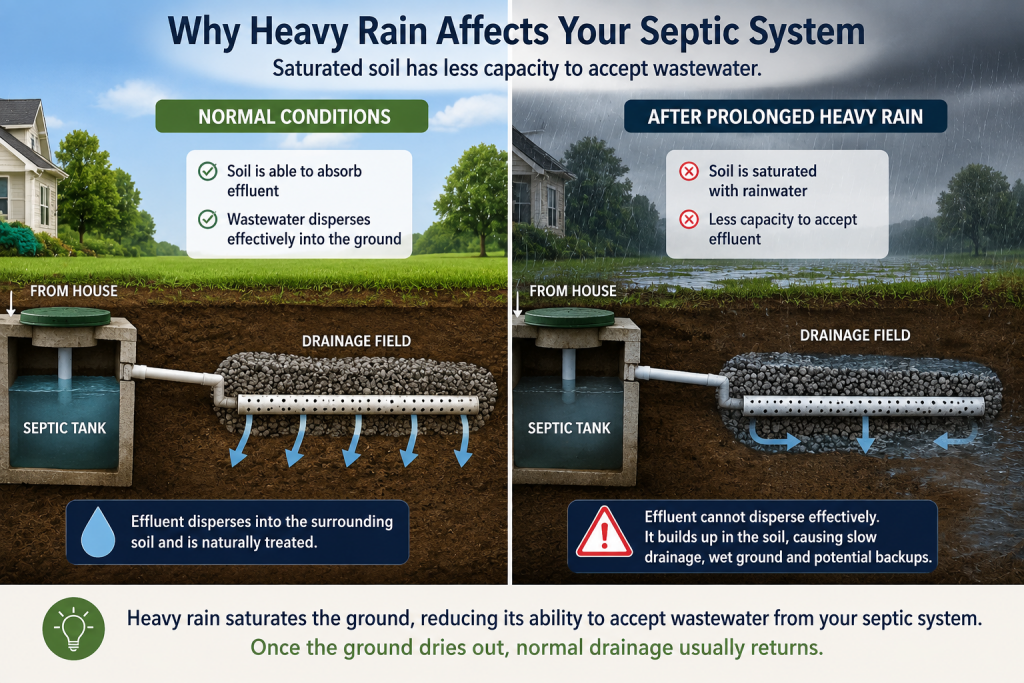
The drainage field is designed to distribute effluent into the surrounding ground.
When that ground is already saturated, the rate at which wastewater can disperse decreases.
The result can look something like this:
Heavy rainfall → saturated soil → slower effluent dispersal → wastewater leaves the septic tank more slowly → the system begins backing up
Initially, the effect may be subtle.
A toilet might take slightly longer to clear or a shower may drain more slowly than normal.
If the ground becomes increasingly saturated while the household continues producing wastewater, the problem can become more noticeable.
Common wet-weather symptoms include:
The timing of the symptoms can tell you a lot.
If your septic system operates normally during dry weather but begins struggling after prolonged rainfall, saturated ground is a plausible cause.
If the same symptoms occur throughout the year regardless of rainfall, another problem may be responsible.
Yes.
This can be confusing because a septic tank normally contains a substantial amount of liquid anyway.
After prolonged rainfall, however, the liquid level can remain unusually high if the drainage field can’t accept effluent quickly enough.
Wastewater continues entering from the property, but it isn’t leaving the system at its normal rate.
The result is effectively a bottleneck.
That doesn’t automatically mean the tank needs emptying.
If excessive sludge isn’t the problem, pumping out the tank may provide only temporary relief because the drainage field is still surrounded by saturated soil.
A sound septic system shouldn’t receive large quantities of rainwater directly.
However, unwanted water can potentially enter through:
Surface-water drainage can also cause problems if it has been incorrectly connected to the septic system.
Roof gutters, yard drainage and other systems carrying rainwater shouldn’t unnecessarily increase the volume entering a septic tank.
Natural Resources Wales specifically advises homeowners not to connect roof or surface-water run-off to a septic system and recommends checking the drainage field monthly to make sure it isn’t waterlogged in its guidance on running and maintaining septic tanks.
If the liquid level inside your tank rises dramatically whenever it rains, unwanted water ingress may therefore be worth investigating.
Yes.
If the drainage field becomes sufficiently saturated, wastewater may struggle to move through the system.
You may first notice several drains becoming slower.
If conditions worsen, wastewater can eventually begin backing up through toilets, showers or other low-level fixtures.
At this stage, repeatedly flushing toilets or running large amounts of water isn’t going to help.
You’re simply adding more wastewater to a system that’s already struggling to discharge it.
Temporarily reducing unnecessary water consumption can reduce the hydraulic load while the surrounding ground drains.
You don’t normally need to change your water consumption simply because it’s raining.
However, if the septic system is already showing signs of struggling during prolonged wet weather, reducing unnecessary water use can help.
That could mean temporarily avoiding:
The aim isn’t to stop using the plumbing.
It’s simply to avoid introducing a sudden large volume of wastewater when the drainage field is already struggling to accept what it’s receiving.
Not automatically.
This depends entirely on what is causing the problem.
If the tank contains excessive sludge and is due for desludging, emptying it is appropriate.
But if the drainage field is temporarily waterlogged, removing the contents of the tank doesn’t restore the ground’s ability to absorb wastewater.
Once you begin using toilets, sinks and showers again, the tank will start receiving wastewater immediately.
If the drainage field is still saturated, the same problem can return.
This is why it’s useful to establish whether you’re dealing with excessive sludge or temporary drainage-field saturation rather than assuming a high liquid level means the tank needs pumping.
Actual flooding is different from ordinary heavy rainfall.
If the tank and surrounding ground are flooded, seek professional advice before arranging an emptying.
Removing the contents changes the forces acting on an underground tank while the surrounding soil may be completely saturated.
This can potentially create structural problems depending on the tank and conditions.
After flooding, it’s therefore better to have the situation assessed rather than automatically ordering a tanker simply because the tank appears full.
Because the drainage field gradually regains its ability to accept wastewater.
A typical wet-weather pattern might be:
Dry conditions
System operates normally.
Persistent rainfall
Ground becomes increasingly saturated.
Very wet conditions
Household drainage begins slowing.
Rain stops and ground dries
Drainage gradually returns to normal.
This pattern can be useful diagnostically.
If the problem occurs once during exceptionally wet weather and disappears completely afterwards, temporary saturation may have been responsible.
If it happens repeatedly, that’s more concerning.
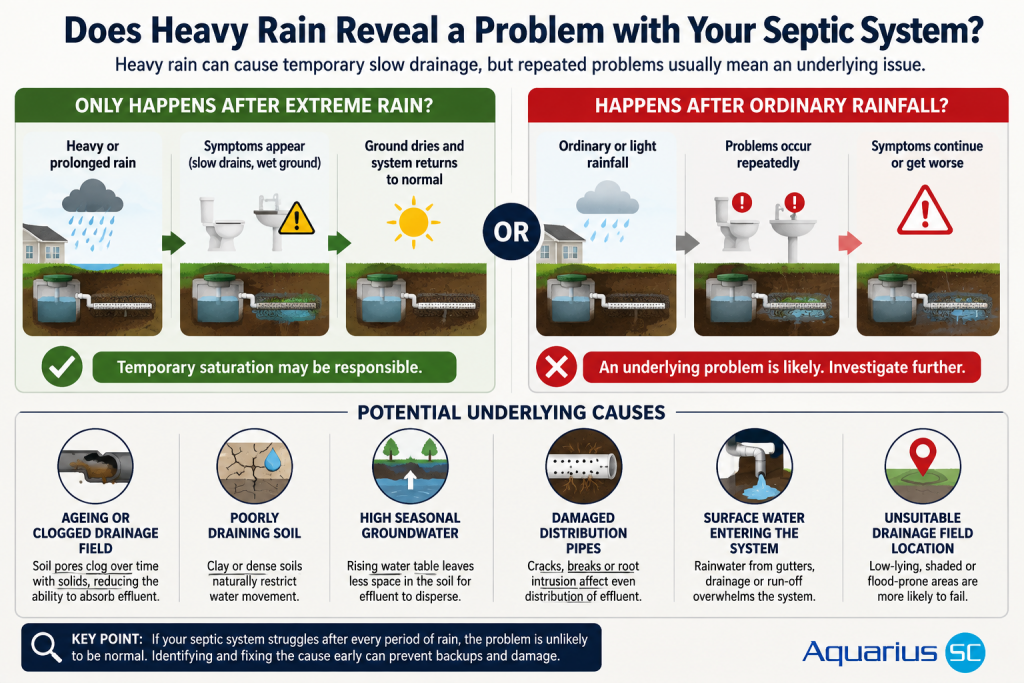
A septic system that struggles every time there is a period of ordinary wet weather may have an underlying problem.
Heavy rain may simply be exposing it.
Possible causes include:
Scottish building guidance makes clear that infiltration systems must be designed to suit the ground conditions into which wastewater is discharged, with soil permeability directly influencing how the system should be designed.
Repeated wet-weather failure therefore shouldn’t simply be dismissed as something all septic tanks do when it rains.
If the drainage field is clearly saturated, avoid making conditions worse.
Give the drainage field less wastewater to handle while the surrounding soil is saturated.
Don’t drive cars, vans or heavy machinery over waterlogged ground.
Wet soil is particularly vulnerable to compaction, and buried drainage pipes can also be damaged by heavy loads.
Check that gutters, downpipes and other surface-water drainage aren’t directing rainwater towards the septic tank or drainage field.
If wastewater has appeared above ground, keep children and animals away from the affected area.
Standing water around a septic system may contain untreated sewage.
No.
Ground can become temporarily waterlogged during exceptionally wet conditions without the drainage field being permanently damaged.
The important question is what happens afterwards.
If the ground dries and the septic system returns completely to normal, temporary saturation may have been responsible.
If the area remains wet long after surrounding ground has dried, or the same problem repeatedly returns, the drainage field needs further investigation.
Welsh heritage guidance notes that soakaway systems can be particularly susceptible to problems in clay soils during winter when the water table rises, which can prevent liquid draining away properly; boggy areas and effluent around the system are signs that professional advice may be needed.
Normal rainfall shouldn’t physically damage a correctly installed septic tank.
Severe flooding is different.
Flooding and saturated ground can potentially contribute to:
A drainage field can also remain saturated for some time after visible floodwater disappears.
If your property has experienced substantial flooding rather than simply prolonged rain, having the system inspected once conditions are safe is sensible.
You can’t control the weather, but you can reduce unnecessary pressure on the system.
Keep rainwater and household wastewater separate.
Don’t direct roof gutters or land drainage towards the septic tank or drainage field.
Avoid parking or constructing permanent structures over the drainage field.
Repair damaged tank covers or pipework that may allow unwanted water into the system.
Most importantly, monitor how the system behaves in different conditions.
A septic system that struggles only during exceptional flooding is very different from one that backs up after every few days of normal UK rainfall.
This is where the future pillar link will sit:
Regular septic tank maintenance can help identify damaged components and drainage problems before prolonged wet weather exposes them.
Arrange an inspection if:
The objective is to establish whether the problem is temporary saturation or an underlying fault that rain is exposing.
Yes. But in most wet-weather situations, the drainage field and surrounding soil are more important than the septic tank itself.
Heavy rainfall can saturate the ground and reduce its ability to accept wastewater. This can cause slower drainage, higher liquid levels and, in severe cases, wastewater backing up or appearing above ground.
Problems caused by exceptional rainfall may disappear once the soil dries.
However, if your septic system struggles every time it rains, don’t assume that’s normal.
Repeated wet-weather problems can indicate unsuitable ground conditions, a deteriorating drainage field, unwanted rainwater entering the system or another underlying fault that needs investigating.