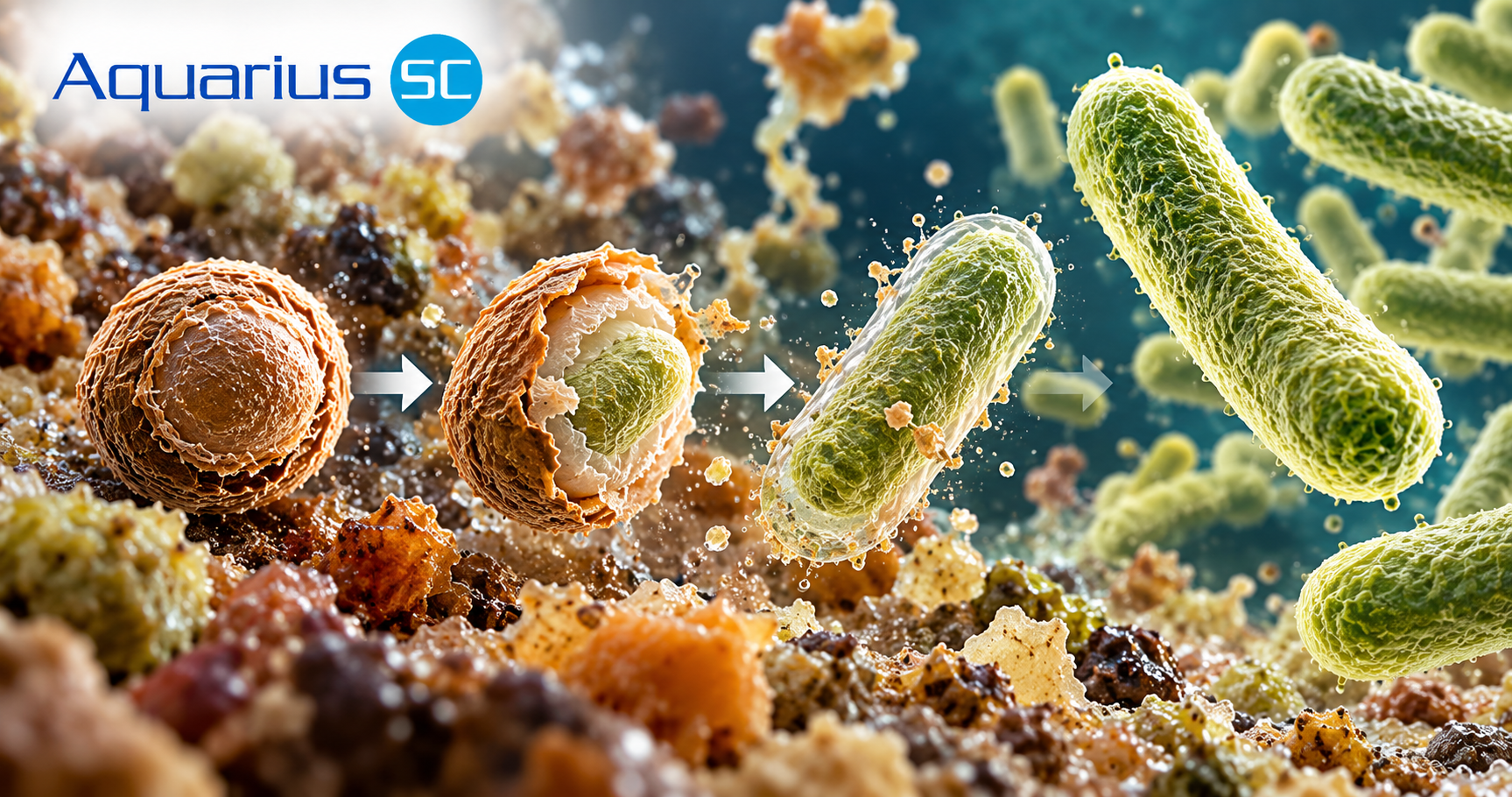
Bacteria involved in organic waste decomposition are not necessarily active throughout their entire lives. Some can enter a dormant state, remaining largely metabolically inactive until environmental conditions provide suitable signals for renewed growth.
Certain Bacillus species achieve this by forming specialised survival structures called endospores.
These spores can persist without actively consuming the surrounding organic material. However, when appropriate germination signals are detected, they can begin a biological transition that ultimately produces growing bacterial cells.
Understanding this transition helps explain an important aspect of microbial waste treatment: bacterial survival and active organic matter decomposition are two different biological processes.
A dormant Bacillus spore is not simply a smaller version of an actively growing bacterial cell.
It represents a specialised survival state in which normal metabolism is greatly reduced or effectively absent.
During this period, the organism is not growing, dividing or continuously manufacturing the enzymes normally associated with active organic waste degradation.
By contrast, an active bacterial cell can absorb nutrients, undertake metabolic reactions and reproduce when conditions permit.
For enzyme-producing species, this active state may also involve the release of extracellular enzymes that help make complex organic substances accessible.
The distinction is essential: spores preserve the potential for future biological activity, but dormancy itself does not constitute active waste decomposition.
Spores do not necessarily become active simply because they come into contact with water.
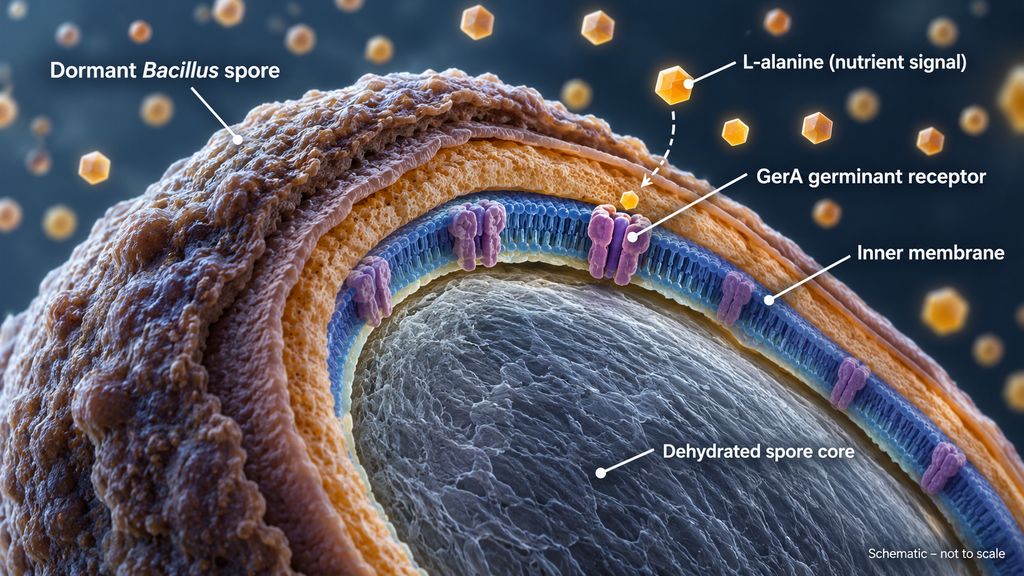
Germination is generally initiated when particular environmental signals are recognised by the spore.
For many Bacillus species, these signals include certain amino acids, sugars or combinations of nutrient-associated compounds.
Research into Bacillus germination has identified specialised receptors that recognise particular molecules.
For example, some Bacillus subtilis spores can respond to L-alanine, while other nutrient combinations activate different germination pathways.
The precise requirements vary between species and strains.
A detailed scientific review of Bacillus spore germination mechanisms explains how nutrient detection initiates the transition away from dormancy.
Importantly, a germination signal does not necessarily provide all the nutrients required for subsequent bacterial growth.
Recognising a suitable signal and successfully establishing an actively growing population are separate events.
Once an appropriate signal is recognised, a sequence of internal changes begins.
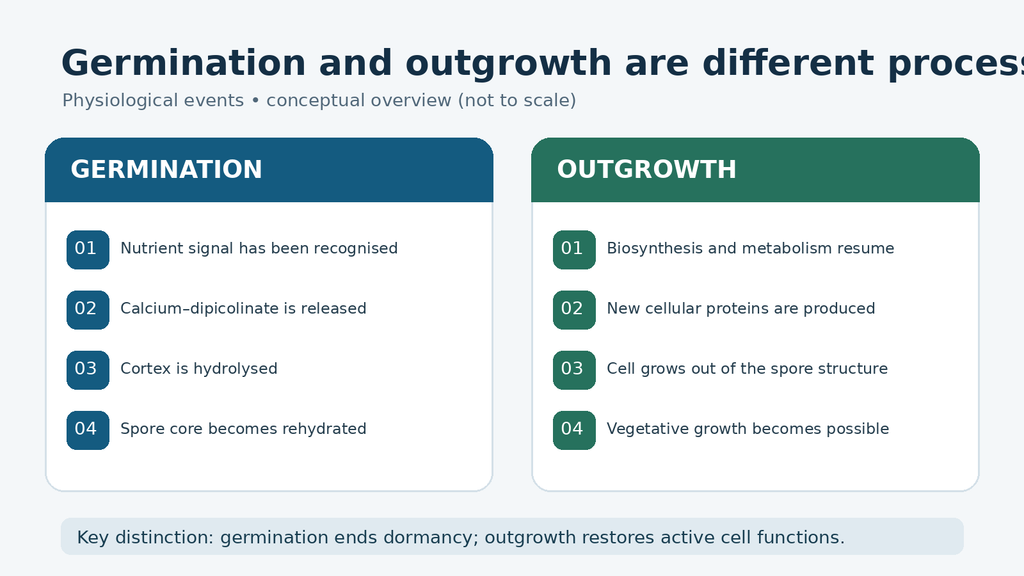
These events include the release of stored calcium-dipicolinate, changes in membrane behaviour and the breakdown of specialised material that helps maintain the dormant spore’s dehydrated state.
As the process continues, water enters the spore core and its internal environment changes.
The spore progressively loses characteristics associated with dormancy and becomes capable of resuming biological activity.
However, the initial germination sequence is unusual because it does not depend on the same level of active metabolism required for ordinary bacterial growth.
Instead, spores use specialised molecular machinery already present before germination begins.
This makes germination fundamentally different from the nutrient-consuming metabolism that follows.
An important distinction in microbiology is the difference between germination and outgrowth.
Germination ends the dormant state, but outgrowth is the subsequent period during which the germinated spore develops into a functioning vegetative bacterial cell.
During outgrowth, the organism resumes essential activities, including the synthesis of new proteins and other cellular components.
It must also establish the metabolic processes necessary to obtain energy and use available nutrients.
Research published in the Annual Review of Microbiology examines these linked but distinct stages in the transition from dormant bacterial spores to growing cells.
For biological waste processing, this distinction is particularly important.
A spore that has germinated has not necessarily developed into a cell capable of sustained organic waste degradation.
That requires successful outgrowth and the establishment of appropriate metabolic activity.
Active organic matter processing becomes relevant once bacteria have developed the metabolic capabilities needed to utilise their surroundings.
For suitable Bacillus strains, growing cells may produce enzymes that act on organic material outside the cell.
These reactions can release smaller nutrients from otherwise difficult-to-access substrates.
The resulting compounds may then support microbial growth and further metabolic activity.
However, the ability to produce a particular enzyme depends on the organism, its genetic capabilities and the conditions influencing enzyme expression.
Germination does not automatically activate every possible enzyme.
Instead, it creates the opportunity for the organism to resume the biological processes associated with its particular strain.
This is why dormant spore survival should not be confused with a measured rate of organic waste decomposition.
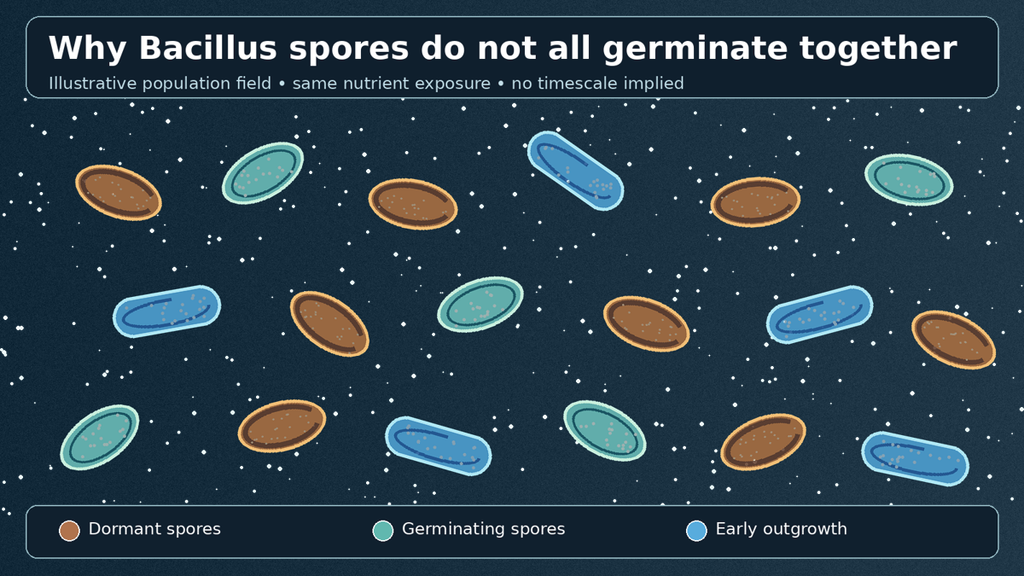
Even spores belonging to the same bacterial population do not always respond identically.
Some may germinate relatively quickly after exposure to a suitable signal, while others remain dormant for considerably longer.
Researchers have investigated this variation by examining the responses of individual spores.
Their findings demonstrate that germination can involve variable delays, even when spores experience similar experimental conditions.
One factor is the abundance and behaviour of nutrient receptors involved in recognising germination signals.
Research published in FEMS Microbiology Reviews also discusses how the conditions under which spores originally formed can influence their subsequent germination behaviour.
The review of how sporulation environments influence spore properties highlights the relationship between a spore’s developmental history and its later biological responses.
These findings help explain why a population of viable spores should not automatically be treated as a population of simultaneously active bacterial cells.
A spore may receive an appropriate germination signal without encountering conditions that support sustained growth.
After germination, the developing cell requires access to suitable nutrients and an environment compatible with its metabolism.
If these requirements are not met, successful outgrowth or further cell division may be limited.
This distinction is relevant to wastewater because the presence of organic material alone does not guarantee that every microbial population can utilise it.
Some substances may be inaccessible, while others require different metabolic capabilities.
The important consideration is whether a microorganism can complete the transition from dormancy into a state where it can contribute to the processing of available organic matter.
Wastewater contains changing concentrations of nutrients and a diverse range of microorganisms.
Some bacteria are already metabolically active, while others may be dormant or present in different physiological states.
For spore-forming Bacillus species, germination offers a route back to active growth when appropriate signals and supporting conditions are encountered.
Once established, suitable vegetative cells may contribute enzyme-producing and nutrient-consuming activities to the wider microbial community.
The significance of spores is therefore their ability to preserve viable microorganisms until conditions permit a return to activity.
They should not be understood as structures that directly digest grease, food residues or other organic material while dormant.
Aquarius SC is a biological treatment containing selected microbial cultures associated with organic waste-degrading enzyme activities.
Understanding Bacillus spore germination provides useful context for the transition between microbial survival and the active biological processes involved in waste decomposition.
The broader Aquarius literature identifies spore-forming Bacillus bacteria among the microorganisms used across its biological product range.
The central principle is that viable microorganisms must become metabolically active before they can sustain the biological reactions involved in processing organic waste.
This complements the explanation of how the microbial cultures and enzyme activities associated with Aquarius SC contribute to organic waste decomposition.
The published Aquarius SC information does not establish the proportion of its cultures supplied as dormant spores, so a specific germination response cannot be assumed for every organism in the formulation.
Bacillus spores illustrate the important relationship between microbial survival and biological activity.
Dormancy allows suitable bacteria to persist without actively processing organic nutrients. Germination begins the transition away from that state, while outgrowth restores the cellular functions required for metabolism and growth.
Only when the relevant microorganisms become active can their particular enzyme-producing and nutrient-utilising capabilities contribute to organic waste decomposition.
Understanding this sequence provides the final connection between the survival of beneficial microorganisms and the biological processes that support wastewater treatment.